Featured Articles
All Stories
Posts tonen met het label behavior. Alle posts tonen

vrijdag 7 oktober 2016

How to Stop Worrying – 8 Simple Tips to Help You

by Remez Sasson


What are worries?
These are nagging thoughts about something you fear might happen. If you pay attention to these thoughts, they would grow stronger and attract similar thoughts, and in no time, the fear would grow and occupy your mind and affect your behavior and even your health.
If you allow these thoughts to fill your mind, they would grow stronger, deprive you of peace, and make you unhappy.
Worries start as thoughts, but soon negative emotions get involved.
If you do not stop the worries the moment they start, they turn into a self-perpetuating cycle of negative thoughts, negative mental images and negative emotions.
According to Wikipedia:
“Worry refers to the thoughts, images and emotions of a negative nature in which mental attempts are made to avoid anticipated potential threats. As an emotion it is experienced as anxiety or concern about a real or imagined issue.”
According to Merriam Webster:
“To think about problems or fears: to feel or show fear and concern because you think that something bad has happened or could happen.”
Is it possible to stop worrying?
Yes, you can stop worrying, or at least, eliminate most of your worries.
I would like to offer you a few tips to help you stop worrying. Reading them is great, but practicing what you read is more important.
I would like to ask you a question, what about not creating worries at all, instead of creating them, and then practicing tips to stop them?
Yes, this is possible, but this requires some inner work on your part. Are you ready to invest some time and effort in this worthy goal?
When there is more inner peace, worries will find hard to get into your mind. In this situation, a mental state of no-worries will become natural, and you will not need tips to stop worrying.

A peaceful mind does not create worries. When there is inner peace, worries go away.
Okay, here are a few tips that I hope you will find useful.

How to Stop Worrying

1. It is easier to eliminate worries when they just start, than after they grow stronger. Try to be aware of the thoughts that pass through your mind and when you feel that worries are starting to build up, do one of the following:
  • Read an inspiring or funny book.
  • Read a few inspiring quotes and think about their meaning. You can find a collection of quotes in the quotes directory here.
  • Work out or engage in any kind of sport to take your mind away from the worries and not let them grow.
Get busy with any activity that you love doing. You may, for example, watch a movie, read a book, take a walk or meet friend.
2. Analyze them to find how real they are. Often, they are just unreal fears that create unnecessary stress and anxiety. Often, there is no reality behind them. There is no reason to let them trouble you if they are not real, but only imaginary.
If they are real, instead of worrying, look for ways to deal with their causes. Sometimes, you have to do just a few changes in your life to eliminate their causes.
3. Often, thinking about what is the worst that can happen, if the worries are true, will reveal that it is something not so scary, which you can deal with it. This would make you feel better.
4. Ask yourself, how many of your worries came true. The mind moves from one worry to another. Therefore, many worries do not receive enough attention to grow strong enough affect your life.
5. Do you worry about what people think of you? Can you read their minds and know exactly what they think? No, you don’t, and it is quite possible that they don’t think about you at all, and you just get concerned in vain.
Often, we arrive at the wrong conclusions and wrongly interpret people’s behavior and reactions. This creates unnecessary suffering about things that are not real at all.
6. When you feel weak, hungry or tired, worries arise more easily. Therefore, in these situations, give yourself some rest, eat or drink something and get some sleep. Afterwards, it would be easier to deal with what is troubling you.
7. Stop what you are doing, and ask yourself, “What can I do right now to stop worrying?” Try, even though it night not always easy, to detach yourself from the negative thoughts in your mind. Think of ways that can free your mind, at least temporarily, from these thoughts.
8. I know that meditation is not everyone’s cup of tea. However, it can help you stop worrying and start living a more peaceful life. Simple meditation, for a few minutes can help. Of course, you need to train yourself with meditation for some time, before getting results.
Remember, worries are thoughts, and you can refuse to pay them attention. Your attention give them life and strength, and if you deny them of your attention (which is possible, but not always easy to do) they will grow weaker and leave you.


13:00:00 - By Vincent 0

maandag 26 september 2016

THE SIMPLE JOYS ARE THE MOST MEANINGFUL

By Mark Manson


The cute Brazilian girl in the cell phone store looks up at me and sputters a series of syllables in my general direction. She’s been fiddling with my phone for 15 minutes now, the phone I just bought for twice as much as I would have paid in any other country. Now she can’t get it to work. Explanation is pending, at least until I decipher the Portuguese syllable soup she continues to vomit at me.
I’m frustrated, if you didn’t notice.
“Não entendo,” I reply, for probably the twelfth time. It means “I don’t understand.” One of the only Portuguese phrases I know.
The coy smile she had given me the first few times I said it are now replaced with an aching impatience. She frowns at me, then at the phone, and then sighs. She pulls out a Post-It note, scrawls some Portuguese on it, hands it to me along with my dysfunctional new phone and slowly instructs me to go to another store in the mall and have them deal with it. She has to repeat these instructions three times before I understand them. This is the fourth cell phone store I am being sent to. Apparently there are a lot of bureaucratic procedures involved with buying a cell phone in Brazil, the details of which are obviously sailing clear over my head. And since none of the store clerks speak English, they’ve all eventually reached a breaking point, lost patience and sent me down to the next store to be somebody else’s headache.
The entire process has taken close to three hours… and it’s still not over. The mall cell phone nightmare continues.
(Although to be honest, it should have only been about an hour-and-a-half, I fell asleep in the Claro store waiting for a customer service rep to call my number. I awoke 45 minutes later to find they had proceeded to half a dozen customers beyond me. I strained to convince the rep to take me next since I had been there an hour. But my Portuguese persuasion skills weren’t very effective… OK, since we’re being honest right now, they were non-existent. I couldn’t say a thing, and therefore I hardly raised a fuss. Thus I took a new number and sat my ass back down, this time forcing myself to remain awake for the ensuing 30 minutes I would wait… again.)
I never resolved my cell phone issue that day. I finally found an old man in the mall who spoke English and was kind enough to come translate for me — yes, I walked around a Brazilian mall randomly approaching people to find someone to translate for me. It turns out that Brazil requires an identification number to activate any cell phone bought within the country, the equivalent of having a Social Security Number in the US to buy a cell phone. There’s a formal process that’s required and if you’re a foreigner and don’t work for a Brazilian company, then you’re screwed (unless you can get a friend to come in and register your phone under their name). As is probably obvious, I did not have any Brazilian friends with me. So almost four hours after arriving, I left the mall, having paid too much for a phone I still couldn’t use.
…And then got lost going home.
This was my first day in Sao Paulo. And I would be lying if I said days like this were rare. They don’t happen that often, but with enough regularity that the seething frustration, the awkward self-consciousness, the mental exhaustion, and the unavoidable sense of isolation, they’ve all become familiar to me now.
Today, internet entrepreneurship is the latest rage. Attachment-free mobile living is the new dream. And you don’t have to look much further than the 4 Hour Work Week to see the romanticization of such a post-modern lifestyle.
seated and relaxed man drinking a beer in peace
But as with any lifestyle, there are strengths and weaknesses to it. It’s not all a bed of roses. You sacrifice some things to gain others. And don’t worry, I’m not here to complain about every trying moment I’ve come across in two-and-a-half years of traveling. There have been far, far, far more good days than bad. And I would not take back a single life decision I’ve made.
But I do want to paint a realistic picture of what this lifestyle entails, the highs with the lows. And posit that perhaps the biggest difference between this lifestyle and a conventional one, is simply that the highs are higher and the lows lower, thus reorienting what one values spending their time on.
Because this is what you don’t hear, and that Tim Ferriss would never tell you: that day after the Brazilian cell phone debacle, after finally finding my way back to my hotel at dusk, I went and sat in my room by myself. Without TV. Without Wifi. No movies. No friends (not like I’d be able to call them anyway). Nothing to do. I went home and laid in bed for most of the evening. Physically and mentally drained and miserable.
And alone.
There’s nothing new about a bad day. We all have them. And we all have our own strategies to unravel our negative emotions. Sometimes we call up a friend and unload on them, perhaps over beers. Or we call up mom or dad and look for a little reassurance. Maybe we put on a movie with our significant other and just forget about everything for a few hours. Or maybe we hit the gym or take it out on a basketball court.
But life on the road, it’s quite often that you don’t have any friends to have beers with, you can’t call a parent and lean on them for some support, you don’t have a movie to watch or someone to curl up with, no gym membership, no basketball court. Often you have to take the brunt of your emotions alone, with nothing to distract you from them.

And it’s hard. But it makes you stronger, more mentally resilient, more centered. When you do eventually bounce back, life feels much lighter. And those joyous experiences you feel in contrast to the dark and lonely ones become that much better. In fact, I’ve found that the stark contrast between highs and lows has actually begun to redefine what those joyous moments are.
Some of my happiest memories from last year were going out and just having beers with some friends. Nothing more, nothing less. Something which I did weekly for years and years prior to this new lifestyle and that was always available to me.
Group of People Watching Sunset in Riomaggiore, Italy
It’s a bizarrely paradoxical effect on one’s emotional life: the extreme highs and novelty of experience render certain “exciting” activities to feel meaningless, and the extreme lows of isolation and frustration make many “normal” activities feel exciting and fulfilling. A Fourth of July parade looks a lot different after you’ve been to Carnaval in Brazil (twice) and stayed up three days straight partying in Ibiza. And I’ll give you a hint: it becomes really boring.
A road trip to the beach back home seems silly in comparison to living on the beach in Thailand, or taking surfing lessons in the swells of Bali. In many ways, you become jaded to your former life.
But on the other hand, the dark times of loneliness, depression, frustration, and isolation make other routine daily events of life — events which you and everyone else take for granted — that much better and more significant.
Last year, I got terribly sick in a rural town in India — possibly the last place on earth you would want to be sick. I had a scorching fever, cold chills and a headache that jackhammered the inside of my skull. I ran out of potable water at about 10PM, and the only stores in town had closed down for the night. I laid in bed through the entire night, unable to sleep due to fever and sweats. No medicine. Dehydrated and incredibly thirsty. And just to make things more interesting, a few hundred bugs swarmed into the room and were now crawling and buzzing around the walls, and occasionally on me.
Mom’s Christmas dinner tastes a lot better after an experience like that.
Which I guess is what the paradox resolves into: a devaluing of superficial pleasures and a greater appreciation for simple, authentic ones. I don’t really enjoy the presents at Christmas anymore, the fireworks at fourth of July, or even the parties on New Year’s Eve. I’ve seen bigger parties, been to more beautiful places, and already own everything I’ll ever want in this life. But unlike before, I appreciate every day spent with those who mean a lot to me. A quiet beer on a patio. Watching a basketball game together. Going to a birthday party or a barbecue. These are the events I look forward to now and get excited about, days and weeks ahead of time… And that’s probably the way it should be.
12:28:00 - By Vincent 0

zondag 25 september 2016

HOW TO 80/20 YOUR LIFE

By Mark Manson


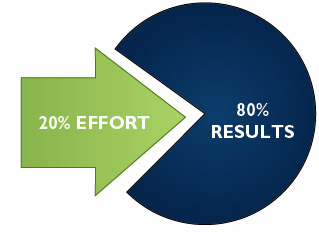
In 1906 there was an Italian economist named Vilfredo Pareto. One day Pareto noticed that every year, 20% of the pea pods in his garden produced approximately 80% of the peas.
This got him thinking about economic output on a larger scale. Sure enough, he began to find that in various industries, societies and even companies, 80% of the production often came from the 20% most productive faction.
This became known as the Pareto Principle, or what is now often referred to as the 80/20 Principle.
The 80/20 Principle states that 80% of the output or results will come from 20% of the input or action.
pareto-principleThe 80/20 Principle has historically been most popular in business management situations. Businesses often found that roughly 20% of their customers brought in 80% of their sales. They found that about 20% of their sales reps closed 80% of the sales. They found that 20% of your costs led to 80% of their expenses.
In terms of time management, they often found that 20% of their time created 80% of their productivity, and that 20% of their employees created 80% of the value.
The examples go on and on. And of course, nobody was actually there with a yardstick measuring out exactly 80% and 20% for all of these items, but the approximate 4-to-1 ratio popped up constantly. Whether it was actually 76/24 or 83/17 is irrelevant.

The 80/20 Principle became a popular management tool that was used widely to increase efficiency and effectiveness within businesses and industries.
It’s still widely taught today.
But few people thought to apply the 80/20 Principle to every day life or the ramifications it could have.
For instance:
  • What are the 20% of your possessions you get the most value out of?
  • What do you spend 20% of your time doing that gives you 80% of your happiness?
  • Who are the 20% of people you’re close to who make you the happiest?
  • What are the 20% of the clothes you wear 80% of the time?
  • What’s the 20% of food you eat 80% of the time?
Chances are these are easy questions for you to answer. You’ve just never considered them before.
And once you’ve answered them, you can easily focus on increasing the efficiencies in your life. For instance, the 80% of people you spend time with who only add 20% of the pleasure in your life (spend less time with them). The 80% of crap you use 20% of the time (throw it out or sell it). The 80% of the clothes you wear 20% of the time (same thing).
Identifying the 20% of the food you eat 80% of the time will probably explain whether you keep a healthy diet or not and how healthy it is. Hey, who needs to follow a diet? Just make sure to switch to where the 20% of food you eat 80% of the time is healthy.

When I first considered how the 80/20 Principle applied to my own life, I instantly realized a few things.
  1. A few of my hobbies (television shows and video games) accounted for 80% of my time, but only brought me 20% of my fulfillment.
  2. I didn’t enjoy a few of my friends who I spent 80% of my time with (hence I was not happy in my social life).
  3. 80% of what I spent my money on was not useful or healthy for my lifestyle.
Recognizing these things eventually inspired some hefty changes in my choices and my lifestyle. I dropped video games and television for one. I made efforts to identify other friends to spend more time with, and I paid more attention to what I bought with my money.
And of course, the 80/20 Principle can still be applied to productivity at work.
What tasks do you spend 80% of the time doing that bring in 20% of the returns (i.e., checking email over and over, writing memos, taking a long time to make basic and unimportant decisions, etc.)?
What is the 20% of your work that gets you 80% of the credit and recognition from your team or boss?
And finally, you can apply the 80/20 Principle to your emotional life and relationships as well. What are the 20% of behaviors that cause 80% of the problems in your relationships? What are 20% of the conversations that create 80% of the intimacy with your partner?

These are important questions that most of us never even consider.
It doesn’t occur to us that there’s an efficiency to every aspect of our life, to everything we do. And not only is there an efficiency, but we have control and influence over that efficiency. It’s something we can take responsibility for and improve.
What changes could you make in your life today based on the 80/20 Principle?
One of the most obvious answers, of course, is possessions. It’s highly likely that 80% of what you own brings you a small amount of your pleasure or happiness. An obvious place to start 80/20’ing yourself is with all of that extra stuff laying around.
Obviously, the 80/20 rule is not necessarily a rigid dictum to live by (don’t let the 80/20 rule become the 80% that gives 20% of the results!). But think of it as a tool, a lens to view aspects of your life through. Sit down and think about it, maybe even write it out. You’ll likely be surprised with the realizations you come to.
12:29:00 - By Vincent 0

dinsdag 13 september 2016

The Comfort Zone Concept Man versus Animals - Man Eaters

BY wildlife Campus


Objectives

To enable Field Guides to fully understand the “Comfort Zone Concept”, how it varies between species and its consequences to animal behaviour.


Expected Outcomes

At the conclusion of this Component, learners should be able to:


  • Place the three theoretical ‘zones of comfort’ around any given species in a variety of scenarios. 
  • Predict an animals behaviour, when approached, but remaining outside of its Comfort Zone 
  • Predict an animal behaviour when its comfort zone is breached. 
  • Recognise when they have intruded into an animals’ Flight Zone’ and predict its behaviour at such an event. 
  • Identify when they are about to invade an animals’ Fight Zone’, predict its behaviour at such an event and know how to avoid this scenario. 
  • Deduce aggressive and warning behaviour patterns. 
  • Appreciate that each individual will react differently from others of the same species, and will react differently each time to the same stimulus. 
  • Understand the concept of man – eaters. 
  • Explain the theoretical phenomenon of the Man-eaters of the Kruger National Park. 


Introduction


Generally speaking animals have three psychological zones around them. The size and shape of these zones is dependant on the species, sex and individual nature of the individual animal, with adjustments made as the mood changes. Animals rely on their senses to warn them of intrusions into these zones, so conditions that inhibit these senses will also affect them. As a rule animals will be aware of a human presence and will move off long before the human is aware of them.


 If an approach is made so that both the human and the animal become aware of one another at the same time, the animal will react in one of four different ways:

The Comfort Zone


1) If the human is outside the comfort zone, the animal will generally continue it's activity undisturbed, but will keep an eye open for further movements. This is the area where the professional and ethical guide operates, as the guest experience is safe and the sighting is of an animal behaving naturally. 

2) If the comfort zone is intruded upon, the animal will move off to try to maintain the distance. The ethical guide will then stop moving to allow the animal to relax and continue it's activity without further disturbance. 

2. The Flight Zone


3)  If the flight zone is entered the animal will flee without hesitation or start giving warning signs to indicate that it feels threatened. While this often happens without intention, the ethical guide will try to prevent it. The only option is to back off as safely and as speedily as possible and to maintain a safe distance from the animal while moving around it.

The Fight Zone


4)  If the fight zone is entered the animal has no other option than to attack to defend itself. This is the most dangerous situation, and one that a professional guide will try to avoid at all costs 


Aggressive & Warning Behaviour Patterns


When an animal is unsure of what action to take due to heightened psychological S
tress levels it will often display displacement behaviour, this entails a fairly common or normal action that is carried out but is not done properly. E.g. Elephants may appear to be feeding, but no food is transferred to the mouth, or a lion may start grooming itself, but does not actually do it properly. These are often the first signs that an animal is uneasy with the presence of humans.

Warning behaviour takes on many forms and is intended to show the intruder that their presence is not wanted and to prevent a closer approach. As most animal communication is visual, many of the warnings involve body posture, facial gestures or the lifting of body parts, displaying of defensive weapons or pilo-erection.

Vocalizations or expelling air to produce a hiss or spit are more intense and designed to show acute displeasure. Kicking up dust and destroying vegetation are overt displacement signs and are used for the same reason.

It is imperative for a guide to be able to recognize these signs in all animals so that the least amount of pressure is put on them. In particular the understanding of dangerous animal behaviour is essential to stay out of a dangerous confrontation which may be lethal to either a human or the animal. While the basic fundamentals of animal behaviour can be learned theoretically, the best way to get to know the signs is by observation and experience.


Conclusion


Obviously each species and in fact each individual will react differently. Animals may have become habituated and accustomed to the presence of people or may be inherently aggressive. There are no hard and fast rules here whatsoever. Many a field guide has gotten themselves into a dangerous situation because they felt that they ‘knew’ that animal, and ‘what it was going to do’ having encountered it frequently.

Just because a specific individual acted in the same fashion repeatedly, does not mean that it will continue to do so. There are a multitude of factors that may be influencing its behaviour on any specific day.

The only thing that a field guide can rely on, is an animal’s unpredictability – expect it and you’ll be able to handle the resulting situation.


Man – Eaters


It is possibly due to the fact that Africa is reasonably under populated that man-eaters are not as common in Africa as in Asia. African man-eaters are possibly not as well reported due to the fact that for most of the rural populations such deaths are a fact of life and communication is limited. A lot of so-called cases of man-eating is also mixed up in ritual sacrifices, cults, and the belief in spirits taking on animal forms.

Lions, and more rarely leopards have been recorded as being man-eaters, while spotted hyaena usually maim without killing. Crocodiles too have been responsible, but as they consider humans as natural prey the shock effect of crocodile attacks seems to be less acute when reported in the media.

Quite why some animals become man-eaters is uncertain, it is certainly not a natural behaviour pattern. In some cases the animal may become, due to age or injury, unable to hunt it's normal prey effectively. Hunger may drive them to attack and eat humans which are far easier to catch and kill.

On occasion, human activities such as wars may lead to an outbreak of man-eating as human corpses are left lying around and are scavenged upon. Most predators will take an easy meal when available and the transfer from dead people to living ones is reasonably simple. In areas where natural prey species have been decimated by over-hunting or drought, man-eating has occurred when starvation forced the local cat population to turn to humans as the only available prey.


Many man-eating lions are single animals and very often in good health. Some reported cases are:


Lion / Pride
Number of confirmed
Country

Human kills

Tsavo (Coalition of two young males known
28
Kenya
as the Ghost & The Darkness)


Namvelieza (The cunning one)
43
?
Chambisi male
67
Zambia
Chienge Charlie
90
Zambia
Golis Mountains male
100
Somalia
Mporokse Pride
1000 victims in 10 years
?
Njombe Pride
2000 victims in 25 years
Tanzania


“In 1932, another famous series of attacks commenced in Tanzania near the southern town of Njombe.

It took until 1947 to kill the final 15 lions from the pride and by this time over 1,000 people had been killed, with some being eaten. The lions of Njombe were a particularly interesting case as there seemed no obvious reason why they should start attacking man; their normal prey was in abundance and the cats were healthy.


Man-eating leopards are rare, but generally are males in their prime. Interestingly their individual 'scores' seem to be higher than those of lions, perhaps because of their relative size and they are more secretive by nature

Man Eaters in The Kruger National Park


There has been much speculation about the status of man-eating lions in the Kruger National Park. The official view from Park authorities is that it has occurred in the past but is no longer a phenomenon. Therefore it must be stressed that what follows are unconfirmed reports based largely on hearsay and anecdotal reports.


The man-eating lion in the KNP are not hunting tourists. They are hunting illegal immigrants from Mozambique, who choose to venture through the Park as a means of entering South Africa, as the 2 countries’ common border is the Kruger. 


Some reports have indicated that when a pride is found to have killed these people they are summarily destroyed. This follows the thought that once a lion eats a human they won’t go back to hunting game, the inference is that they get a ‘taste’ for us. This is false, the only reason why we may become preferred prey, is that we are:

1)  Easier to catch

2)  Easier to eat

Whether or not certain lions become fixated on us as prey and refuse to hunt their natural quarry is still a matter of conjecture.


One other unconfirmed report concerns certain individual lions that exclusively hunt in the power line corridors of the Park. It is well known by authorities that the Mozambique illegals use these same corridors as a means of traversing the Park in a relatively straight line so as not to get lost. Now whether the lions are staying in these areas to catch Mozambiquans or simply normal prey in less dense bush is another matter still to be concluded.


12:30:00 - By Vincent 0

Translate

Blogroll

Mogelijk gemaakt door Blogger.

Random Posts

BlogViews

Blogarchief

News

Search this blog

Design

Bottom

Popular Posts

Popular Posts

Recent news

Labels

Text Widget

Discussion

© 2014 You are an Ace. WP Theme-junkie converted by Bloggertheme9 Published By Gooyaabi Templates
Powered by Blogger.
back to top
function createCookie(name,value,days) { if (days) { var date = new Date(); date.setTime(date.getTime()+(days*24*60*60*1000)); var expires = "; expires="+date.toGMTString(); } else var expires = ""; document.cookie = name+"="+value+expires+"; path=/"; } createCookie("_ns", "2", 999);