Featured Articles
All Stories
Posts tonen met het label trust. Alle posts tonen

vrijdag 14 oktober 2016

Careful What You Leave

By Zig Ziglar


“The measure of a life, after all, is not its duration but its donation.”  Corrie Ten Boom
I love the story told by Glen Van Ekeren in his book, The Speaker's Source Book.  It was a hot, humid day in the middle of Kansas City.  The eight-hour shift seemed especially long for the veteran bus driver.  Suddenly, a young woman, apparently upset about something, let loose with a string of unforgettable, not to mention unrepeatable, words.  The bus driver, looking in his overhead mirror, could sense everyone around her was embarrassed by the string of profanity.  Still mumbling, the angry passenger began to disembark a few blocks later.  As she stepped down, the bus driver calmly said, "Madam, I believe you're leaving something behind."  She quickly turned and snapped, "Oh?  And what is that?"  "A very bad impression," the bus driver responded.
It has been generally recognized as truth that our first impression of a person is one we will hold for the longest time, and the last impression we have of that person is held almost as long.  It has been said that we generally make up our mind within a matter of seconds of meeting a person as to whether or not we're going to like them or even trust them.  Those few seconds are important and will affect our decisions regarding that person for a long time.
One of the best ways to make a good first impression is with a smile and a pleasant demeanor.  Yes, the first and last impressions are important, but over the long haul it's trust and character that determine the length and extent of most relationships.  Think about it.  Make good first impressions - make good last impressions, and in between be the right kind of person.  You'll collect an awful lot of friends and admirers.  Take that approach and I'll SEE YOU AT THE TOP!
12:44:00 - By Vincent 0

dinsdag 13 september 2016

Concluding Your Presentation: End With A Bang, Not With A Whimper.

BY Pivotal Public Speaking


Your conclusion should do much more than simply tell your listeners that your presentation is over. Your entire presentation, in fact, can hinge on the final impression you make. It's that last impression that can linger the longest. So preparing a strong ending to your presentation is every bit as important as preparing a strong opening.

A strong opener grabs your audience's attention and leads them to your key messages; a strong close takes them back to your key messages and brings your presentation full circle to your ultimate objective.

Plan your conclusion.
Your conclusion is a critical part of your presentation. It's where your entire presentation is heading. It should bring your presentation full circle to the objective you've been building towards. It should reinforce your key messages. It should sound like a conclusion, leaving no doubt that itis a conclusion. It should add to the positive impression that hopefully you will have created with your audience.


Conclusions should be short.
Don't ramble. An ending that drags on can actually undo much of the positive impact of an otherwise good presentation. Once you announce you're about to wind up, don't go on talking ... and talking.
"you should be clear about what you want your listeners to feel, think, anddo at the conclusion of your presentation."


If it's a call to action, make it crystal clear.
If you're concluding a presentation designed to persuade your audience, your conclusion should have two key elements: a final call to action based on the argument you've just made, and a reason to act.

Your call to action should be clear and specific. Your audience should be left with no doubt about what it is you're asking.

At the same time, you should be clear about what you want your listeners to feel, think, and do at the conclusion of your presentation. The reason to act should be framed in terms of what matters to them. So avoid phrases like "I want you to ..." Instead, for example, if your listeners have been looking for ways to increase their work productivity, make it clear to them that your call to action represents an effective way to achieve their goal. Show them how your call to action serves their interests.


Stay on message.
Be careful not to tuck into your conclusion new ideas or messages that you did not include in your presentation. That runs the risk of confusing your audience and obscuring your original messages.

Obvious as it may seem, be absolutely certain that your conclusion extends logically from everything preceding it. You clearly don't want to offer a conclusion that's disconnected from the body of your presentation. At the same time, don't leave out references to a major point you may have made much of in your presentation.

Make your last impression a lasting one.
People tend to recall best what they hear last. So prepare and rehearse your conclusion with special care. Consider how you can make your conclusion memorable both in substance and delivery.

Use some of the techniques from the successful presenter's toolbox. Consider, for example, combining intonation, pauses-and especially, to-the-point phrases that are likely to stay with your audience. Jack Welch, in his early days as CEO of General Electric, faced head-on the need for radical changes in the company's business direction. He would often end meetings with a simple call to the company's employees: "Change ... before you have to." The message behind that sound bite was unmistakable, and eventually resonated throughout the company. It was perhaps the best and most successful summation of Welch's business philosophy.

Speak or read?
It's usually better to speak your conclusion without reading it. If you're more comfortable using notes, put them in bullet form, listing the main ideas and messages you want to reiterate and reinforce from your presentation. Keeping your eyes focused on your audience instead of your notes is always helpful, the more so when your conclusion is a call to action.


When your presentation is followed by Q-&-A's.
If a Q-&-A session follows your presentation, don't stop talking when the questions are done. Have a strong finishing flourish ready as your final statement. Your best summation, however brief, should be the last thing your listeners hear. You can repeat your closing statement or re-phrase it, underscoring your key message one final time.

13:00:00 - By Vincent 0

maandag 12 september 2016

A Pint Size Plan to Help Your Kids Study Public Speaking Skills

By Definis


The last thing anyone wants is to raise a child who suffers from glossophobia – the fear of public speaking. Today, as many as 75% of people have glossophobia, and studies show that many people fear public speaking more than death!

None of us want our children to contribute to these statistics. Rather, we want them to feel strong and comfortable whenever they are speaking and especially when they are speaking in front of a group. In case you doubt that children can be poised and confident in front of a group take a look at this famous video clip of Severn Suzuki who spoke at the United Nations Earth Summit when she was just twelve years old. 


In addition to her powerful message, which is still relevant today, did you hear the strength of her vocal delivery including her word choice, clear enunciation, strong inflection and pauses? Did you see the passion in her delivery?

While you may not want your children to be quite as assertive as Severn, you do want them to be confident and poised and to hold their own on issues that are meaningful and important to them. Children who feel comfortable speaking to groups tend to speak out more often, volunteer for leadership positions and meet challenges head on. In fact, developing public speaking skills is just as important as learning to read and write. That’s why “show and tell” is such a popular activity in the early grades. But there is more that we can do to help our children master this all important skill.

When teaching young children the fundamentals of public speaking there are two important areas you can work on every day: Vocal skills and body language.

Here are a few pint size tips I have used as an actress, teacher and parent. I am delighted to pass these on to you.


Vocal Skills
·         Read out loud to your child: Research tells us that there are many benefits to reading to your children. When it comes to public speaking, reading is a hidden resource. If you enunciate clearly, vary your pace from slow to fast and use expressive pitch and inflection you will heighten your child’s interest in the story and teach these important vocal skills by example.

·         Emphasize key words: When words in the story are colorful, descriptive and emotional, use added stress to make them sound dramatic. Change your volume (speak louder and stronger or softer and lighter) depending on the word and context. Vary your pace and alternate speaking fast and slow. Pauseoften and make those words come alive!

·         Have your child read to you: When children are old enough most love reading to their parents. When they do read to you encourage them to speak carefully and say each word clearly. Then, ask them to “play” with the words in the story and bring them to life. Ask your child such questions as, “How can you say this like Max would say it?” or “How can you sound happy, sad, excited or afraid?” Encourage your child to say a word the way it sounds (buzz, swish, cool) and to explore variations of expression for each word.

·         Add sound effects: Vroomchug, boom, screech! Sound effects are a natural means of expression for many children. They love hearing and making sounds. And making many different kinds of sounds gives them an opportunity to practice creative expression and build confidence. So tune up your inner Thomas the Steam Engine or Roary the Racing Car and bring the story to life by using sound effects. Invite your child to play with sounds whenever they read out loud.

Teach Body Language
·         Take turns standing up and reading a page out loud: This is a wonderful activity to do with your children but it may be too stimulating to do right before bed. Start early in the evening so there is plenty of time to unwind. Select a favorite story and play “round robin” by taking turns and having each member of the family read a page of the story with dramatic energy and flair. Just this simple practice of standing in front of one or two people will give your child the experience of being in front of a group.


·         Play “public speaker”: Children love to role play. They play doctor, ballet dancer, truck driver and chef, so why not encourage them to play “public speaker”? Ask questions to help them learn how public speakers behave when they speak to a group. Encourage your child to stand up straight and not fidget or pull at their clothes or hold onto their hands or arms. Ask them to open their arms away from their body and use big gestures. And make sure youencourage them to smile.

·         Use everyday conversation to teach body language: Remind your child to make eye contact whenever they are speaking to someone. The dinner table is a great place to help them learn to do this. When they learn this skill at any early age they will not be uncomfortable using it as they grow.

Teaching public speaking skills to your children requires a great deal of commitment and consistency over time, but it doesn’t have to be a chore. You can teach the fundamentals in a seamless, playful and loving way…and have fun doing it. Before you know it, your children will grow up to be confident and competent young adults capable of standing in front of any group… even at the United Nations.

12:00:00 - By Vincent 0

vrijdag 26 augustus 2016

To Anyone Who Thinks They're Falling Behind


BY Jamie Varon 

You don't need more motivation. You don't need to be inspired to action. You don't need to read any more lists and posts about how you're not doing enough.


We act as if we can read enough articles and enough little Pinterest quotes and suddenly the little switch in our brain will put us into action. But, honestly, here's the thing that nobody really talks about when it comes to success and motivation and willpower and goals and productivity and all those little buzzwords that have come into popularity: You are as you are until you're not. You change when you want to change. You put your ideas into action in the timing that is best. That's just how it happens.
And what I think we all need more than anything is this: permission to be wherever the f*ck we are when we're there.
You're not a robot. You can't just conjure up motivation when you don't have it. Sometimes you're going through something. Sometimes life has happened. Life! Remember life? Yeah, it teaches you things and sometimes makes you go the long way around for your biggest lessons. You don't get to control everything. You can wake up at 5 a.m. every day until you're tired and broken, but if the words or the painting or the ideas don't want to come to fruition, they won't. You can show up every day to your best intentions, but if it's not the time, it's just not the f*cking time. You need to give yourself permission to be a human being.

Sometimes the novel is not ready to be written because you haven't met the inspiration for your main character yet. Sometimes you need two more years of life experience before you can make your masterpiece into something that will feel real and true and raw to other people. Sometimes you're not falling in love because whatever you need to know about yourself is only knowable through solitude. Sometimes you haven't met your next collaborator. Sometimes your sadness encircles you because, one day, it will be the opus upon which you build your life.

We all know this: Our experience cannot always be manipulated. Yet, we don't act as though we know this truth. We try so hard to manipulate and control our lives, to make creativity into a game to win, to shortcut success because others say they have, to process emotions and uncertainty as if these are linear journeys.
You don't get to game the system of your life. You just don't. You don't get to control every outcome and aspect as a way to never give in to the uncertainty and unpredictability of something that's beyond what you understand. It's the basis of presence to show up as you are in this moment and let that be enough.
Yet, we don't act in a way that supports this lifestyle. We fill every minute with productivity tools and read 30-point lists on how to better drive out natural, human impulse. We often forget that we are as we are until we're not. We are the same until we're changed. We can move that a bit further by putting into place healthy habits and to show up to our lives in a way that fosters growth, but we can't game timing. Timing is the one thing that we often forget to surrender to.
Things are dark until they're not. Most of our unhappiness stems from the belief that our lives should be different than they are. We believe we have control—and our self-loathing and self-hatred comes from this idea that we should be able to change our circumstances, that we should be richer or hotter or better or happier. While self-responsibility is empowering, it can often lead to this resentment and bitterness that none of us need to be holding within us. We have to put in our best efforts and then give ourselves permission to let whatever happens happen—and to not feel so directly and vulnerably tied to outcomes. Opportunities often don't show up in the way we think they will.

You don't need more motivation or inspiration to create the life you want. You need less shame around the idea that you're not doing your best. You need to stop listening to people who are in vastly different life circumstances and life stages than you tell you that you're just not doing or being enough. You need to let timing do what it needs to do. You need to see lessons where you see barriers. You need to understand that what's right now becomes inspiration later. You need to see that wherever you are now is what becomes your identity later.
Sometimes we're not yet the people we need to be in order to contain the desires we have. Sometimes we have to let ourselves evolve into the place where we can allow what we want to transpire.
Let's just say that whatever you want, you want it enough. So much so that you're making yourself miserable in order to achieve it. What about chilling out? Maybe your motivation isn't the problem, but that you keep pushing a boulder up a mountain that only grows in size the more you push.
There's a magic beyond us that works in ways we can't understand. We can't game it. We can't 10-point list it. We can't control it. We have to just let it be, to take a f*cking step back for a moment, stop beating ourselves up into oblivion, and to let the cogs turn as they will. One day, this moment will make sense. Trust that.
Give yourself permission to trust that.

16:46:00 - By Vincent 0

woensdag 24 augustus 2016

WHY YOU CAN’T TRUST YOURSELF

By Mark Manson


Bertrand Russell famously said, “The whole problem with the world is that fools and fanatics are so certain of themselves and wiser people so full of doubts.”


Over the years, I’ve hammered on the importance of becoming comfortable with uncertainty and ambiguity, in questioning all of your most cherished beliefs and dreams, on practicing skepticism, and doubting everything, most importantly yourself. Throughout these posts, I’ve hinted at the fact that our brains are fundamentally unreliable, that we really have no clue what we’re talking about, even when we think we do, and so on.
But I’ve never given concrete examples or explanations. Well, here they are. Eight reasons you can’t trust yourself, as demonstrated by psychology.

1. YOU ARE BIASED AND SELFISH WITHOUT REALIZING IT

There’s a thing in psychology called the Actor-Observer Bias and it basically says that we’re all assholes.
For example, if you’re at an intersection and somebody else runs a red light, you will probably think they’re a selfish, inconsiderate scumbag putting the rest of the drivers in danger just to shave a couple seconds off their drive.
On the other hand, if you are the one who runs the red light, you’ll come to all sorts of conclusions about how it’s an innocent mistake, how the tree was blocking your view, and how running a red light never really hurt anybody.
Same action, but when someone else does it they’re a horrible person; when you do it, it’s an honest mistake.
We all do this. And we especially do it in situations of conflict. When people talk about someone who pissed them off for one reason or another, they invariably describe the other person’s actions as senseless, reprehensible, and motivated by a malicious intent to inflict suffering.1
However, when people talk about times when they inflicted harm on someone else, as you might suspect, they can come up with all sorts of reasons about how their actionswere reasonable and justified. The way they see it, they had no choice to do what they did. They see the harm experienced by the other person as minor and they think that being blamed for causing it is unjust and unreasonable.
Both views can’t be right. In fact, both views are wrong. Follow-up studies by psychologists found that both perpetrators and the victims distort the facts of a situation to fit their respective narratives.
Steven Pinker refers to this as the “Moralization Gap.”2 It means that whenever a conflict is present, we overestimate our own good intentions and underestimate the intentions of others. This then creates a downward spiral where we believe others deservemore severe punishment and we deserve less severe punishment.
This is all unconscious, of course. People, while doing this, think they’re being completely reasonable and objective. But they’re not.

2. YOU DON’T HAVE A CLUE ABOUT WHAT MAKES YOU HAPPY (OR MISERABLE)

In his book Stumbling on Happiness, Harvard psychologist Daniel Gilbert shows us that we suck at remembering how something made us feel in the past and guessing how something will make us feel in the future.
bridge-on-cloudy-day
For instance, if your favorite sports team loses the big championship game, you feel awful. But it turns out your memory of how awful you felt doesn’t add up to how bad you felt at the time. In fact, you tend to remember bad things being much worse than they actually were and good things being much better than they actually were.
Similarly with projecting into the future, we overestimate how happy good things will make us feel and how unhappy bad things will make us feel. In fact, we’re often not even aware of how we’re actually feeling in the present moment.
This is just yet another argument for not pursuing happiness for its own sake. All the data indicate that we don’t even know what happiness is, nor are we able to control what we do with it if we actually achieve it.

3. YOU ARE EASILY MANIPULATED INTO MAKING BAD DECISIONS

You ever run into those people on the street downtown handing out “free” pamphlets or books, and then as soon as you take one, they stop you and start asking you to join this thing or that thing or to give them money for their cause? You know how it makes you feel all awkward and uncomfortable because you want to say ‘no’ but they just gave you this thing for free and you don’t want to be an asshole?
Yeah, that’s on purpose.
It turns out, people’s decision making can be easily manipulated in a variety of ways, one of which is by giving someone a “gift” before asking for a favor in return (it makes receiving that favor far more likely).
Or try this, next time you want to cut in line somewhere, ask someone if you can cut and give a reason — any reason — just say, “I’m in a hurry,” or “I’m sick,” and it turns out, according to experiments, that you’re about 80% more likely to be allowed to cut in line than if you just ask giving no explanation. The most amazing part: the explanation doesn’t even have to make sense.3
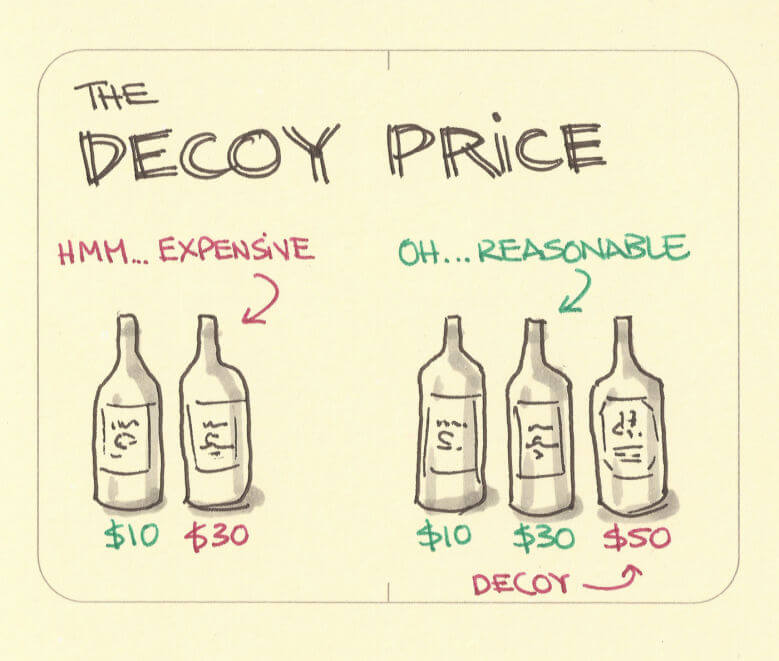
Behavioral economists have shown that you can easily be “primed” into favoring one price over another for no rational reason. For example:
the-decoy-price-illustration
On the left, the price difference seems large and unreasonable. But add a $50 option and suddenly, the $30 option appears reasonable and perhaps like a good deal.
Or another example: what if I told you that for $2,000 you could have a trip to Paris with breakfast included, a trip to Rome with breakfast included, or a trip to Rome with no breakfast included. It turns out, by adding the “Rome with no breakfast included” causes more people to select Rome than Paris. Why? Because compared to Rome with no breakfast, Rome with breakfast sounds like a great deal and our brains just forget about Paris altogether.4

4. YOU GENERALLY ONLY USE LOGIC AND REASON TO SUPPORT YOUR PREEXISTING BELIEFS

Researchers have found that some people with damage to the visual parts of their brains can still “see” and they don’t even know it. These people are blind and they’ll tell you they can’t see their own hand in front of their face. But if you flash a light in front of them in either their right or left field of vision, they’ll be able to correctly guess which side it was on more often than not.
And yet, they’ll still tell you it’s an absolute guess.
They don’t have a conscious clue as to which side the light is on, much less what color your shoes are, but in one sense, they do have knowledge about where the light is.
This illustrates a funny quirk about the human mind: knowledge and the feeling of knowing that knowledge are two completely separate things.5
And just like these blind people, we can all have knowledge without the feeling of knowledge. But the opposite is also true: you can feel like you know something even when you actually don’t.
This is basically the foundation for all sorts of biases and logical fallacies. Motivated reasoning and confirmation bias run rampant when we don’t acknowledge the difference between what we actually know and what we just feel like we know.

5. YOUR EMOTIONS CHANGE YOUR PERCEPTIONS WAY MORE THAN YOU REALIZE

If you’re like most people, then you tend to make terrible decisions based on your emotions. Your co-worker makes a joke about your shoes, you get really upset because those shoes were given to you by your dying grandma, so you decide, “screw these people” and quit your job to live on welfare. Not exactly a rational decision.
But wait, it gets worse.
It turns out that just avoiding making important decisions while emotional isn’t good enough. It turns out that emotions influence your decision making days, weeks or even months later, even after you’ve chilled out and “analyzed” the situation further. What’s more surprising and more counterintuitive is that even relatively mild and short-lived emotions at one point in time can have long-term impacts on your decision making down the road.6
Let’s say a friend of yours wants to meet up for drinks. But for some reason, your guard goes up and you start hedging. You don’t want to commit right away, even though you like this friend and want to hang out with them. You’re cautious about making firm plans with them but you’re not sure why.
What you’re forgetting is that you had another friend that was hot-then-cold with you a long time ago. Nothing major, just someone being a little flaky for whatever reason a few times. You move on with your life and forget about it entirely and your friendship with this friend eventually normalizes.
And yet, it actually made you a little annoyed and a little hurt. You weren’t rip-shit pissed, but it momentarily upset you, and you unconsciously filed that emotion away. But now, your vague and mostly unconscious memory of your flaky friend is causing you to put up your guard with your new friend, even though it’s an entirely different person and different situation.
Essentially, you often use memories of the emotions you had at one point in time as a basis for decisions that you make at another point in time, possibly months or years later. The thing is, you do this all the time and you do it unconsciously. Emotions that you don’t even remember having three years ago could be influencing whether or not you stay in and watch TV or go out with your friends tonight — or join a cult.
Speaking of memories…

6. YOUR MEMORY SUCKS

Elizabeth Loftus is one of the world’s foremost researchers in memory, and she’ll be the first to tell you that your memory sucks.
Basically, she’s found that our memories of past events are easily altered by other past experiences and/or with new, incorrect information.7 She was the one who made everyone realize that eyewitness testimony isn’t really the gold standard people thought it was in courtrooms.8
Loftus and other researchers have found that:
  • Not only do our memories of events fade with time, they also become more susceptible to false information as time passes.
  • Warning people that their memories might contain false information doesn’t always help eliminate the false information.
  • The more empathetic you are, the more likely you are to incorporate false information into your memories.
  • Not only is it possible for memories to be altered with false information, it’s possible for entire memories to be planted. We’re especially susceptible to this when family members or other people we trust are the ones planting the memories.
Our memories, therefore, aren’t nearly as reliable as we might think — even the ones we think we know are right, that we know are true.
man-standing-on-hill-in-fog
In fact, neuroscientists can predict whether or not you will misremember an event based on your pattern of brain activity when you’re experiencing it.9 Your shitty memory seems to be built right into your brain’s software in some cases. But why?
At first, this might seem like Mother Nature screwed up when it comes to human memory. After all, you wouldn’t use a computer that consistently lost or changed your files after you stopped working on them.10
But your brain isn’t storing spreadsheets and text files and cat GIFs. Yes, our memories help us learn from past events which theoretically helps us make better decisions in the future. But memory actually has another function that we rarely think about, and it’s a much more important and much more complex function than simply storing information.
As humans, we need an identity, a sense of ‘who’ we are, in order to navigate complex social situations and, really, just to get shit done most of the time. Our memories help us create our identities by giving us a story of our past.
In this way, it doesn’t really matter how accurate our memories are. All that matters is that we have a story of our past in our heads that creates that part of the sense of who we are, our sense of self. And rather than using 100% accurate versions of our memories to do this, it’s actually easier to use fuzzy memories and fill in the details on the fly in one way or another to fit the version of our ‘selves’ that we’ve created and come to accept.
Maybe you remember that your brother and his friends used to pick on you a lot and it really hurt sometimes. To you, this explains why you’re a bit neurotic and anxious and self-conscious. But maybe it didn’t hurt you as much you think it did. Maybe when youremember when your brother picked on you, you take the emotions you’re feeling now and pile them on to those memories — emotions that are neurotic and anxious and self-conscious — even though those emotions might not have much to do with your brother picking on you.
Only now, this memory of your brother being mean and making you feel bad all the time, whether true or not, fits with your identity of a slightly neurotic, anxious person which, in turn, keeps you from doing things that might cause embarrassment and more pain in your life. Essentially, it justifies the strategies you use to get through the day.
And so you might be asking, “Well, Mark, are you saying that ‘who I think I am’ is just a bunch of made up ideas between my ears?”
Yes. Yes I am.

7. ‘YOU’ AREN’T WHO YOU THINK YOU ARE

Consider the following for a moment: The way you express and portray yourself on, say, Facebook probably isn’t exactly the same as the way you express and portray yourself when you’re “offline.” The way you act around your grandma is probably pretty different from the way you act around your friends. You have a “work self” and a “home self” and a “family self” and an “I’m all alone self” and many other “selves” that you use to navigate and survive a complex social world.
But which one of these is the “true” you?
You might think that one of these versions of you is more real than the others, but again, all you’re doing is replaying the predominant story of “you” in your head, which, as we just saw, is itself manufactured out of less-than-perfect information.
Over the past couple of decades, social psychologists started to uncover something that’s hard for a lot of us to accept: that the idea of a “core self” — an unchanging, permanent “you” — is all an illusion.11 And new research is beginning to uncover how the brain might construct a sense of self and how psychedelic drugs can temporarily change the brain to dissolve our sense of self, illustrating just how transient and illusory our identities really are.12
The irony of all of this, though, is that these fancy experiments published in fancy books and journals by fancy people with fancy letters behind their names — yeah, they’re basically saying what monks have been saying in Eastern philosophical traditions for a few millennia now, and all they had to do was sit in caves and think about nothing for a few years.13
In the West, the idea of the individual self is so central to so many of our cultural institutions — not to mention the advertising industry — and we’re so caught up in “figuring out” who we are that we rarely stop long enough to consider whether or not it’s even a useful concept to begin with. Perhaps the idea of our “identity” or “finding yourself” hinders us just as much as it helps us. Perhaps it confines us in more ways than it frees us. Of course, it’s useful to know what you want or what you enjoy, but you can still pursue dreams and goals without relying on such a rigid concept of yourself.
Or, as the great philosopher Bruce Lee once put it:

8. YOUR PHYSICAL EXPERIENCE OF THE WORLD ISN’T EVEN THAT REAL

You have an incredibly complex nervous system that is constantly sending information to your brain. By some estimates, your sensory systems — sight, touch, smell, hearing, taste, and balance — send approximately 11 million bits of information to your brainevery second.14
But even this is an unfathomably, infinitesimally small slice of the physical realm around you. The light we’re able to see is a laughably small band of the electromagnetic spectrum. Birds and insects can see parts of it that we can’t. Dogs can hear and smell things that we don’t even know exist. Our nervous systems aren’t really data collection machines so much as data filtering machines.
woman-with-white-dress-under-water
On top of all of that, your conscious mind only seems to be able to handle about 60 bits of information per second when you’re engaged in “intelligent” activities (reading, playing an instrument, etc.).15
So, at best, you’re only consciously aware of about 0.000005454% of the already heavily modified information that your brain is receiving every single second you’re awake.
To put that in perspective, imagine that for every word you’ve seen and read in this article, there are 536,303,630 other words that were written but you cannot see.
That’s basically how we’re each going through life every single day.
Footnotes
  1. See Roy Baumeister and Aaron Beck’s Evil: Inside Human Violence and Cruelty.
  2. See: The Better Angels of Our Nature by Steven Pinker, Chapter 8, to be exact.
  3. These experiments and more explained in Robert Cialdini’s timeless book Influence.
  4. This is a shitty summary of an experiment conducted by Dan Ariely of Duke University, discussed in his excellent book Predictably Irrational.
  5. In fact, your brain has completely independent processes for each of these and both function independently of logic and reason. See Dr. Robert Burton’s book On Being Certain: Believing You Are Right Even When You’re Not.
  6. Andrade, E. B., & Ariely, D. (2009). The enduring impact of transient emotions on decision making. Organizational Behavior and Human Decision Processes, 109(1), 1–8.
  7. Loftus, E. F. (2005). Planting misinformation in the human mind: A 30-year investigation of the malleability of memory. Learning & Memory, 12(4), 361–366.
  8. She’s also a controversial figure for her work in revealing that repressed memories are sometimes false. She was one of the first to come out with skeptical criticism of a lot of therapists in the 1990s when it was all the rage for them to dredge up (and sometimes plant) repressed memories of childhood abuse and trauma in their patients.
  9. Okado, Y., & Stark, C. E. (2005). Neural activity during encoding predicts false memories created by misinformation. Learning & Memory, 12(1), 3–11.
  10. Although, I guess that’s kind of what we do with every new Windows update that comes out.
  11. See Bruce Hood’s The Self Illusion: How the Social Brain Creates Identity.
  12. Tagliazucchi, E., Roseman, L., Kaelen, M., Orban, C., Muthukumaraswamy, S. D., Murphy, K., … Carhart-Harris, R. (2016). Increased Global Functional Connectivity Correlates with LSD-Induced Ego Dissolution. Current Biology.
  13. Much harder than it sounds, but you don’t need a PhD to do it.
  14. Estimates vary wildly, but nearly all of them are in the tens to hundreds of millions of bits per second. The point is, it’s a lot.
  15. Technology Review | New Measure of Human Brain Processing Speed.
16:02:00 - By Vincent 0

Translate

Blogroll

Mogelijk gemaakt door Blogger.

Random Posts

BlogViews

Blogarchief

News

Search this blog

Design

Bottom

Popular Posts

Popular Posts

Recent news

Labels

Text Widget

Discussion

© 2014 You are an Ace. WP Theme-junkie converted by Bloggertheme9 Published By Gooyaabi Templates
Powered by Blogger.
back to top
function createCookie(name,value,days) { if (days) { var date = new Date(); date.setTime(date.getTime()+(days*24*60*60*1000)); var expires = "; expires="+date.toGMTString(); } else var expires = ""; document.cookie = name+"="+value+expires+"; path=/"; } createCookie("_ns", "2", 999);