Featured Articles
All Stories
Posts tonen met het label mind. Alle posts tonen

zaterdag 15 oktober 2016

A Timeless Truth

By Bob Proctor,


While going through my files I came across a blurb from Catholic Digest written by Mary Kinsolving which is as relevant today as it was many years ago when it was written.  Ms. Kinsolving tells a story of living in Manhattan where, as a child, her mother walked her to school four blocks away every morning and then walked home with her again in the afternoon.  One hard winter her mother came down with pneumonia and Mary had to go to school and return home by herself.  She states that on the way home the second day she fell on some ice while crossing the street and at that moment a car skidded towards her and came within inches of her before it stopped.  "The driver helped me up," she said, "and I managed to get home but didn't tell my mother because I didn't want her to worry."
The next morning the streets were even icier and when she came to her first cross street she was terrified and stated that she stood at the intersection for a long time.  Finally, an elderly woman came over to her and said, "I don't see very well.  May I hold your hand when I cross the street?"  She replied, "Oh, yes," and the elderly lady took her hand and "before long we were on the other side."  Then Mary Kinsolving walked a short distance and looked back to see how the woman was doing.  To her surprise, "She was crossing the street we had just crossed together and was walking by herself much faster than we had before."  Ms. Kinsolving then realized that the lady had pretended poor eyesight only to help her cross the street.  Much later in life she understood that she could overcome her own fears by helping someone else.
What marvelous advice from years gone past!  Take that approach to life and I will SEE YOU AT THE TOP!
12:55:00 - By Vincent 0

donderdag 13 oktober 2016

Chatter of the Masses

By Bob Proctor


Reader’s Digest is a great publication. It always has a number of articles that are mentally stimulating. The following lines were picked up from a Reader’s Digest a number of years ago.
Small minds talk about people.
Average minds talk about events.
Great minds talk about ideas.

I have come to believe this is fairly accurate. I suppose we all fall into the first two categories; talking about people and events periodically. However, have you ever noticed that those two categories dominate the conversation of most people? Listen carefully and you will hear a buzz of meaningless noise going on around you almost constantly.
It would almost appear as if people were under some obligation to talk whether they had anything to say or not. I refer to this as the chatter of the masses.
If you are not mentally on guard without noticing it happen, you will be swept into this useless waste of time and energy.
If you don’t consciously and deliberately create order in your mind, your environment or the people surrounding you will dictate your mental state of being.
Observe those who are surrounding you on any given occasion. Their conversation and actions could very easily change completely four or five times in less than a minute.
If you think I am exaggerating, check this out for yourself or possibly get involved with a few people in conversation and deliberately change the topic as often as possible over four or five times a minute. If you don’t tell them what you are doing, they will never notice but they will willingly follow.
What does this mean? Well, your mind is the greatest power in the universe. If you’re not diligent you will waste it and go nowhere. Consciously choose to associate with those great souls who discuss BIG Ideas. Your life will never be the same.

Bob Proctor


12:40:00 - By Vincent 0

maandag 10 oktober 2016

Hope to start the day

By Zig Ziglar

Have you ever asked yourself any of these questions?
How do I get myself motivated?
How do I keep myself motivated?
How do I get out of discouragement and despair?
How and where do I find hope?
It seems that no matter where I travel in the world, these are common questions. Everyone has faced difficult circumstances in their life. Everyone wants to know how to get up when they get knocked down.
Today I was reading The One Year Daily Insights written by Dad. I discovered a quote of his I did not remember and it gave me incredible hope.
Here it is:
“The God Who made you can make you over.” Zig Ziglar
Now, that is an overflowing bucket full of hope!
Think about the quote for a moment – to believe anything else is telling the Creator that He is not big enough to handle your problems.
If you are not happy with who you are and where you are right now in your life, that is OK. You are not done yet! You can do something right now to improve your life.
And if you are looking for hope, well, you are not on the journey of life alone. The Creator of hope wants to share.
You are Born To Win, so go ahead and Live To Win!
Tom Ziglar
P.S. Quote of the Day: “The God Who made you can make you over.” Zig Ziglar
13:25:00 - By Vincent 0

donderdag 6 oktober 2016

4 Scientifically Proven Ways for Recovering Self-Esteem after Failure


4 scientifically ways for recovering self-esteem
Have you ever failed miserably?
I certainly have. It’s awful isn’t it?
Failure leaves you disappointed, angry, desperate, and hopeless.
It crushes your self-esteem and convinces you that you’ll always be a failure.
You wish you could know how to get your self-esteem back.
Well, we’ve all failed at least once in our lives. Living without failing is simply impossible.
We fail if we don’t reach a goal. We fail if we don’t deliver as required or if we don’t perform as expected. And we fail if we make a mistake.
Some failures are better to hide than others, and that’s why some people seem to never fail. But deep inside, covering things up is hard, isn’t it?
Because one part of you always knows that you have failed and how you feel about it: Your brain!
You just may not realize how much your brain controls your responses to failure.
You also may not realize how much control you have over your brain —and how that can empower you.

You Control the Power to Change your Brain

As we go through life, our brains create new connections that affect our beliefs and emotions, often to the detriment of our self-esteem.
Fortunately, we have the power to change our brains to help rid our minds off the beliefs that don’t serve us.
The science behind this is called neuroplasticity, a fancy word for a simple but fascinating truth: the brain can always change throughout life.
It doesn’t just learn and create new connections; it can also break old connections.
This amazing ability of the brain and the nervous system to re-organize its structure, function and connections is researched more and more.
This knowledge is used to understand how we learn and de-learn as adults. It is also important in the medical field to help people recover after brain injuries or strokes and to understand addictions and mental diseases like depression.
This knowledge is also important if you want to change your brain.
So if you want to recover your self-esteem after failure, the following four ways will reprogram your brain to create beliefs that boost your confidence:

1. Break the connections that steal your self-esteem

It happens to all of us. We make a mistake that causes us to fail.
Now we are desperate, angry, and unbelievably sad. We then obsess over our stupid mistake —the one that kept us from reaching our goal.
This obsession causes our brains to constantly create new connections. With every new connection, our brains learn again and again that we are a failure.
With every new connection, this belief becomes stronger and stronger.
So you must not let it be engraved in your brain that you are a failure. You failed. That is part of life, and it’s perfectly ok. But you are not a failure.
There’s a big difference. Obsessing about it gives too much power to the failure, and you’re just wasting your precious time doing so.
Fortunately, you can make and also break connections in your brain.
If we take the focus from what causes the connection, we can stop new connections. If we don’t think about it for a while, the connection can be broken.
So, be disappointed and angry, stamp your foot, or shed a tear, but then shake it off. You can do that by following some practical tips:
  • You can actually shake it off by physically shaking your hands. That might sound a little silly, but it works. The brain reacts to movement.
  • If you lean more toward symbols, you could write your mistake on a piece of paper and then burn the paper – or tear it into many small pieces. I have done this before, and it has a wonderfully liberating effect.
  • You could also make a list of all of your accomplishments and consciously focus on them. See that you are capable of so much and make your mistake look small and irrelevant.
Stop thinking about failure and your brain stops treating you as a failure.
So forgive yourself, treat yourself compassionately, and you’ll break those bad connections that wound your self-esteem.
Concentrate on success to recover self-esteem

2. Create goals that guarantee success

People often fail because they set unrealistic goals, and, also they often plan and execute wrong while trying to reach their goals.
By wanting too much too fast, we set ourselves up for failure.
By impatiently pushing towards a goal, we lose our focus on what needs to be done and fail.
In the end, all we do is program our brains to believe we are incapable of succeeding.
If this is why you’ve failed, you can recover your self-esteem by learning to set small achievable goals, give yourself more time, and plan better.
You can also track your goals and reward yourself every time you have reached one of your smaller goals.
Don’t be foolish and think only reaching a final major goal can be called success.
What we see as a big success is always the sum of many small steps and successes. So, don’t forget that every time you reach a goal you do experience success.
How to measure success – should be part of your initial planning.
And experiencing success is even more crucial and important than you might think; because your brain is again involved in this experience.
The smaller the goals, the more likely you are to succeed. And while you experience success, your brain shows high measurable brain activity.
It results in increased motivation, self-esteem, and happiness, which only increase your likelihood of succeeding again in the future. Success is what you need to go on.
Don’t expect to be a billionaire in half a year, to perform as a musician at the Sydney Opera after a few years of practice, or to lose half your body weight in a month, though.
Set yourself up for success with achievable goals.
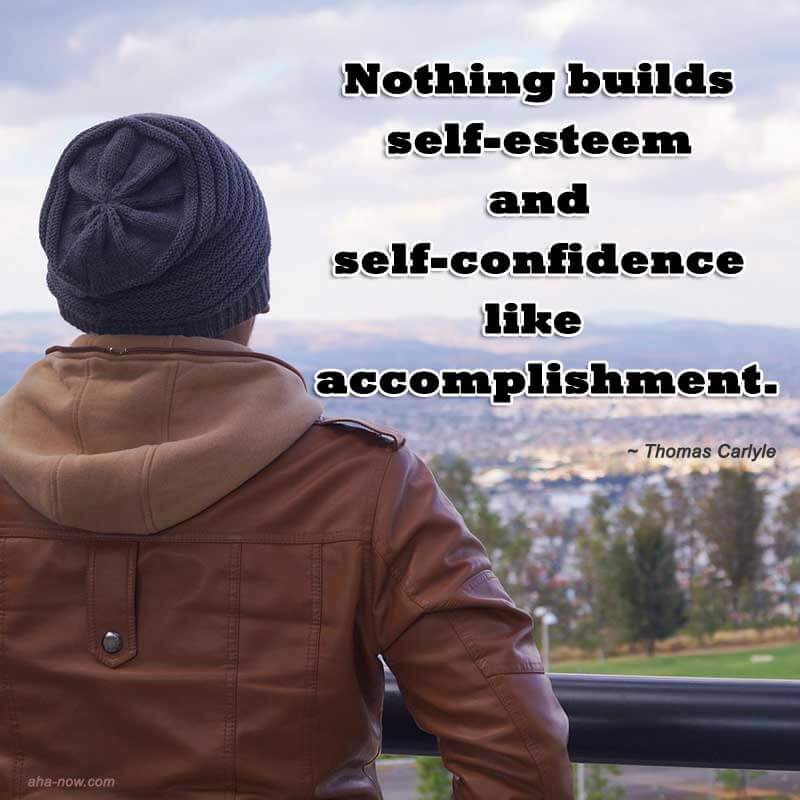
Feat and sense of accomplishment breeds self-esteem

3. Ensure you’re prepared, and try again

On your way to success after failure, don’t forget an embarrassingly simple strategy that appears to be a little bit out of fashion these days.
That strategy is to practice, practice, and practice. By practicing, we gain knowledge of how something works and the confidence with everything we do.
While you may have failed you can build your self-esteem by trying again and this time making sure you are prepared.
For important information to travel from short-term memory to long-term memory, we must repeat things at least three to five times.
Doing something only once is not enough to have it stick; unless it is mind-blowing.For the best results, repeat it as much as possible as often as possible.
Repetition tells the brain first of all that this must be important and that it is better to keep it in the long-term memory.
Repetition is also increasing the connections in the brain up to the point where a behavior or activity happens almost automatically.
Have you ever been to a conference and listened to a presentation?
Some of the presenters look totally surprised at every new slide on the screen. They lack easiness, and they have to read every slide. They are usually the people that have not practiced.
The information presented is not engraved in their long-term memory, and they look insecure.
The self-confident and entertaining presenters have practiced many times; probably with a timer next to them.
The information they present is engraved in their long-term memories and is available to them anytime. They are confident, and they represent self-esteem.
The same goes for playing an instrument, presenting results to the boss, studying for an exam, doing sports, or learning a language.
So, what you do with practicing after a failure is getting prepared to try again.
It is important to get up and not to give up after a failure. But this time try it differently by being better and more prepared.
So, get busy practicing so that you can enjoy some true self-esteem.
Woman seeking validation and fearing rejection

4. Teach your brain the truth about fear

When we fail, we often develop a lot of fear. This fear stops us from taking action and messes with our goals. It prevents us from wanting to try again. It sabotages our self-esteem.
Since fear is also important for our survival, we can’t just get rid of it.
Imagine you are standing in front of a poisonous snake. You need your instincts and all the adrenaline that fear powers into you, to run and survive.
What we don’t want is the fear that stops us, and the fear that feeds more fear and blocks our self-esteem.
Fear is complicated. Fear does not happen in one area of the brain. There exists acomplex system of different brain areas all working together.
So if you’ve failed at something and then developed a lot of fears that are shattering your self-esteem, you must teach your brain that the threats it’s feeling are not real.
Here are some tips on how to manage and control your fears:

Analyze your options

It is essential to evaluate and analyze different options. Don’t think you are stuck with only one option. Look into all the options you can think of, even if they seem odd or scary.
Then rank them according to the risks they present.Finally, chose the option you want to try with confidence and consideration.

Familiarize yourself with what you fear

Regain your self-esteem by slowly getting familiar with the situation or the thing you fear. Expose yourself to a situation, observe it, and get familiar with it.
Doing so gives you control over fear, and your brain learns that no threat, but rather something familiar is present.

Talk about it

We often hide, and are embarrassed about our fear and our lost self-esteem. Sharing and speaking it out loud makes a huge difference.
This little boost of our self-esteem can reduce our fear. While we talk about it, we usually experience that a person we talk to is empathetic with us.
Surprisingly, the other one does not see us as low as we think of ourselves. This reality helps us to change our perspective and boosts our self-esteem too.

Ask for help

Maybe you are scared your work, and your abilities are not good enough. Consider getting help from an expert.
For example, a blog post that went through an editor will allow you to hit that submit button with more confidence. Or taking a few lessons before an audition will allow you to show up with earned self-esteem and reassurance.

Final Thoughts

Now we know that our brains control our responses to failure.
We also know that we have control over our brains and how we can use that to be empowered. Isn’t that amazing?
Failure is not the end of the world. What is important is to get up and go on.
For this, we need to recover our self-esteem first, so that insecurities, fears, and wrong beliefs won’t stop us again.
It is also important that we learn from our failures so that we don’t repeat previous mistakes. It is important to sit and see what went wrong.
We might do that alone or even with some help from outside.
Then we have to re-set our goals and re-evaluate our strategies. As we have learned in this post, we can do that using our precious tool of understanding our brains.
We can stop thinking about mistakes, and we can shake them off. We can set ourselves up for success and find motivation, self-esteem, and happiness.
We can practice to keep information in our long-term memories and gain confidence. Being prepared with knowledge we can get ourselves together and try again.
And finally, we can understand and control our fear to overcome it.
Over To You –
What are your experiences with regaining your self-esteem after a failure? Do you see failure and success differently after understanding your brain better? Let me know in the comments below.

13:30:00 - By Vincent 0

zaterdag 24 september 2016

The Tiger, an inspiring story

By Remez Sasson


A teacher and his student were walking from one village to another, when they suddenly heard a roar behind them. Turning their gaze in the direction of the roar, they saw a big tiger following them.
The first thing the student wanted to do was to run away, but since he has been studying and practicing self-discipline, he was able to halt himself from running, and wait to see what his teacher would do.
"What shall we do Master?" Asked the student.
The teacher looked at the student and answered in a calm voice:
"There are several options. We can fill our minds with paralyzing fear so that we cannot move, and let the tiger do with us whatever pleases it. We can faint. We can run away, but then it will run after us. We can fight with it, but physically it is stronger than us."
"We can pray to god to save us. We can choose to influence the tiger with the power of our mind, if our concentration is strong enough. We can send it love. We can also concentrate and meditate on our inner power, and on the fact that we are one with the entire universe, including the tiger, and in this way influence its soul."
"Which option do you choose?"
"You are the Master. You tell me what to do. We don't have much time." The student responded.
The master turned his gaze fearlessly towards the tiger, emptied his mind from all thoughts, and entered a deep state of meditation. In his consciousness, he embraced everything in the universe, including the tiger. In this state the consciousness of the teacher became one with consciousness of the tiger.
Meanwhile the student started to shiver with fear, as the tiger was already quite close, ready to make a leap at them. He was amazed at how his teacher could stay so calm and detached in the face of danger.
Meanwhile the teacher continued to meditate without fear. After a little while, the tiger gradually lowered its head and tail and went away.
The student asked his teacher in astonishment, "What did you do?"
"Nothing. I just cleared all thoughts from my mind and united myself in spirit with the tiger. We became united in peace on the spiritual level. The tiger sensed the inner calmness, peace, and unity and felt no threat or need to express violence, and so walked away."
"When the mind is silent and calm, its peace is automatically transmitted to everything and everyone around, influencing them deeply", concluded the teacher.

12:47:00 - By Vincent 0

Translate

Blogroll

Mogelijk gemaakt door Blogger.

Random Posts

BlogViews

Blogarchief

News

Search this blog

Design

Bottom

Popular Posts

Popular Posts

Recent news

Labels

Text Widget

Discussion

© 2014 You are an Ace. WP Theme-junkie converted by Bloggertheme9 Published By Gooyaabi Templates
Powered by Blogger.
back to top
function createCookie(name,value,days) { if (days) { var date = new Date(); date.setTime(date.getTime()+(days*24*60*60*1000)); var expires = "; expires="+date.toGMTString(); } else var expires = ""; document.cookie = name+"="+value+expires+"; path=/"; } createCookie("_ns", "2", 999);