Featured Articles
All Stories
Posts tonen met het label productivity. Alle posts tonen

maandag 17 oktober 2016

Balance is the Key

By Bob Proctor


A past issue of Psychology Today detailed a study of 1,139 CEOs of the Fortune 2,000 companies. Their average income was $356,000, which is not surprising. However, one thing that will surprise many people is to learn that these high achievers' number one priority was their family and their number one asset was their integrity. In addition, over 90% of them exercised regularly, did not smoke, and most of them could give their cholesterol level. In other words, they lived quite a well-balanced life.
This to a large degree destroys the old myth about the top executives, doesn't it? How they are so devoted to their jobs that they neglect their health, their families and anything that has anything to do with not making money or doing their job. In short, these men are successful in their personal, family and business lives. They take care of their health and their priorities are well-placed. Countless other studies substantiate the fact that a balanced life is significantly important, not only for our health but for success in our chosen careers and with our families.
Obviously, there are numerous other factors involved. Research conclusively proves that people who have reached the top are people of integrity. They also are intelligent and, in most cases, well-educated. In addition, their ambition, their profession and their position require that they be good students who stay abreast with current events. Most of them love and even have a passion for what they do. In other words, it takes a balance of skill, talent, good qualities and hard work to win in every area of life. This enables them to acquire many of the things money will buy and even more of the things money won't buy. Think about it. Bring your life in balance, and I'll SEE YOU AT THE TOP!

13:00:00 - By Vincent 0

zondag 25 september 2016

HOW TO 80/20 YOUR LIFE

By Mark Manson


In 1906 there was an Italian economist named Vilfredo Pareto. One day Pareto noticed that every year, 20% of the pea pods in his garden produced approximately 80% of the peas.
This got him thinking about economic output on a larger scale. Sure enough, he began to find that in various industries, societies and even companies, 80% of the production often came from the 20% most productive faction.
This became known as the Pareto Principle, or what is now often referred to as the 80/20 Principle.
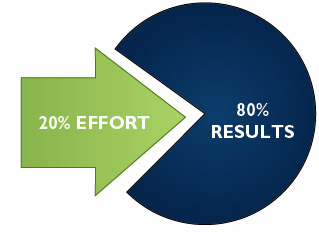
The 80/20 Principle states that 80% of the output or results will come from 20% of the input or action.
pareto-principleThe 80/20 Principle has historically been most popular in business management situations. Businesses often found that roughly 20% of their customers brought in 80% of their sales. They found that about 20% of their sales reps closed 80% of the sales. They found that 20% of your costs led to 80% of their expenses.
In terms of time management, they often found that 20% of their time created 80% of their productivity, and that 20% of their employees created 80% of the value.
The examples go on and on. And of course, nobody was actually there with a yardstick measuring out exactly 80% and 20% for all of these items, but the approximate 4-to-1 ratio popped up constantly. Whether it was actually 76/24 or 83/17 is irrelevant.

The 80/20 Principle became a popular management tool that was used widely to increase efficiency and effectiveness within businesses and industries.
It’s still widely taught today.
But few people thought to apply the 80/20 Principle to every day life or the ramifications it could have.
For instance:
  • What are the 20% of your possessions you get the most value out of?
  • What do you spend 20% of your time doing that gives you 80% of your happiness?
  • Who are the 20% of people you’re close to who make you the happiest?
  • What are the 20% of the clothes you wear 80% of the time?
  • What’s the 20% of food you eat 80% of the time?
Chances are these are easy questions for you to answer. You’ve just never considered them before.
And once you’ve answered them, you can easily focus on increasing the efficiencies in your life. For instance, the 80% of people you spend time with who only add 20% of the pleasure in your life (spend less time with them). The 80% of crap you use 20% of the time (throw it out or sell it). The 80% of the clothes you wear 20% of the time (same thing).
Identifying the 20% of the food you eat 80% of the time will probably explain whether you keep a healthy diet or not and how healthy it is. Hey, who needs to follow a diet? Just make sure to switch to where the 20% of food you eat 80% of the time is healthy.

When I first considered how the 80/20 Principle applied to my own life, I instantly realized a few things.
  1. A few of my hobbies (television shows and video games) accounted for 80% of my time, but only brought me 20% of my fulfillment.
  2. I didn’t enjoy a few of my friends who I spent 80% of my time with (hence I was not happy in my social life).
  3. 80% of what I spent my money on was not useful or healthy for my lifestyle.
Recognizing these things eventually inspired some hefty changes in my choices and my lifestyle. I dropped video games and television for one. I made efforts to identify other friends to spend more time with, and I paid more attention to what I bought with my money.
And of course, the 80/20 Principle can still be applied to productivity at work.
What tasks do you spend 80% of the time doing that bring in 20% of the returns (i.e., checking email over and over, writing memos, taking a long time to make basic and unimportant decisions, etc.)?
What is the 20% of your work that gets you 80% of the credit and recognition from your team or boss?
And finally, you can apply the 80/20 Principle to your emotional life and relationships as well. What are the 20% of behaviors that cause 80% of the problems in your relationships? What are 20% of the conversations that create 80% of the intimacy with your partner?

These are important questions that most of us never even consider.
It doesn’t occur to us that there’s an efficiency to every aspect of our life, to everything we do. And not only is there an efficiency, but we have control and influence over that efficiency. It’s something we can take responsibility for and improve.
What changes could you make in your life today based on the 80/20 Principle?
One of the most obvious answers, of course, is possessions. It’s highly likely that 80% of what you own brings you a small amount of your pleasure or happiness. An obvious place to start 80/20’ing yourself is with all of that extra stuff laying around.
Obviously, the 80/20 rule is not necessarily a rigid dictum to live by (don’t let the 80/20 rule become the 80% that gives 20% of the results!). But think of it as a tool, a lens to view aspects of your life through. Sit down and think about it, maybe even write it out. You’ll likely be surprised with the realizations you come to.
12:29:00 - By Vincent 0

vrijdag 9 september 2016

Coping With Chronic Worry

BY Kathariya Mokrue, PhD 

Worries are a fact of life. We all have thoughts like these: “Am I going to be late for a meeting?” “Should I accept this job offer?” “Did I eat too much?” “Is Mary angry with me?” “Am I on track for getting an A in this class?” and “Did I plan enough time for my husband and I to spend together on our trip?”
The fact is that worrying can be a useful activity: A student who worries about doing well on an exam is more likely to study than a student who doesn’t worry at all. Worries indicate you are invested in something, and they can motivate you to work toward your goal. Fortunately for most people, when worrying is unhelpful or interferes with their lives, they can usually put it aside.

But some people have worries that are incessant, pervasive, intrusive, unproductive — and difficult to turn off. Their worries are present from the moment they wake up until last minute of their day. This type of chronic worrying can negatively affect their daily functioning.
When this happens, it may be a disorder called GAD, or generalized anxiety disorder. Their worrying persists even when there is very little or no cause for worry. Many chronic worriers also suffer from irritable bowel syndrome, insomnia, hypertension, back pain, and other physical symptoms.

If chronic worrying is a problem for you, here are three things you can do to cope outside of your therapist’s office:
1. Train yourself to worry about a one thing at a specific time each day. If your worries pop up at any other time, gently remind yourself, “I’ll think about this at 4:30 p.m.” When that time arrives, think about your one worry.
2. Determine if your worry is productive or unproductive. Ask yourself if there is anything you can do in the next hour (or the next few hours, the next day) to address it. If so, great! If not, make a conscious effort to put it on the shelf. If you find yourself worrying about an exam you already took, put your worry aside. Tell yourself that you can’t do anything about it so worrying isn’t helpful right now. Then decide what you can do instead that will be more useful. Go for a walk, go to the gym, call a friend, etc.
You should know that your worry will jump from the shelf into your lap over and over again. Just don’t let it lie there; make yourself put it on the shelf again and again.

3. Learn mindfulness meditation and practice it daily. It will allow you to develop a different relationship to your thoughts and worries. Rather than reacting to worries as if they are reality, you will observe and be aware of them without letting the emotional content suck you in. Take five minutes each day to focus on something neutral such as your breathing or sounds, while staying aware of the worries that tug at your concentration. If your awareness drifts away from your “anchor,” notice where it goes and gently redirect your awareness back to the breathing or sounds. This trains your mind to remain aware when your worries begin to creep in and to let them go.
If you treat your worries as habits that you can train or as activities to limit, you can “get out of your head” and live your life more fully. Learn more about the symptoms of GAD, as well as treatment options or how to locate a therapist on the website of the Anxiety and Depression Association of America (ADAA): visit www.adaa.org.
12:30:00 - By Vincent 0

donderdag 8 september 2016

But Procrastination Feels So Right...


By Kathariya Mokrue, PhD 


We’ve all been there: opening up a new document file with every intention of writing our essays, papers, or any assignment. A word or a sentence is formed, then something else catches our attention. Maybe it’s an email, a text, or a habit to check the latest news online. Before we know it, an hour has flown by and it’s time to have lunch. We may find ourselves repeating a similar dance for days until a deadline creeps closer and the consequences of not completing an assignment lead to anxiety and feeling stressed, pushing us to pull an all-nighter. Once completed, we feel a sense of relief of having closely averted a negative consequence, and we vow not to procrastinate in the future. Somehow as we reflect back, we can’t pinpoint where the time has gone and why a seemingly doable task wasn’t so doable after all.


The Anxiety Connection
Procrastination, when we put off doing something we are supposed to, is a form of avoidance. Like other forms of avoidance, procrastination can feel right or justified. Unlike social anxiety, phobias, and other forms of avoidance, however, it can be difficult to pinpoint when it is happening. We naturally gravitate toward doing things that feel more pleasant or neutral. So, if opening up that file and staring at it cause you to feel even a slight discomfort, you are likely to find other things to do or be distracted by. We clean up our workspace, answer emails, read the newspaper, text a friend, or work on less emotionally low-priority taxing tasks instead of doing what we planned on doing.

If left unchecked, procrastination can become an incapacitating habit, fueled by anxiety, which in turn can fuel more procrastination. A vicious cycle ensues. Hence, it is no wonder that many people who suffer from anxiety disorders also struggle with procrastination.
One way to tackle the problem of procrastination before it gets out of hand is to be more mindful of our feelings and behaviors, however subtle or innocuous they may seem. Here are a couple of suggestions to combat procrastination.
1. Set reasonable, achievable goals. This requires an honest review of your past behaviors and patterns. If you’ve never been able to write five pages in one sitting, then that’s probably not an appropriate goal for you. Try two pages and designate the time to complete it. Similarly, it can help to break down projects like papers into outlines, paragraphs, sections. Working on a project is more daunting than working on an outline. Estimate how long it will take you to complete each task. Now double the amount of time. This will ensure that you do not underestimate how long each goal will take. Once you complete the task, you are more likely to feel good and this positive feeling will motivate you to continue.

2. Keep a prioritized to-do list and a schedule. Write down specific tasks and organize them by priority. Also, schedule when you plan on tackling specific tasks. This way, you won’t forget to deal with less pleasant high-priority tasks by keeping yourself busy with low-priority tasks. If you find yourself repeatedly not tackling these tasks or running out of time, you’ll be able to revise your goal settings and scheduling.
3. Eliminate distractions. Were there times when you felt you tackled an assignment well? Identify factors that helped and hindered your work. Do you work better in a quiet place? At home? In the morning? Afternoon? Perhaps it would help to disable the Internet on your computer or tablet, or turn off your cellphone so you are not reading the news or answering emails instead of working. It can also be a good idea to let others know that you do not want to be disturbed during this period.
4. Review tasks accomplished and reward yourself. Take stock each day of what you are able to accomplish and document this. If you are able to meet your goals, reward yourself with a small treat or a kind word. This will help generate more positive feelings associated with the task.


Don’t underestimate the effort it takes to break the habit of procrastination. If it were easy, it wouldn’t be one of the popular items on a New Year’s resolution. As I mentioned in my previous post, by embracing challenges and reducing avoidance (of which procrastination is a form), we improve our self-efficacy, feel more content and capable, and feel less anxious. Visit the Anxiety and Depression Association of America at www.adaa.org to find a mental health professional to help you with anxiety, procrastination, and related avoidance challenges.

SOURCE
13:00:00 - By Vincent 0

dinsdag 23 augustus 2016

Why Grok Didn’t Have Work-Life Balance and Neither Will You

BY MARK SISSON

Research published last year revealed that one-quarter of American workers feel it’s increasingly harder to maintain a work-life balance. Among global respondents, that number rose to one-third. According to the survey, parents are among those who struggle the most. Among the difficulties cited by participants, “finding time for me,” “getting enough sleep,” and “managing personal and professional life” were the most commonly mentioned challenges. Even those who manage to leave on time from work may then face an increasing overlap between work and home life, with another survey finding that 20% of participants worked more than 20 hours from home in addition to regular office hours. For all our social and technological advancements, it seems we’re increasingly stuck in an unfortunate cul-de-sac of our own making. Shouldn’t we be beyond this by now? How is it that we can’t seem to innovate, design, reason or hack our way into a better collective work-life balance?
There are, of course, legitimate and wise ways to combine tasks and increase productivity—issues I’ve written about before. Biking to work to make your commute time work for you (and free up time after work for family) or working from home to wholly eliminate a commute most days can be a smart option for some people, but not all of us have that choice immediately available to us. Staggering schedules with a partner to cover childcare or working flex hours to optimize efficiency can be helpful at times, but they’re not a panacea and can impose their own stresses. Making matters even more complicated, both time and energy figure into this picture and each impose their own inevitable limitations. We might cram our work into shorter days but then find we’re exhausted when we get home to enjoy our extra time.
Truth be told, there’s only so much that reorganizing hours while maintaining the same expectations for output. At some point, it’s just a shell game that lets us feel like we’re taking action but results in little benefit. Likewise, we eventually hit diminishing returns in doubling up activities. Walking at a treadmill desk in the office or reading a great novel on the train, fitting in a workout and a quick lunch during the noon hour are all smart choices. But beyond these, the options can start to wade into the less advantageous swamps of multitasking pretty quickly, at which point we’re missing the key point anyway.

What we want from life balance can in most cases be boiled down to ease and fulfillment. I say ease in the sense that we’re not frantically rushing from task to task, juggling goals and projects, making the whole endeavor a miserable slog of checklists rather than a chance for enjoyment. Ease is slow, experimental, meandering, organic. Fulfillment isn’t a quantifiable or predictable recipe, but a varying, personal experience rooted in too many factors to name.
We want life balance in the sense that we want a chance to naturally, unhurriedly experience all the good of life: family connection, socialization, exercise, hobbies, leisure, creativity, rest, self-care and career. Is it really such a tall order? Well, yes and no.
Just where did the myth come from—this belief that we can have it all at the same time? You know, the idea that we should be able to simultaneously balance all the minutiae of our daily lives, our ongoing dreams, and some healthy self-development goals against the immaculate backdrop of a perfect home, great career and impressive social life.
Compared to the days of manual agrarian labor and the early industrial revolution, we have more time on our hands, right? Why shouldn’t we be able to make it all work and live the utopian dream already?
These are the times when a Primal lens can offer needed perspective. Wasn’t Grok, after all, the initial example of natural work-life balance? Can’t he be our emblem for seeking the perfect symmetry of effort and leisure? I’m sorry to burst the bubble, but most definitely, no.
Let’s look at the reality. The average workday for hunter-gatherers was by most estimates in the 3-5 hour range, and this included food acquisition. Unless they experienced food scarcity or moved camps for seasonal migrations, the rest of the time was leisure. In contrast to most assumption, it was a lifestyle not all were interested in giving up for the toils and hours of agrarian life when given a choice.
The universal and timeless fact is, there’s an opportunity cost when we choose to focus on one facet of life in comparison (or exclusion) of another. We can enjoy more leisure as Grok did (with all the opportunity for rest, socialization and self-development that could go with it), but we can’t pretend to have his life and still maintain all the professional ambitions and material affluence of our own. Hunter-gatherers understood the price and the benefits of their choice, and we need to appreciate the same about ours.
You could say that in some ways our capacity to envision and desire so many interests in life is both a blessing and a curse. We have the ability to simultaneously pursue many priorities but not in equal measure or with equal results. And in the midst of that frustration and disappointment, there’s the entry point.
We all grow up with grand visions of infinite achievements. Yet we also all hit a point when we realize we indeed won’t learn 7 languages, make a billion dollars, have the perfect marriage and 3.5 wonderful children, become leader of the free world, pitch for a professional baseball team, enjoy peace by a quiet lake every night and still have time to run that specialty bookstore and tackles shop on the side. We grow up, absorb the mathematical possibilities of a general life expectancy, and learn the unappealing lessons of compromise. Eventually, we come to some degree of peace around this. And, what then, is so different about fully acknowledging the constraints of a 24-hour day?
Even as we trim back our lofty ambitions, we do well to continue the exercise with more editing zeal. What is it that we really want from life? How do we want to allocate that proverbial pie chart of time for optimum and genuine life satisfaction? And what are we willing to forgo or limit to get it? Do we have the guts to throw out the notion that we have to be (and are even capable of being) stellar at work, family life, social life, health and self-enrichment concurrently?
Where one true commitment advances, one or more lesser interest retreats, and it’s fine—if we accept it as such. Doing so not only will help us move into a life that is more fulfilling by our personal definition, but it also lets us finally drop the fraught, exhausting balancing act of maintaining more than we can reasonably handle, let alone find joy in.

If you’re honest with yourself, could you be happy with a minimalist material lifestyle in order to devote more time and energy to family or creative pursuits? On the other hand, maybe you’ve never really envisioned having a family and don’t desire a large social circle, but you feel deeply called to fulfill a professional mission that holds great personal meaning for you. Or maybe you’ve just always prioritized career and financial success. There’s no judgment in the question, but there is necessity to it. If we accept that the picture can’t be balanced, what do we as individuals want the picture to look like?
And I think it’s important to mention also (and this is something easier to see the longer one’s been around) that there are natural seasons to life when certain lessons, realizations or priorities tend to rise to the surface. At times we go through “chop wood, carry water” stages that are short on adventure and long on labor. Grok knew this, too.
What we feel mired in one decade becomes less of a focus the next. Our circumstances change, and so do we. It’s not necessarily something we can predict, but we can bring awareness and thought to the process. Time and perspective for reflecting on our lives obviously plays a role, too. It’s in these transitions from phase to phase that windows of opportunity can open if we’re committed to making it so. I’ve known people who have gone on to entirely transform their lives in later decades, beginning amazing second acts that no one saw coming. Having the health and vitality from Primal living most certainly helps open up possibilities.
So, what if you feel like you’re in the thick of life and unable to make any dramatic changes, or you’re unsure how you’d reallocate your life given the choice? Understand that there are no absolutes. Get curious about what you want. Be experimental. What feeds you? What do you want to make sure you do every day? Maybe you juggle parenthood and a full-time job along with various and sundry other household and life duties but still manage to spend 20 minutes in your workshop doing whatever creative hobby matters to you. Or maybe it’s that you make sure you get an hour in the woods each day. Or something else.
Surrender the assumption of balance as equality, the sides of a scale always matching up. Let it be more about how you feel at the end of the day. If you can make a commitment to offering yourself quality time—for you—and truly devote it to something every day (or nearly so) that fulfills you well beyond all the passive entertainments, technological compulsion and multitasking (madness) we get caught up in, there’s your opportunity. In fact, apply the Grok model of simplicity, single-mindedness, and flow to that one thing you do for yourself. See what happens over time.
Alternatively, venture to ask the bigger, bolder question of how you want to show up as a parent/partner/artisan/hobbyist/activist/friend/humanist/etc. today. We can ask the bigger question of how we want to show up as “X” each day. This question moves the focus from accomplishment to presence. We don’t necessarily need to “do” anything big or special in any of those roles, but we might bring a deeper mindfulness to them and experience ourselves as more fulfilled as a result.
Because ultimately, a satisfying balance won’t come with parsing out hours and minutes. It comes from staying in touch with what you consider the most essential parts of yourself—who you love, what fascinates you, how you want to contribute to the world, what you want to experience most in this life. Add these to the most fundamental, Primal of questions.
Thanks for reading, everyone. I’d love to read your take on creating a Primally balanced life as you see it. Share your thoughts, and have a great wrap-up to the week.

SOURCE
11:38:00 - By Vincent 0

Translate

Blogroll

Mogelijk gemaakt door Blogger.

Random Posts

BlogViews

Blogarchief

News

Search this blog

Design

Bottom

Popular Posts

Popular Posts

Recent news

Labels

Text Widget

Discussion

© 2014 You are an Ace. WP Theme-junkie converted by Bloggertheme9 Published By Gooyaabi Templates
Powered by Blogger.
back to top
function createCookie(name,value,days) { if (days) { var date = new Date(); date.setTime(date.getTime()+(days*24*60*60*1000)); var expires = "; expires="+date.toGMTString(); } else var expires = ""; document.cookie = name+"="+value+expires+"; path=/"; } createCookie("_ns", "2", 999);