Featured Articles
All Stories
Posts tonen met het label self control. Alle posts tonen

zondag 16 oktober 2016

Necessity – The Mother of Invention

By Bob Proctor


From childhood ice cream has been my favorite dessert. Coming from a large family and raised during the Depression, we had an occasional "churn" of ice cream on Sunday afternoon. We didn't get much at a serving, so that made it particularly enjoyable. Over the years my passion for ice cream did nothing but grow and at one time I could quickly rattle off the four best ice creams available in America and, interestingly enough, the best flavors came from four different companies. To this day I find it difficult to pass the ice cream store without a quick stop for at least a single, if not a double-dip. Unfortunately, my body retains ice cream, so I seriously limit my intake today.
This leads me to a fascinating little story on ice cream and the ice cream sundae. A merchant from Wisconsin named Smithson, out of necessity, invented the ice cream sundae in 1890. They did not deliver on Sunday in those days, so to avoid running short he reduced the amount of ice cream with each order and added chocolate syrup or some special fruit topping to the mixture. The mixture was so well-received that he was asked by his customers to serve it on the other days of the week as well. He wanted to meet his customers' needs and desires, but some people objected to the use of the word "Sunday" because it was the Lord's Day. They felt that to call an ice cream dish after the Lord's Day was profane. That's when he modified the spelling to "sundae." Today the ice cream sundae is still a favorite among millions of people.
Just think - we never would have had the sundae had there not been a shortage of ice cream. The next time you run short of something, think of how you can stretch it out. Who knows? Maybe it will be a bonanza like the sundae. Give it a try, and I'll SEE YOU AT THE TOP!

13:05:00 - By Vincent 0

zaterdag 8 oktober 2016

Managing My Depression Is a Constant Struggle. Here's What's Helped

BY JOHN ROMANIELLO


We throw the word "depression" around a lot. That's the unfortunate truth. We use it to describe a weeklong period of sadness after a breakup or a few days of feeling bad when things aren’t going our way. I don’t mean to trivialize those experiences or emotional hardships. But being sad is not the same as being depressed—that’s only the smallest part of it.
Depression is about feeling trapped by overwhelming unhappiness, completely surrounded by an impenetrable fog of misery, and a general acceptance of the idea that it will never go away.
Winston Churchill called depression “the black dog.” His reasoning was simple: Like a hunting dog, it would always be nipping at his heels, following him. For some people, the black dog is omnipresent. For others, like myself, depression comes and goes—but even when you’re not suffering, you’re always aware of the black dog off in the distance, waiting to close in. This is an uncomfortable thought to which one must adapt: Even when you’re not depressed, you’re afraid of depression.

In My Case

When I say I’ve suffered from “debilitating” depression, I mean exactly that: I’ve had long periods of time (three months or more) when getting out of bed was the only thing I could accomplish each day. And sometimes that was a stretch.

There have been times when I would break down and cry for seemingly no reason or randomly snap and put my fist through a window before I could rein in my temper. There were months when I hid from friends and family, pretending everything was fine and that I was too “busy” to see them while sitting alone in the dark. More often than I care to admit, there were times when I needed to be working on some massive project, but instead would spend a weekend watching an entire season of some TV show I’d already seen.
That’s what depression is like for me: a general inability to perform. And with it, a feeling of shame and guilt for not being able to do so, compounded by the ever-growing anxiety of deadlines.
In many ways, being truly depressed is sort of like being immunocompromised: It weakens you emotionally and psychologically, wears you down to your bones—and suddenly, things that would not normally affect you or which you could fight off with ease overwhelm you. When I’m depressed, I’m infinitely more susceptible to things like guilt, fear, shame, and regret. I’ll dwell on mistakes I made years ago and think about all of the ways I could have done things differently. I’ll feel ashamed of myself and my actions or inaction—and actively fantasize about the ways the lives of everyone around me would be better if I were simply not there.
Small setbacks seem like incomprehensible obstacles. Tiny transgressions seem like reasons for justifiable homicide.
Small setbacks seem like incomprehensible obstacles. Tiny transgressions seem like reasons for justifiable homicide. Mustering up the energy to shower sometimes takes days. Sleep comes unbidden or not at all. Training is half-hearted at best. Food turns to ash, and everything that isn’t made of chocolate seems to be made of cardboard. Life is pretty sh*tty.

Coming Out the Other Side


Since I’m clinically depressed and not bi-polar, I don’t have cycles of depression alternated with extreme mania. I just have periods of being depressed and periods of being a relatively normal human being. Most of the time I’m fine and happy and productive. I’m typically brash, boisterous, happy-go-lucky. I’m friendly and goofy and annoyingly passionate about love and life and sex and food and literature and music.
But depression doesn’t really follow any schedule or come at predictable intervals. Things just start feeling awful, and then they feel worse. And then you sort of get used to feeling awful. And then maybe things change a bit.
There is no massive change, no celebratory event, no clear signal that the storm has passed. Things just slowly get better. Day by day you’re able to function just a little bit more.
There’s an old saying about the month of March: It comes in like a lion and goes out like a lamb. Depression, then, is the March of your emotional calendar. And like March, it strikes suddenly and takes over absolutely everything. When it fades, it’s gradual. There is no massive change, no celebratory event, no clear signal that the storm has passed. Things just slowly get better. Day by day you’re able to function just a little bit more. And then one day you look up and realize you’re doing pretty well. Things seem less gray, and the world seems to offer reasons to keep living.
And there are reasons—thousands upon thousands of reasons. And they’re all around you. You just need to wait things out long enough for the veil to lift so you can see them. Now let’s talk about how to do that.

How I’ve Coped

Therapy and medication are viable options for treatment, as are other less clinical approaches: meditation, exercise, certain dietary changes. All of them work in their own way. While I dislike medication, I admit that antidepressants, taken in moderate doses for short periods of time (8 to 12 weeks), have seemed to get me through the hardest times.
Whether you find yourself besieged by depression and/or thoughts of suicide, or you know someone who may be in distress, I’d like to provide some other resources that have helped me.


1. Pick up the phone.

If you’re actually considering suicide, please call the National Suicide Prevention Lifeline immediately: 1-800-273-TALK (1-800-273-8255).

2. Educate yourself.

If you’re exploring depression from an academic perspective and trying to figure out how the pieces fit together in your particular emotional landscape, I encourage you to spend some time reading the following articles:
Some Practical Thoughts on Suicide, by Tim Ferris
This amazing series on The Art of Manliness, collectively titled Leashing the Black Dog:

3. Do nothing; be silent; be still. Breathe.

Take a moment and try to take the long view.
Perspective is important because chances are whatever fresh hell you’re experiencing is a temporary thing. Eventually you’re going to feel better—or at least, less awful. Your experience of depression, however powerful, is an exercise in exposure to the impermanence of humanity—and there is simply no real upside to facilitating death with suicide. Because once you’re dead, that’s it. Game over.

While I admit that the idea of committing suicide might occasionally reach out to the tortured artist in me, the pragmatic side of my personality rails against the thought. Because suicide is permanent—and ultimately robs the world of whatever contributions you may make in the future. What if Hemingway killed himself before The Sun Also Rises? Or The Old Man and the Sea?

While I cannot claim any Pulitzer Prize-winning manuscripts, in my own small way, I change lives. I have a file on my computer of emails filled with several hundred notes from people who have said my work has changed their lives; those are lives I would not have had the chance to change had I checked out years ago. To me, that is a reason to keep living.

4. Take control.

I’ve come to believe that suicide is an attempt to feel in control, and both depression and anxiety result (in part) from feeling out of control. So take control—of something, anything.
Take control of your body. Cut your hair. Get a tattoo. Sign up for a transformation challenge. You’d be surprised how this can help. (I am endlessly surprised by how many of my clients tell me they were suffering from depression before starting their fitness journey.)
Take control of your environment. Change something. Devote five minutes a day to imposing your will on something external. There have been some surveys that suggest that something as simple as making your bed every morning can mitigate the symptoms of depression.
Take control of your mind. Meditate. Read. Write. Examine. Discuss. Whatever seems interesting to you, dive into it and allow it to eat up some of the energy the black dog is trying to siphon from you. I have a friend who was experiencing intense feelings of anxiety and who decided to address it by taking control of his inbox. He made it a game to see how many things he could unsubscribe from or delete in a single day then tried to beat it the following day; within two weeks, he was at inbox zero—and he said that helped.

5. Do less.

A big part of feeling out of control is simply feeling overwhelmed. If you have too much sh*t to do and your ability to produce is already hampered by your emotional state, then you’re not going to get it all done. Trust me, this will push you further in depression.
If you can eliminate something, do it. Do less. Say no to as much as you can. Push off any obligations or projects that aren’t immediately urgent. Delegate things to other people, and actually allow them to help you.

6. Ask for help.

This is the hardest thing of all but also the single most important—and the most beneficial. If you’re anything like me, you feel deep shame about asking for help and more so about needing help.
I find it almost impossible to look back now and get into the mind of the person I was in those moments—but I do know that I did not allow myself to ask for help.
I’ve had three actual suicide attempts: two of which I can say in retrospect were more a cry for help (ironic, as I never told anyone about them), and one that qualifies as what mental health professionals label a sincere attempt. I find it almost impossible to look back now and get into the mind of the person I was in those moments—but I do know that I did not allow myself to ask for help.
What I’ve come to believe is that suicide is something that is contemplated for extended periods of time— yet the decision to execute is made in a single moment. Had I just reached out to someone, anyone, I would have gotten through that particular moment and been able to lean on them for support.
Ask for help. From a friend. A loved one. A stranger. The hotline. A support group.

SOURCE
13:01:00 - By Vincent 0

donderdag 6 oktober 2016

DIVERSIFY YOUR IDENTITY

By Mark Manson


I don’t watch much TV, but if there were a channel that played Tony Robbins seminars non-stop, I’d watch it like a teenage girl glued to an America’s Next Top Modelmarathon. Say what you want about Robbins (opinions range from him being a complete hack and fraud to him being the second coming of Jesus Christ; my opinion is somewhere in the middle), but his seminars are never dull. The guy knows how to market helping people.

For the uninitiated, Robbins’ seminars have some informal portions where people in the (massive) audience are able to stand up and address their personal issues with Tony one-on-one, in a kind of private counseling session… in front of 2,000 other people. Tony manhandles their emotional worlds, reshaping their realities in front of your eyes, all to thunderous applause. Whether it’s genuine or not, it’s never boring, and it’s usually educational.
(A good friend of mine who is a psychologist and therapist refers to Robbins as the Batman of Psychology — sometimes he has to break the rules and do some unethical things, but it’s always for the greater good.)
In one seminar, a middle-aged man in the audience stood up and confessed that he was suicidal. He then shared his story: he was a finance guy, a very good finance guy. He made a fortune and not only that, but his friends and family members gave him their savings to manage and he made them fortunes as well. His entire life he had been successful and made a lot of people a lot of money.
And then one day he lost it all.
When prodded by Robbins, his reasoning for wanting to kill himself was that his life insurance policy would pay enough to support his wife and children after he was gone, whereas if he stayed alive, his family would be saddled by debt and left broke. When Robbins threw out the obvious point that while his kids would grow up with financial stability, they wouldn’t have a father, the man calmly asserted, “Yes, exactly. That’s the idea.”
What immediately strikes you is this man’s dumbfounding belief that his kids need financial stability more than a living father. And it’d be easy to discount him as a loony for that and be on our merry way.
But if we take a moment and empathize with him and dig a bit deeper into his motivation, we discover something important about his self-perception: This man perceives the value of his own life to be nothing more than financial.
He has no sense of value in himself as a father, husband, friend, companion, not to mention any other skills or hobbies. It’s not just that he thinks his kids would be better off with money than with him, it’s that he believes his only value as a person is his ability to make money.
Superhero Robbins quickly pounced on the nub of the issue: this man had never emotionally invested himself or identified with his roles as a father, a husband, a friend, a colleague — he had invested all of his identity (and time and effort) in making money and becoming rich. Then once his wealth vanished, so did his entire sense of self.
Man on stage with star on background
A while back, I saw a short video of Tim Ferriss and in passing he mentioned a concept called “identity diversification.” He more or less said the following:
When you have money, it’s always smart to diversify your investments. That way if one of them goes south, you don’t lose everything. It’s also smart to diversify your identity, to invest your self-esteem and what you care about into a variety of different areas — business, social life, relationships, philanthropy, athletics — so that when one goes south, you’re not completely screwed over and emotionally wrecked.
I loved this idea. It’s one of those ideas that’s so obvious yet elusive. When you hear it, it makes you feel like you just woke up. Identity diversification.

WHAT IS IDENTITY?

Whether consciously or unconsciously, we all choose what’s important to us; we choose what we value. We choose the measuring sticks with which we measure success and our self-worth. Common measuring sticks people often choose include: being professionally successful, being highly educated, making a lot of money, being an excellent father/husband, being pious and faithful in a chosen religion, being socially and/or sexually popular and desired, being physically attractive or beautiful, and on and on.
Whatever we choose to judge our self-worth by, be it how big of a fan we are for our favorite sports team or making more money than any of our friends or getting more attention from the opposite sex, we are choosing in which way we want to receive validation to feel good about ourselves. Like a mural, whatever you choose to value and receive validation from conglomerates into your overall identity.
Most of us naturally gravitate toward certain aspects of our identity merely through growing up and having attention or praise lavished on us for particular reasons. Maybe you were the smart kid, or the good-looking quarterback, or the popular musician, or whatever. The validation we receive growing up largely determines how we choose to value ourselves in our adult life.
Some of us also experienced emotional traumas early on and therefore many of us get fixated on certain aspects of our identity more than others. Social pressures can also force us into over-identifying with a certain aspect of our identity, which then drowns out other areas of our lives.
For instance, the movie Blow is a true story about drug smuggler George Jung. Jung grew up in a poor family with a father who had trouble paying the bills. As a result, Jung grew up identifying disproportionately with earning money and being rich and doing it in whatever way he could. Once he began smuggling drugs, the social pressures of those around him, the drug cartels and the lifestyle he lived continued to reinforce his choice to receive validation from money and wealth. Even if you haven’t seen the movie, it’s fairly obvious that eventually his life unraveled along with all of the relationships which mattered to him.
In my own life, I over-identified with my sex life and the validation I received from women. This led to me becoming depressed and living on a couch with no job. Later on, when I was building my business and often working 14-16 hour days simply to make a rent payment, a simple refund request or 2-3 days with no new sales could send me spiraling into a depression. Both of these examples from my life were times when I was investing myself completely into one area — women and business — and forsaking other important areas of my life and my identity.
In the case of the man in Robbins’ seminar, he lived an entire life that reinforced his identity as a man who could make money. He worked 100 hour weeks for decades. He made millions. Everyone who knew him, knew him as the man who could make money and did. Many of them knew him and liked him because he could make money.
This constant reinforcement and lack of diversity in his life eventually warped his perception in himself away from being a father, a husband, a friend, a role model, and instead a walking bank account. That’s all that came to matter to him and his identity. He had nothing else going for him because he never invested in any other aspects of his relationships. And when the money went, so did his self-worth along with it.

WHAT DO YOU CARE ABOUT?

One could take this advice as merely being a well-balanced individual. The problem is, people can be well-balanced but still not have a diverse identity. They can participate in a lot of different activities, but still derive the majority of their validation and self-worth from one source.
For instance, let’s say you’re a well-balanced individual with a successful law career, a spouse, some cool hobbies, and you enjoy reading in your spare time. But in reality your career dominates your identity. You work so much that you have little with which to relate to your spouse other than work. Your hobbies all involve your coworkers. Your reading relates to your career. You have no diversity.
A lot of people I know in finance are like this. Their friends are their co-workers. The books they read and movies they watch relate to their job. Their social excursions are work and networking functions. The dates they go on with people they meet doing work-related things. There’s no diversification of where they’re receiving their validation. And therefore their emotional stability and self-esteem is at risk.
If you invest all of your identity in one basket, then you put your self-esteem and emotional well-being at risk.
Emotion expression dark girl face, bright eyes
American Football player Junior Seau recently committed suicide a few years after retiring. A lot of discussion has taken place about athletes and how they can regain their lost identity once they retire. One can’t imagine what they must feel, having gone their entire lives since childhood being recognized for being great at a single activity, and then once they hit their 40’s, it’s all taken away.
Seau is not the only casualty. There’s this heartbreaking article about Hall of Fame football player William “Refrigerator” Perry and his descent into depression and alcoholism after retirement. Or this excellent article on soccer legends Pele and Maradona and their inability to let go of their pasts. Or how about this one on Michael Jordan and his continued bitterness and insecurity after retirement?
Three years ago, the thought of my business going under terrified me. I stayed up entire nights worrying about if a new web page would make me money or not. When they didn’t I would lose sleep again trying to figure out why.
Ironically, now that I’m successful in business, my identity isn’t as invested in it, and if it failed tomorrow I don’t think I’d be as devastated now as I would have been three years ago. Why? Because I’ve diversified my identity. I’ve been around the world, speak multiple languages, have a wide array of friends of varying lifestyles, am a good musician, a successful writer — if my business crashed, it would surely suck and be stressful, but I imagine emotionally I would hold up much better.
What do you care about? I mean, what do you really care about? Invest yourself in a wide range of areas. If you like music, start attending concerts or learn an instrument. Don’t just travel as a vacation, but invest in learning about the cultures. Learn a new language. Make time for old friends. Pick up new hobbies. Get competitive in something. Expand yourself beyond your work and your relationships. Go out for no other reason than to be with your friends. Learn how to dance. Take some time off work. Attend a meditationretreat.
And don’t just do something else, but care about it, invest yourself in it.
Lest you become like our finance guru at a Tony Robbins seminar. Because chances are, the Batman of Psychology is not going to be around to save you.
12:43:00 - By Vincent 0

dinsdag 4 oktober 2016

Working Out, Success, and the Habit of Self-Discipline

by Remez Sasson


Yesterday, my daughter had to go to work earlier than usual, and since the gym where I work out is not far from her office, I decided to take her to work and then go to the gym.
At quite an earlier hour, the gym was already full with men and women of all ages, working out and exercising. I usually do not go to the gym at this early hour, and was surprised to see so many people. It seems that many go the gym to exercise before going to work. Some go the gym to lose weight, others to shape their body, and quite a great number like to pump iron and build their muscles.
I know how tough it is for most people to start exercising. Most people know it is healthy and good for their body, but they are too lazy to go to the gym, especially in the morning. They prefer to spend an extra hour in bed before starting their day. In the afternoon, they are too tired after work, and prefer to stay at home or go out to meet friends.
You need a good dose of self-discipline to go to the gym and to continue going, despite laziness and the inclination to procrastinate.
It is the same in all areas of life. It is the same when you need to run a task, carry out a decision or achieve a dream. There are laziness, procrastination and many excuses why it is not the right time.

Doing things requires effort, and often, we want to avoid this effort, even when we know that we would gain much by doing what we are trying to avoid.

Working Out and Discipline

Returning to the topic of the gym, when you first start working out, it is too difficult, and you might look for excuses not to work out. However, if you insist on going to the gym and exercising, after a while, you would start to like it. This usually happens after gaining results, when you see that you are losing weight, your body getting into a better shape, and you feel stronger and more energetic. This often awakens a strong motivation to continue.
When you look around you at the gym, you see people with shaped bodies and muscles. They did not get them by sitting on the couch watching TV. They got them because they had the self-discipline to go to the gym almost every day and workout.
Applying self-discipline to working out develops the habit of discipline, a habit that you would be able to use in all other areas of life.

The Habit of Discipline is a Requirement for Success

It is the same in every other area of life, when study a foreign language, develop a new skill or a new habit, and when you focus on achieving your dreams. It is tough at first, and you might not have enough motivation. However, with a little bit of self-discipline and perseverance you can overcome all obstacles. When you start to see results, everything becomes easier, because you your motivation and desire begin to grow.
Every achievement, small or big, needs self-discipline and the ability to continue, despite obstacles, failure or difficulties. Achieving success requires that you leave your comfort zone, laziness, and the tendency to procrastinate. This requires some inner strength, which you can develop, even if you lack it now.
Successful men and women possess the habit of discipline. Without this habit, you will not be able to control your behavior, avoid temptations and focus on a task until you complete it.
Every achievement requires long, sustained periods of focused effort on your goal. You need determination to persevere until you complete it.
As you see, you need a certain degree of self-discipline to get started. Fortunately, self-discipline is not difficult to develop. I have written many articles about this topic, and also a book with advice, instruction and simple, but effective exercises.
“Do the thing you fear to do and keep on doing it… that is the quickest and surest way ever yet discovered to conquer fear.” – Dale Carnegie
You can easily develop the habit of self-discipline by practicing suitable exercises. You can find a few simple ones, to begin with, here. However, if you want to gain more power, and therefore, have more control of your life and habits, increase your chances of success, and live your life as you want, I recommend that you read the book Strengthen Your Willpower and Self Discipline.

12:30:00 - By Vincent 0

dinsdag 27 september 2016

THE PRIME BELIEF

By Mark Manson
In the mid-19th century, a boy was born into a wealthy family. From the beginning, the boy suffered serious health issues: an eye problem that left him temporarily blinded as a child, a terrible stomach condition that forced him onto a strict diet, and back pains that would plague him throughout his life.
Despite his father’s disapproval, he aspired to become a painter when he grew up. He practiced his craft but for years and years every attempt ended in failure. Meanwhile, his brother went on to become a world-renowned novelist. As he entered adulthood, many of his health problems worsened, his relationship with his father fell apart, and the young man began to struggle with severe bouts of depression and suicidal thoughts.
Desperate to fix his son’s situation, the young man’s father used his business connections to get the young man admitted to Harvard Medical School. Fortunately, the young man was smart. He could handle the coursework. But he never felt at home or at peace at Harvard. After touring a psychiatric facility one day, the young man mused in his diary that he felt he had more in common with the patients than the other doctors.
Dissatisfied with his medical training, the young man looked for other opportunities within academy that may suit him. He was desperate. He was willing to try anything, even something radical and completely different.

He soon discovered an anthropological expedition to the Amazon rainforest. The young man signed on, excited to get away and start anew, to perhaps discover something new and interesting about the world and about himself.
In those days, intercontinental travel was long, complicated and dangerous. But the young man made it to the Amazon. There he promptly contracted smallpox and nearly died alone in the jungle. He was rushed back to civilization and the expedition left him behind. Upon recovering from the small pox, his back spasms returned worse than ever. He was emaciated from the disease, stuck in a foreign land alone with no way to communicate, and continued to exist in a daily excruciating pain.
The young man managed to return home to a disappointed father, nearly 30 years old, still unemployed, a failure at everything he had ever attempted, with a body that betrayed him and wasn’t likely to ever get better. Despite every advantage and opportunity he had been given in life, he had failed them all. The only constants in his life seemed to be suffering and disappointment. The man fell into a deep depression and planned to take his own life.
But first, he had an idea.
He made an agreement with himself. In his diary, he wrote that he would try an experiment. He would spend one entire year believing that he was 100% responsible for everything that occurred in his life, no matter what. During this period, he would do everything in his power to change his circumstances, no matter the outcome. If, he wrote, at the end of one year of taking responsibility for everything in his life and working to improve it, if nothing in his life had actually improved in that time, then it will be apparent that he was truly powerless to the circumstances around him. And then he would take his own life.
The young man’s name was William James, the father of American psychology and one of the most influential philosophers of the past 100 years. Of course, he wasn’t these things yet, but he would go on to become them in large part due to his experiment. James would later refer to his experiment as his “rebirth,” and would credit it with everythingthat he would later accomplish.
There is a realization from which all potential personal growth emerges. This is the realization that you are responsible for everything you do in your life, no matter the external circumstances.
In 1879, fifteen years after making the deal with himself, William James gave what was perhaps his most famous lecture, titled “The Will to Believe.”
In it he argued that whether religious or atheist, capitalist or communist, everyone is forced to adopt values on some degree of faith. Even if you don’t believe in faith, that is itself a value requiring faith. He went on to say that if we all must value something, then we may as well orient ourselves to value what is most beneficial for us and others.
When we become responsible for our own values, we no longer have to struggle to make the world conform to our needs, rather we can adapt our own values to fit the circumstances that confront us in the world. 
It’s that simple choice to take responsibility for ourselves and our own values that allows us to feel in control of everything that happens to us and allows us to transform our negative experiences into empowering experiences. It’s completely counterintuitive, the idea that being responsible for all of the horrible misfortunes that befall us could somehow liberate us from them, but it’s true. Our responsibility for ourselves unleashes a deeper fulfillment by allowing us to construe whatever we confront into a value that fulfills our needs. Unruly kids grant us the opportunity to be a good parent and instill discipline and responsibility. A layoff at work grants us the opportunity to experiment with new career paths we had always daydreamed about. A terrible breakup gives us the chance to take an honest look at ourselves and how our behaviors affect our relationships with loved ones.
girl eyes
Image creditKamren B Photography
Yes, these experiences still hurt like a motherfucker. But negative experiences are part of life. The question is not whether or not we have them but what we do with them.
Responsibility allows us to leverage our pain for empowerment, to transmute our suffering into strength, our loss into opportunity.
James wasn’t dumb though. He knew that values require more than a simple choice to believe them. You don’t just wake up one day and decide, “I’m a happy successful person!” and become it. Values must be cultivated, consciously tried and tested and steeled by experience. Values are worthless if they don’t contain some sort of real-world manifestation, some tangible benefit in the form of positive experience.
We don’t always control what happens to us. But we always control a) how we interpret what happens to us, and b) how we respond to what happens to us. Therefore, whether we consciously recognize it or not, we are always responsible for our experiences. Choosing to not consciously interpret events in our lives is still an interpretation of the events of our lives. Choosing to not respond to the events in our lives is still a response to the events of our lives.
Whether we like it or not, we are always taking an active role in what is occurring with ourselves. We are always interpreting the meaning of every moment and every occurrence. We are always creating values of ourselves and others. And we are always choosing our actions based on those values. Always. Whether we realize it or not, we arealready choosing our actions. We are already responsible for our negative experiences. We just aren’t always conscious of it.

12:41:00 - By Vincent 0

zondag 25 september 2016

HOW TO 80/20 YOUR LIFE

By Mark Manson


In 1906 there was an Italian economist named Vilfredo Pareto. One day Pareto noticed that every year, 20% of the pea pods in his garden produced approximately 80% of the peas.
This got him thinking about economic output on a larger scale. Sure enough, he began to find that in various industries, societies and even companies, 80% of the production often came from the 20% most productive faction.
This became known as the Pareto Principle, or what is now often referred to as the 80/20 Principle.
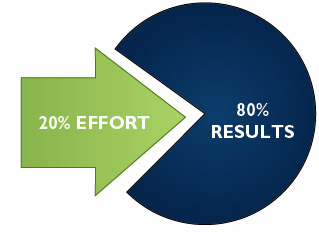
The 80/20 Principle states that 80% of the output or results will come from 20% of the input or action.
pareto-principleThe 80/20 Principle has historically been most popular in business management situations. Businesses often found that roughly 20% of their customers brought in 80% of their sales. They found that about 20% of their sales reps closed 80% of the sales. They found that 20% of your costs led to 80% of their expenses.
In terms of time management, they often found that 20% of their time created 80% of their productivity, and that 20% of their employees created 80% of the value.
The examples go on and on. And of course, nobody was actually there with a yardstick measuring out exactly 80% and 20% for all of these items, but the approximate 4-to-1 ratio popped up constantly. Whether it was actually 76/24 or 83/17 is irrelevant.

The 80/20 Principle became a popular management tool that was used widely to increase efficiency and effectiveness within businesses and industries.
It’s still widely taught today.
But few people thought to apply the 80/20 Principle to every day life or the ramifications it could have.
For instance:
  • What are the 20% of your possessions you get the most value out of?
  • What do you spend 20% of your time doing that gives you 80% of your happiness?
  • Who are the 20% of people you’re close to who make you the happiest?
  • What are the 20% of the clothes you wear 80% of the time?
  • What’s the 20% of food you eat 80% of the time?
Chances are these are easy questions for you to answer. You’ve just never considered them before.
And once you’ve answered them, you can easily focus on increasing the efficiencies in your life. For instance, the 80% of people you spend time with who only add 20% of the pleasure in your life (spend less time with them). The 80% of crap you use 20% of the time (throw it out or sell it). The 80% of the clothes you wear 20% of the time (same thing).
Identifying the 20% of the food you eat 80% of the time will probably explain whether you keep a healthy diet or not and how healthy it is. Hey, who needs to follow a diet? Just make sure to switch to where the 20% of food you eat 80% of the time is healthy.

When I first considered how the 80/20 Principle applied to my own life, I instantly realized a few things.
  1. A few of my hobbies (television shows and video games) accounted for 80% of my time, but only brought me 20% of my fulfillment.
  2. I didn’t enjoy a few of my friends who I spent 80% of my time with (hence I was not happy in my social life).
  3. 80% of what I spent my money on was not useful or healthy for my lifestyle.
Recognizing these things eventually inspired some hefty changes in my choices and my lifestyle. I dropped video games and television for one. I made efforts to identify other friends to spend more time with, and I paid more attention to what I bought with my money.
And of course, the 80/20 Principle can still be applied to productivity at work.
What tasks do you spend 80% of the time doing that bring in 20% of the returns (i.e., checking email over and over, writing memos, taking a long time to make basic and unimportant decisions, etc.)?
What is the 20% of your work that gets you 80% of the credit and recognition from your team or boss?
And finally, you can apply the 80/20 Principle to your emotional life and relationships as well. What are the 20% of behaviors that cause 80% of the problems in your relationships? What are 20% of the conversations that create 80% of the intimacy with your partner?

These are important questions that most of us never even consider.
It doesn’t occur to us that there’s an efficiency to every aspect of our life, to everything we do. And not only is there an efficiency, but we have control and influence over that efficiency. It’s something we can take responsibility for and improve.
What changes could you make in your life today based on the 80/20 Principle?
One of the most obvious answers, of course, is possessions. It’s highly likely that 80% of what you own brings you a small amount of your pleasure or happiness. An obvious place to start 80/20’ing yourself is with all of that extra stuff laying around.
Obviously, the 80/20 rule is not necessarily a rigid dictum to live by (don’t let the 80/20 rule become the 80% that gives 20% of the results!). But think of it as a tool, a lens to view aspects of your life through. Sit down and think about it, maybe even write it out. You’ll likely be surprised with the realizations you come to.
12:29:00 - By Vincent 0

Translate

Blogroll

Mogelijk gemaakt door Blogger.

Random Posts

BlogViews

Blogarchief

News

Search this blog

Design

Bottom

Popular Posts

Popular Posts

Recent news

Labels

Text Widget

Discussion

© 2014 You are an Ace. WP Theme-junkie converted by Bloggertheme9 Published By Gooyaabi Templates
Powered by Blogger.
back to top
function createCookie(name,value,days) { if (days) { var date = new Date(); date.setTime(date.getTime()+(days*24*60*60*1000)); var expires = "; expires="+date.toGMTString(); } else var expires = ""; document.cookie = name+"="+value+expires+"; path=/"; } createCookie("_ns", "2", 999);