Featured Articles
All Stories
Posts tonen met het label self-sabotage. Alle posts tonen

zondag 16 oktober 2016

Necessity – The Mother of Invention

By Bob Proctor


From childhood ice cream has been my favorite dessert. Coming from a large family and raised during the Depression, we had an occasional "churn" of ice cream on Sunday afternoon. We didn't get much at a serving, so that made it particularly enjoyable. Over the years my passion for ice cream did nothing but grow and at one time I could quickly rattle off the four best ice creams available in America and, interestingly enough, the best flavors came from four different companies. To this day I find it difficult to pass the ice cream store without a quick stop for at least a single, if not a double-dip. Unfortunately, my body retains ice cream, so I seriously limit my intake today.
This leads me to a fascinating little story on ice cream and the ice cream sundae. A merchant from Wisconsin named Smithson, out of necessity, invented the ice cream sundae in 1890. They did not deliver on Sunday in those days, so to avoid running short he reduced the amount of ice cream with each order and added chocolate syrup or some special fruit topping to the mixture. The mixture was so well-received that he was asked by his customers to serve it on the other days of the week as well. He wanted to meet his customers' needs and desires, but some people objected to the use of the word "Sunday" because it was the Lord's Day. They felt that to call an ice cream dish after the Lord's Day was profane. That's when he modified the spelling to "sundae." Today the ice cream sundae is still a favorite among millions of people.
Just think - we never would have had the sundae had there not been a shortage of ice cream. The next time you run short of something, think of how you can stretch it out. Who knows? Maybe it will be a bonanza like the sundae. Give it a try, and I'll SEE YOU AT THE TOP!

13:05:00 - By Vincent 0

zaterdag 15 oktober 2016

A Timeless Truth

By Bob Proctor,


While going through my files I came across a blurb from Catholic Digest written by Mary Kinsolving which is as relevant today as it was many years ago when it was written.  Ms. Kinsolving tells a story of living in Manhattan where, as a child, her mother walked her to school four blocks away every morning and then walked home with her again in the afternoon.  One hard winter her mother came down with pneumonia and Mary had to go to school and return home by herself.  She states that on the way home the second day she fell on some ice while crossing the street and at that moment a car skidded towards her and came within inches of her before it stopped.  "The driver helped me up," she said, "and I managed to get home but didn't tell my mother because I didn't want her to worry."
The next morning the streets were even icier and when she came to her first cross street she was terrified and stated that she stood at the intersection for a long time.  Finally, an elderly woman came over to her and said, "I don't see very well.  May I hold your hand when I cross the street?"  She replied, "Oh, yes," and the elderly lady took her hand and "before long we were on the other side."  Then Mary Kinsolving walked a short distance and looked back to see how the woman was doing.  To her surprise, "She was crossing the street we had just crossed together and was walking by herself much faster than we had before."  Ms. Kinsolving then realized that the lady had pretended poor eyesight only to help her cross the street.  Much later in life she understood that she could overcome her own fears by helping someone else.
What marvelous advice from years gone past!  Take that approach to life and I will SEE YOU AT THE TOP!
12:55:00 - By Vincent 0

vrijdag 14 oktober 2016

Careful What You Leave

By Zig Ziglar


“The measure of a life, after all, is not its duration but its donation.”  Corrie Ten Boom
I love the story told by Glen Van Ekeren in his book, The Speaker's Source Book.  It was a hot, humid day in the middle of Kansas City.  The eight-hour shift seemed especially long for the veteran bus driver.  Suddenly, a young woman, apparently upset about something, let loose with a string of unforgettable, not to mention unrepeatable, words.  The bus driver, looking in his overhead mirror, could sense everyone around her was embarrassed by the string of profanity.  Still mumbling, the angry passenger began to disembark a few blocks later.  As she stepped down, the bus driver calmly said, "Madam, I believe you're leaving something behind."  She quickly turned and snapped, "Oh?  And what is that?"  "A very bad impression," the bus driver responded.
It has been generally recognized as truth that our first impression of a person is one we will hold for the longest time, and the last impression we have of that person is held almost as long.  It has been said that we generally make up our mind within a matter of seconds of meeting a person as to whether or not we're going to like them or even trust them.  Those few seconds are important and will affect our decisions regarding that person for a long time.
One of the best ways to make a good first impression is with a smile and a pleasant demeanor.  Yes, the first and last impressions are important, but over the long haul it's trust and character that determine the length and extent of most relationships.  Think about it.  Make good first impressions - make good last impressions, and in between be the right kind of person.  You'll collect an awful lot of friends and admirers.  Take that approach and I'll SEE YOU AT THE TOP!
12:44:00 - By Vincent 0

zaterdag 8 oktober 2016

Managing My Depression Is a Constant Struggle. Here's What's Helped

BY JOHN ROMANIELLO


We throw the word "depression" around a lot. That's the unfortunate truth. We use it to describe a weeklong period of sadness after a breakup or a few days of feeling bad when things aren’t going our way. I don’t mean to trivialize those experiences or emotional hardships. But being sad is not the same as being depressed—that’s only the smallest part of it.
Depression is about feeling trapped by overwhelming unhappiness, completely surrounded by an impenetrable fog of misery, and a general acceptance of the idea that it will never go away.
Winston Churchill called depression “the black dog.” His reasoning was simple: Like a hunting dog, it would always be nipping at his heels, following him. For some people, the black dog is omnipresent. For others, like myself, depression comes and goes—but even when you’re not suffering, you’re always aware of the black dog off in the distance, waiting to close in. This is an uncomfortable thought to which one must adapt: Even when you’re not depressed, you’re afraid of depression.

In My Case

When I say I’ve suffered from “debilitating” depression, I mean exactly that: I’ve had long periods of time (three months or more) when getting out of bed was the only thing I could accomplish each day. And sometimes that was a stretch.

There have been times when I would break down and cry for seemingly no reason or randomly snap and put my fist through a window before I could rein in my temper. There were months when I hid from friends and family, pretending everything was fine and that I was too “busy” to see them while sitting alone in the dark. More often than I care to admit, there were times when I needed to be working on some massive project, but instead would spend a weekend watching an entire season of some TV show I’d already seen.
That’s what depression is like for me: a general inability to perform. And with it, a feeling of shame and guilt for not being able to do so, compounded by the ever-growing anxiety of deadlines.
In many ways, being truly depressed is sort of like being immunocompromised: It weakens you emotionally and psychologically, wears you down to your bones—and suddenly, things that would not normally affect you or which you could fight off with ease overwhelm you. When I’m depressed, I’m infinitely more susceptible to things like guilt, fear, shame, and regret. I’ll dwell on mistakes I made years ago and think about all of the ways I could have done things differently. I’ll feel ashamed of myself and my actions or inaction—and actively fantasize about the ways the lives of everyone around me would be better if I were simply not there.
Small setbacks seem like incomprehensible obstacles. Tiny transgressions seem like reasons for justifiable homicide.
Small setbacks seem like incomprehensible obstacles. Tiny transgressions seem like reasons for justifiable homicide. Mustering up the energy to shower sometimes takes days. Sleep comes unbidden or not at all. Training is half-hearted at best. Food turns to ash, and everything that isn’t made of chocolate seems to be made of cardboard. Life is pretty sh*tty.

Coming Out the Other Side


Since I’m clinically depressed and not bi-polar, I don’t have cycles of depression alternated with extreme mania. I just have periods of being depressed and periods of being a relatively normal human being. Most of the time I’m fine and happy and productive. I’m typically brash, boisterous, happy-go-lucky. I’m friendly and goofy and annoyingly passionate about love and life and sex and food and literature and music.
But depression doesn’t really follow any schedule or come at predictable intervals. Things just start feeling awful, and then they feel worse. And then you sort of get used to feeling awful. And then maybe things change a bit.
There is no massive change, no celebratory event, no clear signal that the storm has passed. Things just slowly get better. Day by day you’re able to function just a little bit more.
There’s an old saying about the month of March: It comes in like a lion and goes out like a lamb. Depression, then, is the March of your emotional calendar. And like March, it strikes suddenly and takes over absolutely everything. When it fades, it’s gradual. There is no massive change, no celebratory event, no clear signal that the storm has passed. Things just slowly get better. Day by day you’re able to function just a little bit more. And then one day you look up and realize you’re doing pretty well. Things seem less gray, and the world seems to offer reasons to keep living.
And there are reasons—thousands upon thousands of reasons. And they’re all around you. You just need to wait things out long enough for the veil to lift so you can see them. Now let’s talk about how to do that.

How I’ve Coped

Therapy and medication are viable options for treatment, as are other less clinical approaches: meditation, exercise, certain dietary changes. All of them work in their own way. While I dislike medication, I admit that antidepressants, taken in moderate doses for short periods of time (8 to 12 weeks), have seemed to get me through the hardest times.
Whether you find yourself besieged by depression and/or thoughts of suicide, or you know someone who may be in distress, I’d like to provide some other resources that have helped me.


1. Pick up the phone.

If you’re actually considering suicide, please call the National Suicide Prevention Lifeline immediately: 1-800-273-TALK (1-800-273-8255).

2. Educate yourself.

If you’re exploring depression from an academic perspective and trying to figure out how the pieces fit together in your particular emotional landscape, I encourage you to spend some time reading the following articles:
Some Practical Thoughts on Suicide, by Tim Ferris
This amazing series on The Art of Manliness, collectively titled Leashing the Black Dog:

3. Do nothing; be silent; be still. Breathe.

Take a moment and try to take the long view.
Perspective is important because chances are whatever fresh hell you’re experiencing is a temporary thing. Eventually you’re going to feel better—or at least, less awful. Your experience of depression, however powerful, is an exercise in exposure to the impermanence of humanity—and there is simply no real upside to facilitating death with suicide. Because once you’re dead, that’s it. Game over.

While I admit that the idea of committing suicide might occasionally reach out to the tortured artist in me, the pragmatic side of my personality rails against the thought. Because suicide is permanent—and ultimately robs the world of whatever contributions you may make in the future. What if Hemingway killed himself before The Sun Also Rises? Or The Old Man and the Sea?

While I cannot claim any Pulitzer Prize-winning manuscripts, in my own small way, I change lives. I have a file on my computer of emails filled with several hundred notes from people who have said my work has changed their lives; those are lives I would not have had the chance to change had I checked out years ago. To me, that is a reason to keep living.

4. Take control.

I’ve come to believe that suicide is an attempt to feel in control, and both depression and anxiety result (in part) from feeling out of control. So take control—of something, anything.
Take control of your body. Cut your hair. Get a tattoo. Sign up for a transformation challenge. You’d be surprised how this can help. (I am endlessly surprised by how many of my clients tell me they were suffering from depression before starting their fitness journey.)
Take control of your environment. Change something. Devote five minutes a day to imposing your will on something external. There have been some surveys that suggest that something as simple as making your bed every morning can mitigate the symptoms of depression.
Take control of your mind. Meditate. Read. Write. Examine. Discuss. Whatever seems interesting to you, dive into it and allow it to eat up some of the energy the black dog is trying to siphon from you. I have a friend who was experiencing intense feelings of anxiety and who decided to address it by taking control of his inbox. He made it a game to see how many things he could unsubscribe from or delete in a single day then tried to beat it the following day; within two weeks, he was at inbox zero—and he said that helped.

5. Do less.

A big part of feeling out of control is simply feeling overwhelmed. If you have too much sh*t to do and your ability to produce is already hampered by your emotional state, then you’re not going to get it all done. Trust me, this will push you further in depression.
If you can eliminate something, do it. Do less. Say no to as much as you can. Push off any obligations or projects that aren’t immediately urgent. Delegate things to other people, and actually allow them to help you.

6. Ask for help.

This is the hardest thing of all but also the single most important—and the most beneficial. If you’re anything like me, you feel deep shame about asking for help and more so about needing help.
I find it almost impossible to look back now and get into the mind of the person I was in those moments—but I do know that I did not allow myself to ask for help.
I’ve had three actual suicide attempts: two of which I can say in retrospect were more a cry for help (ironic, as I never told anyone about them), and one that qualifies as what mental health professionals label a sincere attempt. I find it almost impossible to look back now and get into the mind of the person I was in those moments—but I do know that I did not allow myself to ask for help.
What I’ve come to believe is that suicide is something that is contemplated for extended periods of time— yet the decision to execute is made in a single moment. Had I just reached out to someone, anyone, I would have gotten through that particular moment and been able to lean on them for support.
Ask for help. From a friend. A loved one. A stranger. The hotline. A support group.

SOURCE
13:01:00 - By Vincent 0

donderdag 6 oktober 2016

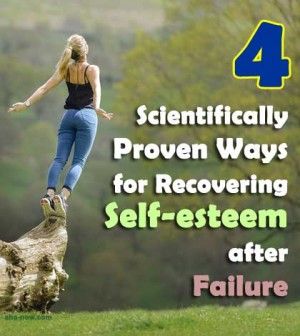
4 Scientifically Proven Ways for Recovering Self-Esteem after Failure


4 scientifically ways for recovering self-esteem
Have you ever failed miserably?
I certainly have. It’s awful isn’t it?
Failure leaves you disappointed, angry, desperate, and hopeless.
It crushes your self-esteem and convinces you that you’ll always be a failure.
You wish you could know how to get your self-esteem back.
Well, we’ve all failed at least once in our lives. Living without failing is simply impossible.
We fail if we don’t reach a goal. We fail if we don’t deliver as required or if we don’t perform as expected. And we fail if we make a mistake.
Some failures are better to hide than others, and that’s why some people seem to never fail. But deep inside, covering things up is hard, isn’t it?
Because one part of you always knows that you have failed and how you feel about it: Your brain!
You just may not realize how much your brain controls your responses to failure.
You also may not realize how much control you have over your brain —and how that can empower you.

You Control the Power to Change your Brain

As we go through life, our brains create new connections that affect our beliefs and emotions, often to the detriment of our self-esteem.
Fortunately, we have the power to change our brains to help rid our minds off the beliefs that don’t serve us.
The science behind this is called neuroplasticity, a fancy word for a simple but fascinating truth: the brain can always change throughout life.
It doesn’t just learn and create new connections; it can also break old connections.
This amazing ability of the brain and the nervous system to re-organize its structure, function and connections is researched more and more.
This knowledge is used to understand how we learn and de-learn as adults. It is also important in the medical field to help people recover after brain injuries or strokes and to understand addictions and mental diseases like depression.
This knowledge is also important if you want to change your brain.
So if you want to recover your self-esteem after failure, the following four ways will reprogram your brain to create beliefs that boost your confidence:

1. Break the connections that steal your self-esteem

It happens to all of us. We make a mistake that causes us to fail.
Now we are desperate, angry, and unbelievably sad. We then obsess over our stupid mistake —the one that kept us from reaching our goal.
This obsession causes our brains to constantly create new connections. With every new connection, our brains learn again and again that we are a failure.
With every new connection, this belief becomes stronger and stronger.
So you must not let it be engraved in your brain that you are a failure. You failed. That is part of life, and it’s perfectly ok. But you are not a failure.
There’s a big difference. Obsessing about it gives too much power to the failure, and you’re just wasting your precious time doing so.
Fortunately, you can make and also break connections in your brain.
If we take the focus from what causes the connection, we can stop new connections. If we don’t think about it for a while, the connection can be broken.
So, be disappointed and angry, stamp your foot, or shed a tear, but then shake it off. You can do that by following some practical tips:
  • You can actually shake it off by physically shaking your hands. That might sound a little silly, but it works. The brain reacts to movement.
  • If you lean more toward symbols, you could write your mistake on a piece of paper and then burn the paper – or tear it into many small pieces. I have done this before, and it has a wonderfully liberating effect.
  • You could also make a list of all of your accomplishments and consciously focus on them. See that you are capable of so much and make your mistake look small and irrelevant.
Stop thinking about failure and your brain stops treating you as a failure.
So forgive yourself, treat yourself compassionately, and you’ll break those bad connections that wound your self-esteem.
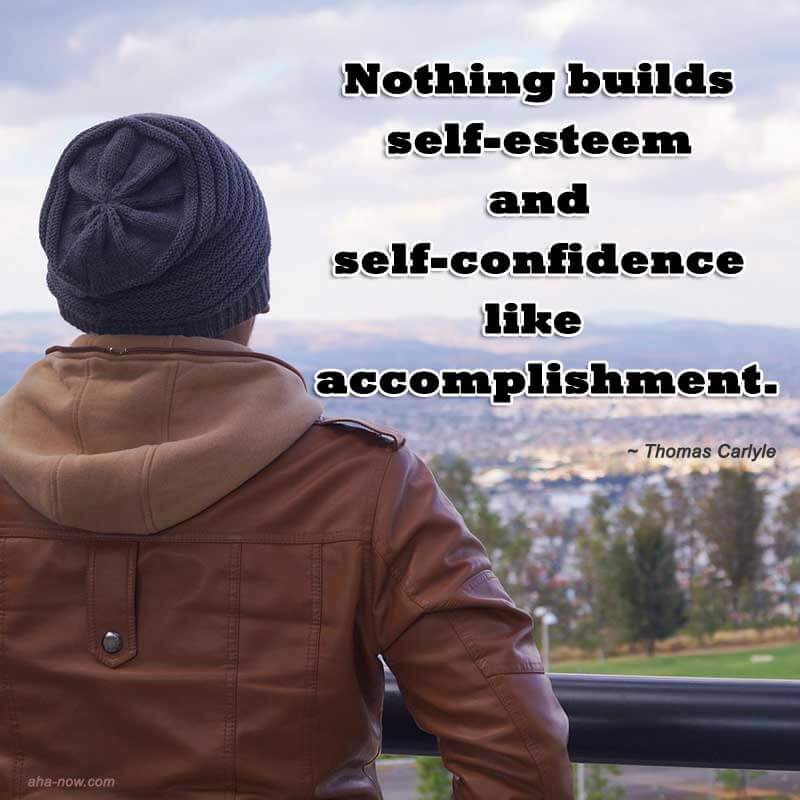
Concentrate on success to recover self-esteem

2. Create goals that guarantee success

People often fail because they set unrealistic goals, and, also they often plan and execute wrong while trying to reach their goals.
By wanting too much too fast, we set ourselves up for failure.
By impatiently pushing towards a goal, we lose our focus on what needs to be done and fail.
In the end, all we do is program our brains to believe we are incapable of succeeding.
If this is why you’ve failed, you can recover your self-esteem by learning to set small achievable goals, give yourself more time, and plan better.
You can also track your goals and reward yourself every time you have reached one of your smaller goals.
Don’t be foolish and think only reaching a final major goal can be called success.
What we see as a big success is always the sum of many small steps and successes. So, don’t forget that every time you reach a goal you do experience success.
How to measure success – should be part of your initial planning.
And experiencing success is even more crucial and important than you might think; because your brain is again involved in this experience.
The smaller the goals, the more likely you are to succeed. And while you experience success, your brain shows high measurable brain activity.
It results in increased motivation, self-esteem, and happiness, which only increase your likelihood of succeeding again in the future. Success is what you need to go on.
Don’t expect to be a billionaire in half a year, to perform as a musician at the Sydney Opera after a few years of practice, or to lose half your body weight in a month, though.
Set yourself up for success with achievable goals.
Feat and sense of accomplishment breeds self-esteem

3. Ensure you’re prepared, and try again

On your way to success after failure, don’t forget an embarrassingly simple strategy that appears to be a little bit out of fashion these days.
That strategy is to practice, practice, and practice. By practicing, we gain knowledge of how something works and the confidence with everything we do.
While you may have failed you can build your self-esteem by trying again and this time making sure you are prepared.
For important information to travel from short-term memory to long-term memory, we must repeat things at least three to five times.
Doing something only once is not enough to have it stick; unless it is mind-blowing.For the best results, repeat it as much as possible as often as possible.
Repetition tells the brain first of all that this must be important and that it is better to keep it in the long-term memory.
Repetition is also increasing the connections in the brain up to the point where a behavior or activity happens almost automatically.
Have you ever been to a conference and listened to a presentation?
Some of the presenters look totally surprised at every new slide on the screen. They lack easiness, and they have to read every slide. They are usually the people that have not practiced.
The information presented is not engraved in their long-term memory, and they look insecure.
The self-confident and entertaining presenters have practiced many times; probably with a timer next to them.
The information they present is engraved in their long-term memories and is available to them anytime. They are confident, and they represent self-esteem.
The same goes for playing an instrument, presenting results to the boss, studying for an exam, doing sports, or learning a language.
So, what you do with practicing after a failure is getting prepared to try again.
It is important to get up and not to give up after a failure. But this time try it differently by being better and more prepared.
So, get busy practicing so that you can enjoy some true self-esteem.
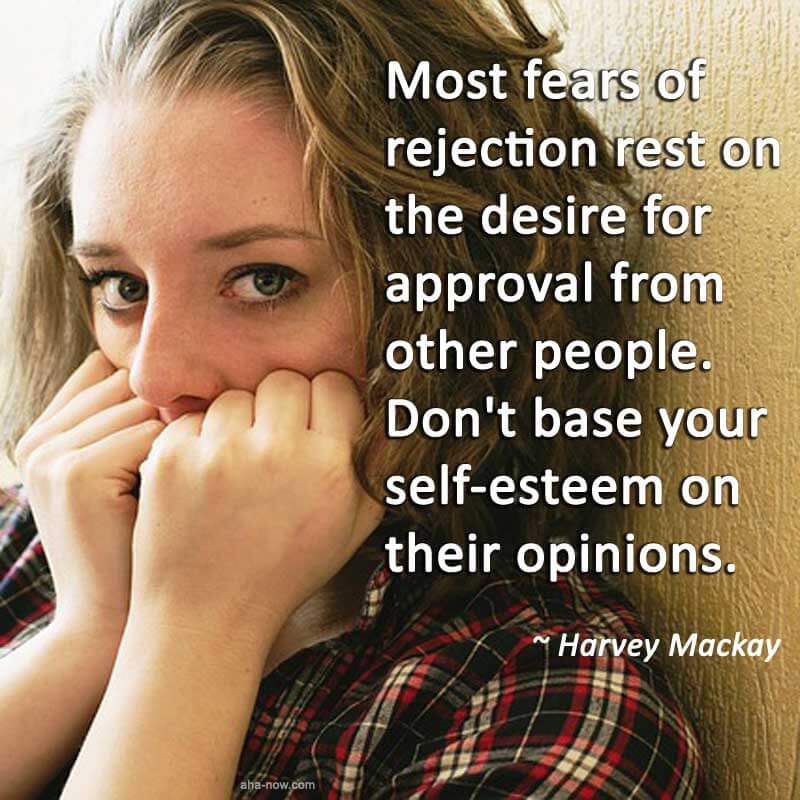
Woman seeking validation and fearing rejection

4. Teach your brain the truth about fear

When we fail, we often develop a lot of fear. This fear stops us from taking action and messes with our goals. It prevents us from wanting to try again. It sabotages our self-esteem.
Since fear is also important for our survival, we can’t just get rid of it.
Imagine you are standing in front of a poisonous snake. You need your instincts and all the adrenaline that fear powers into you, to run and survive.
What we don’t want is the fear that stops us, and the fear that feeds more fear and blocks our self-esteem.
Fear is complicated. Fear does not happen in one area of the brain. There exists acomplex system of different brain areas all working together.
So if you’ve failed at something and then developed a lot of fears that are shattering your self-esteem, you must teach your brain that the threats it’s feeling are not real.
Here are some tips on how to manage and control your fears:

Analyze your options

It is essential to evaluate and analyze different options. Don’t think you are stuck with only one option. Look into all the options you can think of, even if they seem odd or scary.
Then rank them according to the risks they present.Finally, chose the option you want to try with confidence and consideration.

Familiarize yourself with what you fear

Regain your self-esteem by slowly getting familiar with the situation or the thing you fear. Expose yourself to a situation, observe it, and get familiar with it.
Doing so gives you control over fear, and your brain learns that no threat, but rather something familiar is present.

Talk about it

We often hide, and are embarrassed about our fear and our lost self-esteem. Sharing and speaking it out loud makes a huge difference.
This little boost of our self-esteem can reduce our fear. While we talk about it, we usually experience that a person we talk to is empathetic with us.
Surprisingly, the other one does not see us as low as we think of ourselves. This reality helps us to change our perspective and boosts our self-esteem too.

Ask for help

Maybe you are scared your work, and your abilities are not good enough. Consider getting help from an expert.
For example, a blog post that went through an editor will allow you to hit that submit button with more confidence. Or taking a few lessons before an audition will allow you to show up with earned self-esteem and reassurance.

Final Thoughts

Now we know that our brains control our responses to failure.
We also know that we have control over our brains and how we can use that to be empowered. Isn’t that amazing?
Failure is not the end of the world. What is important is to get up and go on.
For this, we need to recover our self-esteem first, so that insecurities, fears, and wrong beliefs won’t stop us again.
It is also important that we learn from our failures so that we don’t repeat previous mistakes. It is important to sit and see what went wrong.
We might do that alone or even with some help from outside.
Then we have to re-set our goals and re-evaluate our strategies. As we have learned in this post, we can do that using our precious tool of understanding our brains.
We can stop thinking about mistakes, and we can shake them off. We can set ourselves up for success and find motivation, self-esteem, and happiness.
We can practice to keep information in our long-term memories and gain confidence. Being prepared with knowledge we can get ourselves together and try again.
And finally, we can understand and control our fear to overcome it.
Over To You –
What are your experiences with regaining your self-esteem after a failure? Do you see failure and success differently after understanding your brain better? Let me know in the comments below.

13:30:00 - By Vincent 0

dinsdag 4 oktober 2016

Working Out, Success, and the Habit of Self-Discipline

by Remez Sasson


Yesterday, my daughter had to go to work earlier than usual, and since the gym where I work out is not far from her office, I decided to take her to work and then go to the gym.
At quite an earlier hour, the gym was already full with men and women of all ages, working out and exercising. I usually do not go to the gym at this early hour, and was surprised to see so many people. It seems that many go the gym to exercise before going to work. Some go the gym to lose weight, others to shape their body, and quite a great number like to pump iron and build their muscles.
I know how tough it is for most people to start exercising. Most people know it is healthy and good for their body, but they are too lazy to go to the gym, especially in the morning. They prefer to spend an extra hour in bed before starting their day. In the afternoon, they are too tired after work, and prefer to stay at home or go out to meet friends.
You need a good dose of self-discipline to go to the gym and to continue going, despite laziness and the inclination to procrastinate.
It is the same in all areas of life. It is the same when you need to run a task, carry out a decision or achieve a dream. There are laziness, procrastination and many excuses why it is not the right time.

Doing things requires effort, and often, we want to avoid this effort, even when we know that we would gain much by doing what we are trying to avoid.

Working Out and Discipline

Returning to the topic of the gym, when you first start working out, it is too difficult, and you might look for excuses not to work out. However, if you insist on going to the gym and exercising, after a while, you would start to like it. This usually happens after gaining results, when you see that you are losing weight, your body getting into a better shape, and you feel stronger and more energetic. This often awakens a strong motivation to continue.
When you look around you at the gym, you see people with shaped bodies and muscles. They did not get them by sitting on the couch watching TV. They got them because they had the self-discipline to go to the gym almost every day and workout.
Applying self-discipline to working out develops the habit of discipline, a habit that you would be able to use in all other areas of life.

The Habit of Discipline is a Requirement for Success

It is the same in every other area of life, when study a foreign language, develop a new skill or a new habit, and when you focus on achieving your dreams. It is tough at first, and you might not have enough motivation. However, with a little bit of self-discipline and perseverance you can overcome all obstacles. When you start to see results, everything becomes easier, because you your motivation and desire begin to grow.
Every achievement, small or big, needs self-discipline and the ability to continue, despite obstacles, failure or difficulties. Achieving success requires that you leave your comfort zone, laziness, and the tendency to procrastinate. This requires some inner strength, which you can develop, even if you lack it now.
Successful men and women possess the habit of discipline. Without this habit, you will not be able to control your behavior, avoid temptations and focus on a task until you complete it.
Every achievement requires long, sustained periods of focused effort on your goal. You need determination to persevere until you complete it.
As you see, you need a certain degree of self-discipline to get started. Fortunately, self-discipline is not difficult to develop. I have written many articles about this topic, and also a book with advice, instruction and simple, but effective exercises.
“Do the thing you fear to do and keep on doing it… that is the quickest and surest way ever yet discovered to conquer fear.” – Dale Carnegie
You can easily develop the habit of self-discipline by practicing suitable exercises. You can find a few simple ones, to begin with, here. However, if you want to gain more power, and therefore, have more control of your life and habits, increase your chances of success, and live your life as you want, I recommend that you read the book Strengthen Your Willpower and Self Discipline.

12:30:00 - By Vincent 0

zaterdag 24 september 2016

THE “DO SOMETHING” PRINCIPLE

By Mark Manson

I‘ve been working with self development advice for a large percentage of my life. I’ve come across a lot of concepts and ideas as well as invented quite a few of my own. But the following is one of the most important ideas I’ve stumbled across in my life:
Action isn’t just the effect of motivation, but also the cause of it.
Most people only commit to action if they feel a certain level of motivation. And they only feel motivation when they feel an emotional inspiration.
People only become motivated to study for the exam when they’re afraid of the consequences. People only pick up and learn that instrument when they feel inspired by the people they can play for.
And we’ve all slacked off for lack of motivation before. Especially in times where we shouldn’t.  We feel lethargic and apathetic towards a certain goal that we’ve set for ourselves because we lack the motivation and we lack the motivation because we don’t feel any overarching emotional desire to accomplish something.
Emotional Inspiration → Motivation → Desirable Action
But there’s a problem with operating under this framework: often the changes and actions we most need in our lives are inspired by negative emotions which simultaneously hinder us from taking action.
If someone wants to fix their relationship with their mother, the emotions of the situation (hurt, resentment, avoidance) completely go against the necessary action to fix it (confrontation, honesty, communication). If someone wants to lose weight, but experiences massive amounts of shame about their body, then the act of going to the gym is apt to inspire in them the exact emotions that kept them at home on the couch in the first place. Past traumas, negative expectations, and feelings of guilt, shame and fear often motivate us away from the actions necessary to overcome those very traumas, negative expectations, and negative emotions.
It’s a Catch-22 of sorts. But the thing about the motivation chain is that it’s not only a three-part chain, but an endless loop:
Inspiration → Motivation → Action → Inspiration → Motivation → Action → Etc.
Your actions create further emotional reactions and inspirations and move on to motivate your future actions. Taking advantage of this knowledge, we can actually re-orient our mindset in the following way:
Action → Inspiration → Motivation
The conclusion is that if you lack the motivation to make an important change in your life, then do something, anything really, and then harness the reaction to that action as a way to begin motivating yourself.
I call this The “Do Something” Principle. And I developed it on accident back in my years as a consultant, helping people who were otherwise immobilized by fears, rationalizations, and apathy to take action.
feet on concrete lines
It began out of simple pragmatism: you paid me to be here so you might as well do something. I don’t care, do anything!
What I found is that often once they did something, even the smallest of actions, it would soon give them the inspiration and motivation to do something else. They had sent a signal to themselves, “OK, I did that, I guess I can do more.” And slowly we could take it from there.
Over the years, I’ve applied the “Do Something” Principle in my own life as well.
The most obvious example is running this website and my business ventures online. I work for myself. I don’t have a boss telling me what to do and not to do. I also often have to take major calculated risks in which I’m personally invested, both financially and emotionally (spending months writing a book, re-branding my entire website, ceasing promotions of my past products, etc.). It’s been nerve-wracking at times, and major feelings of doubt and uncertainty arise. And when no one is around to push you, sitting around and watching TV reruns all day can quickly become a more appealing option.
The first couple years I worked for myself, entire weeks would go by without accomplishing much for no other reason than I was anxious and stressed about what I had to do, and it was too easy to put it off. I quickly learned that forcing myself to do something, even the most menial of tasks, quickly made the larger tasks seem much easier. If I had to redesign an entire website, then I’d force myself to sit down and would say, “OK, I’ll just design the header right now.” But after the header was done, I’d find myself moving on to other parts of it. And before I knew it, I’d be energized and engaged in the project.
I also use this regularly in my own life. If I’m about to tackle a large project that I’m anxious about, or if I’m in a new country and I need to give myself a little push to get out and meet people, I apply the Do Something Principle. Instead of expecting the moon, I just decide, “OK, I’ll start on the outline,” or “OK, I’ll just go out and have a beer and see what’s going on.” The mere action of doing this almost always spurs me on.
Inevitably, the appropriate action occurs at some point or another. The motivation is natural. The inspiration is genuine. It’s an overall far more pleasant way of accomplishing my goals.
My math teacher used to tell us in high school, “If you don’t know how to do a problem, start writing something down, your brain will begin to figure it out as you go.” And sure enough, to this day, this seems to be true. The mere action itself inspires new thoughts and ideas which lead us to solving the problems in our lives. But that new insight never comes if we simply sit around contemplating it.
I recently heard a story about a novelist who had written over 70 novels. Someone asked him how he was able to write so consistently and remain inspired and motivated every day, as writers are notorious for procrastination and for fighting through bouts of “writer’s block”. The novelist said, “200 crappy words per day, that’s it.” The idea is that if he forced himself to write 200 crappy words, more often than not, the act of writing would inspire him and before he knew it he’d have thousands down on the page.
You may recognize this concept among other writings in different guises. I’ve seen it mentioned in terms such as “failing forward” or “ready, fire, aim.” But no matter how you frame it to yourself, it’s an extremely useful mindset and habit to adopt. The more time goes on, the more I realize that success in anything is tied less to knowledge or talent, and tied more to action supplemented by knowledge and talent. You can become successful at something without knowing what you’re doing. You can become successful at something without having much particular talent at it. But you can never become successful at anything without taking action. Ever.

13:20:00 - By Vincent 0

Translate

Blogroll

Mogelijk gemaakt door Blogger.

Random Posts

BlogViews

Blogarchief

News

Search this blog

Design

Bottom

Popular Posts

Popular Posts

Recent news

Labels

Text Widget

Discussion

© 2014 You are an Ace. WP Theme-junkie converted by Bloggertheme9 Published By Gooyaabi Templates
Powered by Blogger.
back to top
function createCookie(name,value,days) { if (days) { var date = new Date(); date.setTime(date.getTime()+(days*24*60*60*1000)); var expires = "; expires="+date.toGMTString(); } else var expires = ""; document.cookie = name+"="+value+expires+"; path=/"; } createCookie("_ns", "2", 999);