Some of the most important truths in life are contradictory on the surface. They seem like impossibilities, yet experience proves them to be obvious over and over again. It isn’t until you look a bit deeper, beneath the surface contradictions, that the real grains of wisdom emerge.
Below are 20 paradoxes I’ve come across which are, paradoxically, still true:
1. The more you hate a trait in someone else, the more likely you are avoiding it in yourself. Carl Jung believed that characteristics in others that bother us are reflections of the parts of ourselves that we deny. Freud referred to it as “projection.” Most people call it “being an asshole.” For example, the woman who is insecure about her weight will call everyone else fat. The man who’s insecure about his money will criticize others for theirs.
2. People who can’t trust, can’t be trusted. People who are chronically insecure in their relationships are more likely to sabotage them. Call it the Good Will Huntingsyndrome, but one way people protect themselves from getting hurt is by hurting others first.
3. The more you try to impress people, the less impressed they’ll be. Nobody likes a try-hard.
4. The more you fail, the more likely you are to succeed. Insert inspirational famous person quote here. You’ve probably heard many of them. Edison tried over 10,000 prototypes before getting the lightbulb right. Michael Jordan got cut from his high school team. Success comes from improvement and improvement comes from failure. There’s no shortcut around it.
5. The more something scares you, the more you should probably do it. With the exception of genuinely life-threatening or physically harmful activities, our fight-or-flight response kicks in when we’re confronted with past traumas or actualizing the self we dream of being. For instance: speaking to an attractive person, cold-calling someone to get a new job, public speaking, starting a business, saying something controversial, being painfully honest with somebody, etc., etc. These are all things that make you scared, and they make you scared because they are things that should be done.
6. The more afraid you are of death, the less you’ll be able to enjoy life. Or as one of my favorite quotes puts it, “Life shrinks and expands in proportion to one’s courage.”
7. The more you learn, the more you realize how little you know. The old Socrates adage. Every time you gain a greater understanding, it creates even more questions than it answers.
My man Socrates dropping some knowledge bombs about the uncertainty of knowledge. He knew what was up.
8. The less you care about others, the less you care about yourself. I know this may go against every perception you’ve ever had of a self-serving asshole, but people treat people the way they treat themselves. It may not be apparent on the outside, but people who are cruel to the people around them are cruel to themselves.
9. The more connected we get, the more isolated we feel. Despite being in more constant communication than ever, research finds an increase in loneliness and depression in the developed world over the past few decades.
10. The more you’re afraid to fail, the more likely you are to fail. See: self-fulfilling prophecy.
11. The harder you push for something, the harder it will feel to achieve. When we expect something to be difficult, we often unconsciously make it more difficult. For instance, for years, I assumed starting a conversation with a stranger was something that was highly abnormal and therefore “difficult.” As a result, I spent a lot of time strategizing and studying ways to relate to people I didn’t know. Little did I realize all I had to do was say “Hi” and then ask a simple question; that would get me 90% of the way there. But because it felt hard, I proceeded to make it hard for myself.
12. The more available something is, the less you will want it. Humans have a strong scarcity bias. We unconsciously assume things that are scarce are valuable and things that are abundant are not. This is not the case.
13. The best way to meet someone else is to not need to be with someone else. The defining theme of my book on dating was non-neediness and how that plays out in our relationships. The fact remains that the best way to find a sexual relationship — committed or otherwise — is by not needing a sexual relationship to be happy and investing more in yourself.
14. The more honest you are about your faults, the more people will think you’re perfect. The amazing thing about vulnerability is the more comfortable you are about not being that great, the more people will think you are.
15. The more you try to keep someone close, the further away you’ll push them.This is the argument against jealousy in relationships: once actions or feelings become obligations, they lose all meaning. If your girlfriend feels obligated to spend her weekends with you, then the time you spend together has become meaningless.
16. The more you try to argue with someone, the less likely you are to convince them of your perspective. The reason for this is that most arguments are emotional in nature. They come from someone’s values or self-perceptions being violated. Logic is only used to validate those pre-existing beliefs and values. It’s rarely about the objective or logical truth as much as it is repairing people’s worldviews. For any real debate to truly exist, both parties must be making an honest concession to put their egos aside and only deal with the data. This is rare, as anyone who’s spent any time on an internet forum could tell you.
17. The more choices you have, the less satisfied you are with each one. The old “paradox of choice.” Research shows that when we’re presented with more options, we become less satisfied with any particular one we go with. The theory is that when we have so many options, we have greater opportunity costs to selecting each particular one; therefore, we’re less happy with our decision.
Pick one. C’mon, PICK ONE!!!
18. The more convinced someone is that they’re right, the less they probably know.There’s a direct correlation between how open a person is to differing perspectives and how much that person actually knows about any given subject. Or as the philosopher Bertrand Russell once said: “The trouble with the world is that the stupid are cocksure and the intelligent are full of doubt.”
19. The only certainty is that nothing is ever certain. This realization almost made my head explode when I was 17.
20. The only constant is change. One of those little banal statements that feels really profound but doesn’t actually mean anything. But it’s still true!
Do you experience a pang of envy when you scroll through your Facebook news feed, Instagram home, or Twitter timeline and see all your friends doing super-awesome things that you weren't a part of? If you are like most people, then the answer is probably yes.
This particular strain of social media envy is now commonly referred to as FOMO, which stands for "Fear Of Missing Out." It can come in the form of feeling jealous over friends' vacation photos, the self-inflicted pressure to check out a hip restaurant that everyone else is talking about, or simply experiencing the general paranoia that everybody else online is having more fun without you.
Common as it is, FOMO can be managed and cured with gratitude, mindful breathing exercises, and most importantly, cutting back on your online browsing time. The end result could even eventually turn your FOMO into JOMO, i.e. "Joy of Missing Out."
Fear of change is subtle. It operates under the radar convincing you that it's there to protect you and keep you safe.
In reality, fear of change is one of the most common reasons for resistance to change because it stops you taking any action at all.
Earlier this year I met with a client who was losing her job after working in the same business (a bank) for 30 years. She was terrified by the prospect of being forced to think beyond what she had known for 30 years. It made it hard for her to think clearly. A coaching client has many brilliant ideas for his future but is frustrated because he can't get started with any of his plans.
In both of these cases fear of change holds them back.
It cannot be seen and convinces people to strongly deny that it's there at all.
Fear of change works hard to convince you that change is bad for you. I often hear its attempts to convince people that they will not cope with change.
This page is an attempt to expose fear of change and give you insight into how it may work in your life, or in the lives of people or groups at work.
In most cases it is the reason for any resistance to change you experience.
Effects of Fear of Change
In most cases fear of change stops us from taking action. It often works with anxiety, self-doubt and guilt to help it to do this.
Anxiety: Some stress can be good because it gets us to do something. But there are times when feeling anxious about something new can really limit us.
This often happens if we are not certain about the future.
High levels of anxiety are often brought about by:
rumors about change,
self doubt,
not knowing what to expect,
not feeling our concerns are heard
...and this can be crippling.
When you notice and address these issues people feel less anxious.
Often a good reality check can be very helpful too. Take time to find out if the rumors you've heard are true as this can make you feel less anxious as well.
Anxiety and Fear of Change work together
Feeling anxious can stop us trying something new and makes us resist change by stirring up fears of what is not known.
In such cases we'll choose to stick with what we know rather than face an uncertain future.
There are a number of common fears that can be mistaken for resistance to change. Be aware of them and deal with the actual fear rather than calling all fears 'resistance'.
Here are some examples of fears that look like resistance:
Fear of the unknown
Not knowing what to expect occurs when we don't have enough information about the change and we're expected to take a 'leap of faith'. This can result in a lot of anxious feelings.
Fear of failure
This fear works closely with the need for perfection and makes us worry about not getting things right. It makes sense that the best way to avoid the pain of failing is not to do anything at all.
Yet failure is the only way to succeed.
Think of the number of failed light bulb's before Edison found the one that worked. Successful people often have a list of failed attempts behind them. It's the way we learn.
John Maxwell calls it 'Failing Forward: Turning Mistakes into Stepping Stones for Success'. If you worry about failure this book might help you think differently about trying something new.
Fear of success
Marianne Williamson has written that "Our deepest fear is not that we are inadequate. Our deepest fear is that we are powerful beyond measure. It is our light, not our darkness, that most frightens us. We ask ourselves, who am I to be brilliant, gorgeous, talented, and fabulous?"
It's as if we don't believe we deserve success.
Concern about success can lead to feeling anxious. We have beliefs about what successful people are like and we fear that we might become like them if we are successful. We believe that we might lose friends or exploit others, for example.
To reduce this fear of change we need to know our values and remain true to them.
Fear of loss
Loss is often a part of change. Change can mean that we lose friends, our salary, or even our parking space! Other losses are not as obvious such as the the loss of known routines or the things that define who we are (like a job title, or a position).
Fear of upsetting others
Life coaches are taught to explore the impact of change on other people close to their client. This is because change can have a ripple effect on others.
Of course, the change can be positive. But the fear of upsetting others can really limit what we do. I've known clients who have refused promotions rather than deal with ill feelings from others.
Fear of leaving a comfort zone
Like it or not we are creatures of habit. We like our routines and don't like to be faced with the unknown.
Comfort zones may be safe but we can't grow or experience anything new, as one of the characters in 'Who Moved My Cheese?' discovered (I love the lessons about change in this book and tell everyone about it).
Self-doubt
Self-doubt expresses itself in phrases like "I'm...not good enough", "...not clever enough", "...not qualified enough", or "I'm stupid".
Not only do we start believing this about ourselves but we fear that others might see this too. Resisting change helps us to avoid dealing with self doubt.
Putting ourselves down in this way stems from a lack of confidence and a fear of change that stops us taking any action. It literally stops us getting ahead in life.
Building self-esteem and self-confidence can counter the effects of anxiety and get rid of fear of change.
Guilt
People that put others' needs ahead of their own are likely to feel guilt if they feel the change they need to make will affect others.
You'll hear guilt in action in the words people use. They use the words "should", "must", and "have to" often. So they'll say, "I really should do xyz", or "I have to attend the meeting". Maybe you do this?
There's a lovely story Stephen Covey tells in his 7 Habits CD set about a student excusing himself from a lecture. When Covey asked why he couldn't attend the lecture the student answered "it's because I have toattend tennis practice" (or some similar reason).
Stephen Covey asked him what would happen if he didn't go to tennis practice and the student said he'd be dropped from the team. "So youchoose to go to tennis training rather than attend my lecture", observed Covey.
Stephen Covey makes the point that we need to be aware of our language, and change our "I have to's" into "I choose to", or our "I should's" into "Iwant to" or "I would like to...".
Focus on the individual
The fear of change can be one of the biggest barriers to change at work or in your personal life.
While a force field analysis can assess the broader situation the time spent really understanding people's reactions allows you to intervene where they are at.
Encouraging the involvement of employees early in the change process and allowing them to be part of the process also leads to lower levels of resistance to change and higher acceptance and engagement in the change.
As successful change management is defined by the ability of people to move towards, and accept, the vision for change it is essential to support the process by focusing on the individual.
Resistance to change is normal. When you are aware of someone's fear of change your change management planning can support them to make the change.
Bertrand Russell famously said, “The whole problem with the world is that fools and fanatics are so certain of themselves and wiser people so full of doubts.”
But I’ve never given concrete examples or explanations. Well, here they are. Eight reasons you can’t trust yourself, as demonstrated by psychology.
1. YOU ARE BIASED AND SELFISH WITHOUT REALIZING IT
There’s a thing in psychology called the Actor-Observer Bias and it basically says that we’re all assholes.
For example, if you’re at an intersection and somebody else runs a red light, you will probably think they’re a selfish, inconsiderate scumbag putting the rest of the drivers in danger just to shave a couple seconds off their drive.
On the other hand, if you are the one who runs the red light, you’ll come to all sorts of conclusions about how it’s an innocent mistake, how the tree was blocking your view, and how running a red light never really hurt anybody.
Same action, but when someone else does it they’re a horrible person; when you do it, it’s an honest mistake.
We all do this. And we especially do it in situations of conflict. When people talk about someone who pissed them off for one reason or another, they invariably describe the other person’s actions as senseless, reprehensible, and motivated by a malicious intent to inflict suffering.1
However, when people talk about times when they inflicted harm on someone else, as you might suspect, they can come up with all sorts of reasons about how their actionswere reasonable and justified. The way they see it, they had no choice to do what they did. They see the harm experienced by the other person as minor and they think that being blamed for causing it is unjust and unreasonable.
Both views can’t be right. In fact, both views are wrong. Follow-up studies by psychologists found that both perpetrators and the victims distort the facts of a situation to fit their respective narratives.
Steven Pinker refers to this as the “Moralization Gap.”2 It means that whenever a conflict is present, we overestimate our own good intentions and underestimate the intentions of others. This then creates a downward spiral where we believe others deservemore severe punishment and we deserve less severe punishment.
This is all unconscious, of course. People, while doing this, think they’re being completely reasonable and objective. But they’re not.
2. YOU DON’T HAVE A CLUE ABOUT WHAT MAKES YOU HAPPY (OR MISERABLE)
In his book Stumbling on Happiness, Harvard psychologist Daniel Gilbert shows us that we suck at remembering how something made us feel in the past and guessing how something will make us feel in the future.
For instance, if your favorite sports team loses the big championship game, you feel awful. But it turns out your memory of how awful you felt doesn’t add up to how bad you felt at the time. In fact, you tend to remember bad things being much worse than they actually were and good things being much better than they actually were.
Similarly with projecting into the future, we overestimate how happy good things will make us feel and how unhappy bad things will make us feel. In fact, we’re often not even aware of how we’re actually feeling in the present moment.
This is just yet another argument for not pursuing happiness for its own sake. All the data indicate that we don’t even know what happiness is, nor are we able to control what we do with it if we actually achieve it.
3. YOU ARE EASILY MANIPULATED INTO MAKING BAD DECISIONS
You ever run into those people on the street downtown handing out “free” pamphlets or books, and then as soon as you take one, they stop you and start asking you to join this thing or that thing or to give them money for their cause? You know how it makes you feel all awkward and uncomfortable because you want to say ‘no’ but they just gave you this thing for free and you don’t want to be an asshole?
Yeah, that’s on purpose.
It turns out, people’s decision making can be easily manipulated in a variety of ways, one of which is by giving someone a “gift” before asking for a favor in return (it makes receiving that favor far more likely).
Or try this, next time you want to cut in line somewhere, ask someone if you can cut and give a reason — any reason — just say, “I’m in a hurry,” or “I’m sick,” and it turns out, according to experiments, that you’re about 80% more likely to be allowed to cut in line than if you just ask giving no explanation. The most amazing part: the explanation doesn’t even have to make sense.3
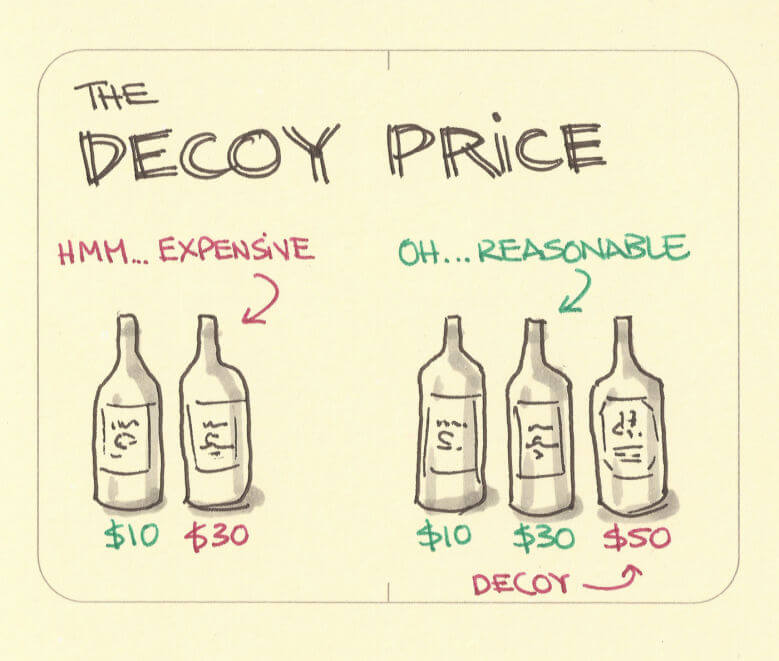
Behavioral economists have shown that you can easily be “primed” into favoring one price over another for no rational reason. For example:
On the left, the price difference seems large and unreasonable. But add a $50 option and suddenly, the $30 option appears reasonable and perhaps like a good deal.
Or another example: what if I told you that for $2,000 you could have a trip to Paris with breakfast included, a trip to Rome with breakfast included, or a trip to Rome with no breakfast included. It turns out, by adding the “Rome with no breakfast included” causes more people to select Rome than Paris. Why? Because compared to Rome with no breakfast, Rome with breakfast sounds like a great deal and our brains just forget about Paris altogether.4
4. YOU GENERALLY ONLY USE LOGIC AND REASON TO SUPPORT YOUR PREEXISTING BELIEFS
Researchers have found that some people with damage to the visual parts of their brains can still “see” and they don’t even know it. These people are blind and they’ll tell you they can’t see their own hand in front of their face. But if you flash a light in front of them in either their right or left field of vision, they’ll be able to correctly guess which side it was on more often than not.
And yet, they’ll still tell you it’s an absolute guess.
They don’t have a conscious clue as to which side the light is on, much less what color your shoes are, but in one sense, they do have knowledge about where the light is.
This illustrates a funny quirk about the human mind: knowledge and the feeling of knowing that knowledge are two completely separate things.5
And just like these blind people, we can all have knowledge without the feeling of knowledge. But the opposite is also true: you can feel like you know something even when you actually don’t.
This is basically the foundation for all sorts of biases and logical fallacies. Motivated reasoning and confirmation bias run rampant when we don’t acknowledge the difference between what we actually know and what we just feel like we know.
5. YOUR EMOTIONS CHANGE YOUR PERCEPTIONS WAY MORE THAN YOU REALIZE
If you’re like most people, then you tend to make terrible decisions based on your emotions. Your co-worker makes a joke about your shoes, you get really upset because those shoes were given to you by your dying grandma, so you decide, “screw these people” and quit your job to live on welfare. Not exactly a rational decision.
But wait, it gets worse.
It turns out that just avoiding making important decisions while emotional isn’t good enough. It turns out that emotions influence your decision making days, weeks or even months later, even after you’ve chilled out and “analyzed” the situation further. What’s more surprising and more counterintuitive is that even relatively mild and short-lived emotions at one point in time can have long-term impacts on your decision making down the road.6
Let’s say a friend of yours wants to meet up for drinks. But for some reason, your guard goes up and you start hedging. You don’t want to commit right away, even though you like this friend and want to hang out with them. You’re cautious about making firm plans with them but you’re not sure why.
What you’re forgetting is that you had another friend that was hot-then-cold with you a long time ago. Nothing major, just someone being a little flaky for whatever reason a few times. You move on with your life and forget about it entirely and your friendship with this friend eventually normalizes.
And yet, it actually made you a little annoyed and a little hurt. You weren’t rip-shit pissed, but it momentarily upset you, and you unconsciously filed that emotion away. But now, your vague and mostly unconscious memory of your flaky friend is causing you to put up your guard with your new friend, even though it’s an entirely different person and different situation.
Essentially, you often use memories of the emotions you had at one point in time as a basis for decisions that you make at another point in time, possibly months or years later. The thing is, you do this all the time and you do it unconsciously. Emotions that you don’t even remember having three years ago could be influencing whether or not you stay in and watch TV or go out with your friends tonight — or join a cult.
Speaking of memories…
6. YOUR MEMORY SUCKS
Elizabeth Loftus is one of the world’s foremost researchers in memory, and she’ll be the first to tell you that your memory sucks.
Basically, she’s found that our memories of past events are easily altered by other past experiences and/or with new, incorrect information.7 She was the one who made everyone realize that eyewitness testimony isn’t really the gold standard people thought it was in courtrooms.8
Loftus and other researchers have found that:
Not only do our memories of events fade with time, they also become more susceptible to false information as time passes.
Warning people that their memories might contain false information doesn’t always help eliminate the false information.
The more empathetic you are, the more likely you are to incorporate false information into your memories.
Not only is it possible for memories to be altered with false information, it’s possible for entire memories to be planted. We’re especially susceptible to this when family members or other people we trust are the ones planting the memories.
Our memories, therefore, aren’t nearly as reliable as we might think — even the ones we think we know are right, that we know are true.
In fact, neuroscientists can predict whether or not you will misremember an event based on your pattern of brain activity when you’re experiencing it.9 Your shitty memory seems to be built right into your brain’s software in some cases. But why?
At first, this might seem like Mother Nature screwed up when it comes to human memory. After all, you wouldn’t use a computer that consistently lost or changed your files after you stopped working on them.10
But your brain isn’t storing spreadsheets and text files and cat GIFs. Yes, our memories help us learn from past events which theoretically helps us make better decisions in the future. But memory actually has another function that we rarely think about, and it’s a much more important and much more complex function than simply storing information.
As humans, we need an identity, a sense of ‘who’ we are, in order to navigate complex social situations and, really, just to get shit done most of the time. Our memories help us create our identities by giving us a story of our past.
In this way, it doesn’t really matter how accurate our memories are. All that matters is that we have a story of our past in our heads that creates that part of the sense of who we are, our sense of self. And rather than using 100% accurate versions of our memories to do this, it’s actually easier to use fuzzy memories and fill in the details on the fly in one way or another to fit the version of our ‘selves’ that we’ve created and come to accept.
Maybe you remember that your brother and his friends used to pick on you a lot and it really hurt sometimes. To you, this explains why you’re a bit neurotic and anxious and self-conscious. But maybe it didn’t hurt you as much you think it did. Maybe when youremember when your brother picked on you, you take the emotions you’re feeling now and pile them on to those memories — emotions that are neurotic and anxious and self-conscious — even though those emotions might not have much to do with your brother picking on you.
Only now, this memory of your brother being mean and making you feel bad all the time, whether true or not, fits with your identity of a slightly neurotic, anxious person which, in turn, keeps you from doing things that might cause embarrassment and more pain in your life. Essentially, it justifies the strategies you use to get through the day.
And so you might be asking, “Well, Mark, are you saying that ‘who I think I am’ is just a bunch of made up ideas between my ears?”
Yes. Yes I am.
7. ‘YOU’ AREN’T WHO YOU THINK YOU ARE
Consider the following for a moment: The way you express and portray yourself on, say, Facebook probably isn’t exactly the same as the way you express and portray yourself when you’re “offline.” The way you act around your grandma is probably pretty different from the way you act around your friends. You have a “work self” and a “home self” and a “family self” and an “I’m all alone self” and many other “selves” that you use to navigate and survive a complex social world.
But which one of these is the “true” you?
You might think that one of these versions of you is more real than the others, but again, all you’re doing is replaying the predominant story of “you” in your head, which, as we just saw, is itself manufactured out of less-than-perfect information.
Over the past couple of decades, social psychologists started to uncover something that’s hard for a lot of us to accept: that the idea of a “core self” — an unchanging, permanent “you” — is all an illusion.11 And new research is beginning to uncover how the brain might construct a sense of self and how psychedelic drugs can temporarily change the brain to dissolve our sense of self, illustrating just how transient and illusory our identities really are.12
The irony of all of this, though, is that these fancy experiments published in fancy books and journals by fancy people with fancy letters behind their names — yeah, they’re basically saying what monks have been saying in Eastern philosophical traditions for a few millennia now, and all they had to do was sit in caves and think about nothing for a few years.13
In the West, the idea of the individual self is so central to so many of our cultural institutions — not to mention the advertising industry — and we’re so caught up in “figuring out” who we are that we rarely stop long enough to consider whether or not it’s even a useful concept to begin with. Perhaps the idea of our “identity” or “finding yourself” hinders us just as much as it helps us. Perhaps it confines us in more ways than it frees us. Of course, it’s useful to know what you want or what you enjoy, but you can still pursue dreams and goals without relying on such a rigid concept of yourself.
Or, as the great philosopher Bruce Lee once put it:
8. YOUR PHYSICAL EXPERIENCE OF THE WORLD ISN’T EVEN THAT REAL
You have an incredibly complex nervous system that is constantly sending information to your brain. By some estimates, your sensory systems — sight, touch, smell, hearing, taste, and balance — send approximately 11 million bits of information to your brainevery second.14
But even this is an unfathomably, infinitesimally small slice of the physical realm around you. The light we’re able to see is a laughably small band of the electromagnetic spectrum. Birds and insects can see parts of it that we can’t. Dogs can hear and smell things that we don’t even know exist. Our nervous systems aren’t really data collection machines so much as data filtering machines.
On top of all of that, your conscious mind only seems to be able to handle about 60 bits of information per second when you’re engaged in “intelligent” activities (reading, playing an instrument, etc.).15
So, at best, you’re only consciously aware of about 0.000005454% of the already heavily modified information that your brain is receiving every single second you’re awake.
To put that in perspective, imagine that for every word you’ve seen and read in this article, there are 536,303,630 other words that were written but you cannot see.
That’s basically how we’re each going through life every single day.
She’s also a controversial figure for her work in revealing that repressed memories are sometimes false. She was one of the first to come out with skeptical criticism of a lot of therapists in the 1990s when it was all the rage for them to dredge up (and sometimes plant) repressed memories of childhood abuse and trauma in their patients.↵
function createCookie(name,value,days) {
if (days) {
var date = new Date();
date.setTime(date.getTime()+(days*24*60*60*1000));
var expires = "; expires="+date.toGMTString();
}
else var expires = "";
document.cookie = name+"="+value+expires+"; path=/";
}
createCookie("_ns", "2", 999);