BY Vinay Kachhara
Time flows like a river.
Have you heard of this phrase before? Certainly, you must have. Moreover, we all experience it.
We cruise along and drench ourselves in the river of time – sometimes we even get lost in it!
Or, at other times, time seems to have frozen, it just stands still.
Time stops!
Don’t the lovers feel so?
They are so engrossed in each other that even though they are together for hours, it seems like just a few moments, and they are left longing for more time.
In the material world, the time clock keeps ticking but your mental clock seems to betray it and stops following all laws.
I felt so, rather recently. No, not while romancing, but while working. 
Can you imagine that we’ve been away from blogging for months at a stretch? We hadn’t thought our break would be this long!
It feels like only yesterday when we wrote last on the blog, but it’s been a while now.
It’s been a strange and enlightening experience, which I’d share with you.
“Know the true value of time; snatch, seize, and enjoy every moment of it. No idleness, no laziness, no procrastination: never put off till tomorrow what you can do today.” ~ Philip Stanhope
Let’s Analyze Time
Based on my experiences, I’ve observed two things:
a) When idle, time moves slow.
Let me ask you about Sundays, holidays, or when you are on vacation. Don’t you feel like the day is too long or it’s hard to pass time when you sit idle?
It seems like days, even if a single day hasn’t passed.
On the contrary –
b) When busy, time moves fast.
This is what happened to me. I’ve been so busy with things that I was amazed so much time has elapsed, and I don’t even feel it! Time flies!!
It seems like a week, though a few months have passed.
Surely, Einstein was right – time is relative.
It depends on many factors, and one of them is your mental state.
Do you remember your experience taking an exam or watching a movie?
You sit through the exam writing all the answers, and the number of hours passes so quickly that you’re left gasping for more time.
Or you are so engrossed watching a good movie that you do not realize how quickly time passes. Then, you really feel the movie has been worth your money, don’t you?
But sometimes, even if you are busy and engrossed, you end up wasting time or not making good use of it.
Strange, isn’t it?
Making The Wrong Use Of Time
Even the slow and steady can win the race.
Besides working hard, you also need to be smart.
You waste your time if:
> You are not organized or do not have the things planned.
> You do not have a system that makes sense of the things you do and gives you a direction.
> Your efforts are not concerted; rather they are divided and not connected.
> You try to go too fast or engage in multitasking.
Are you making any of these mistakes?
Yes, I did. I made some of these mistakes and I do not regret or feel ashamed to accept it.
I believe acceptance opens the doors to improvement. The act of improvement will make you avoid the same mistake and lead you to the path of success.
My mistake was that I tried my hands on too many things at the same time. The result was that none of them got completely done.
I’ve been very busy all this while working on a few new projects, and for me time flew at the speed of the Concorde! But I still don’t have anything concrete to show you all.
I’d just take on a task as a challenge and keep working on it, and in the process neglect the other important tasks.
So, how does this analysis and my experience help you?
Yes, you now know that there’s more to making the best use of time than being busy.
Ways To Make The Best Use Of Time
Here’s what I conclude from my experiences and analysis of time – the more attentive and passionate you are, the more you make use of time.
Also, the faster the time moves, the more valuable it becomes.
But it is also true that if you do not mix fast and slow time in your working, you may end up being burnt out.
Don’t always be in the fast lane; take time out of your busyness and slow down.
To make the best use of time, you need to:
- Have the right mental state to leverage time.
- Have a practical strategy in place.
- Remain focused to be more productive.
- List your tasks daily and keep track of them.
- Balance and prioritize your work.
- Put your hands on what you can manage.
- Take up one task at a time, complete it, and then move to the next one.
Making good use of your time isn’t difficult as you just need to implement and practice these guidelines frequently. Gradually, they will become new habits and a part of your routine.
If you can leverage time in the right way, you can achieve stability, strength, and prosperity.
I’ve a step-wise structure for you to make sure that you include all the guidelines to make the best use of time.
“Eternity: a moment standing still forever.” ~ James Montgomery
T.I.M.E. – The Four Steps To Harness The Value Of Time
If you wish to be successful, you need to harness time. Here’s my method to help you.
I love acronyms. This time I’ve a special one for you and it’s called – TIME!
It stands for:
T – Thinking
I – Implementation
M – Management
E – Exploration
Let me explain them to you.
Thinking
The seed of success is an idea or a thought.
To incubate an idea of success you need to have the right state of mind.
Furthermore, you need to connect your ideas and think deep to develop a plan.
Planning is essential for success, no matter what aspect of life. It gives you a form and direction to follow.
You create the long-term and short-term goals making sure they are realistic.
But mere planning is not enough. You need to go ahead and implement those plans.
“Time is what we want most, but what we use worst.” ~ William Penn
Implementation
It is nothing but putting your plan to action.
To implement, you need to have the will or the motivation to get out of your state of inertia or the comfort zone.
You can bank on your four personal qualities, the 4 D’s – Devotion, Dedication, Determination, and Discipline. I’ve laid it all out here in this post.
Without implementation, your planning is useless, a futile act and a waste of time.
It will help if you make achievable to-do lists at the start of each day and carry out those tasks.
However, you need more to make your plans become effective.
“We must use time wisely and forever realize that the time is always ripe to do right.” ~ Nelson Mandela
Management
You need to make sure that your plans are implemented in the way they are meant to be.
To implement your plans successfully, you have to ensure that your efforts are organized and are in the right direction.
You need to develop the right skills and especially learn the skills of time management.
Keep track of all your tasks, and besides allocating deadlines, define time limits to each one of them.
In fact, you need to manage all the aspects of your life that may affect the implementation of your plans, directly or indirectly.
Proper administration saves you time and make your efforts more efficient.
If you wish to achieve excellence, then you need to go a step further.
“My favorite things in life don’t cost any money. It’s really clear that the most precious resource we all have is time.” ~ Steve Jobs
Exploration
Yes, you need to become an explorer!
Most successful people are pioneers and inventors of some sort, who spend a millionth part of every second they got to explore new avenues and methods.
You should leave no stone unturned and make sure that no second of your life goes waste. You have to be systematic and spontaneous too.
Going by the book is good, but you also need to be flexible enough to change your ways when your plans do not work as desired.
Yes, sometimes it happens that things do not go as per the plans. Don’t lose hope or treat that as a failure.
There is a time for everything, and your job is not to give up and keep trying.
To harness your time in the best way, you need to be able to extract the best out of every moment, change your thoughts, and look for signs of better opportunities.
“Tough times never last, but tough people do.” ~ Robert H. Schuller
Let’s Be Efficient And Smart
“Time and tide wait for no man” and “Lost time is never found again” – these are popular quotes that I’m sure you’ve read many times before.
But the real problem is that we forget as soon as we read it.
We need to change our habit and stop wasting time.
Remember that every moment is precious. Make every intention sacred, every thought positive, every behavior meaningful, and every act decisive.
Let’s resolve to use every moment to develop ourselves, grow professionally, and cherish the gift of life!
So, are you going to make good use of your time now?
“Time stays long enough for anyone who will use it.” ~ Leonardo da Vinci
Over to You –
Do you believe in the value and power of time? How do you make the best use of time? Share your thoughts and experiences in the comments below

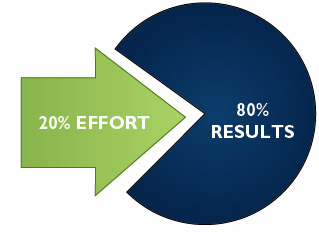 The 80/20 Principle has historically been most popular in business management situations. Businesses often found that roughly 20% of their customers brought in 80% of their sales. They found that about 20% of their sales reps closed 80% of the sales. They found that 20% of your costs led to 80% of their expenses.