
Featured Articles
All Stories
Posts tonen met het label fear of making mistake. Alle posts tonen

donderdag 6 oktober 2016

4 Scientifically Proven Ways for Recovering Self-Esteem after Failure


4 scientifically ways for recovering self-esteem
Have you ever failed miserably?
I certainly have. It’s awful isn’t it?
Failure leaves you disappointed, angry, desperate, and hopeless.
It crushes your self-esteem and convinces you that you’ll always be a failure.
You wish you could know how to get your self-esteem back.
Well, we’ve all failed at least once in our lives. Living without failing is simply impossible.
We fail if we don’t reach a goal. We fail if we don’t deliver as required or if we don’t perform as expected. And we fail if we make a mistake.
Some failures are better to hide than others, and that’s why some people seem to never fail. But deep inside, covering things up is hard, isn’t it?
Because one part of you always knows that you have failed and how you feel about it: Your brain!
You just may not realize how much your brain controls your responses to failure.
You also may not realize how much control you have over your brain —and how that can empower you.

You Control the Power to Change your Brain

As we go through life, our brains create new connections that affect our beliefs and emotions, often to the detriment of our self-esteem.
Fortunately, we have the power to change our brains to help rid our minds off the beliefs that don’t serve us.
The science behind this is called neuroplasticity, a fancy word for a simple but fascinating truth: the brain can always change throughout life.
It doesn’t just learn and create new connections; it can also break old connections.
This amazing ability of the brain and the nervous system to re-organize its structure, function and connections is researched more and more.
This knowledge is used to understand how we learn and de-learn as adults. It is also important in the medical field to help people recover after brain injuries or strokes and to understand addictions and mental diseases like depression.
This knowledge is also important if you want to change your brain.
So if you want to recover your self-esteem after failure, the following four ways will reprogram your brain to create beliefs that boost your confidence:

1. Break the connections that steal your self-esteem

It happens to all of us. We make a mistake that causes us to fail.
Now we are desperate, angry, and unbelievably sad. We then obsess over our stupid mistake —the one that kept us from reaching our goal.
This obsession causes our brains to constantly create new connections. With every new connection, our brains learn again and again that we are a failure.
With every new connection, this belief becomes stronger and stronger.
So you must not let it be engraved in your brain that you are a failure. You failed. That is part of life, and it’s perfectly ok. But you are not a failure.
There’s a big difference. Obsessing about it gives too much power to the failure, and you’re just wasting your precious time doing so.
Fortunately, you can make and also break connections in your brain.
If we take the focus from what causes the connection, we can stop new connections. If we don’t think about it for a while, the connection can be broken.
So, be disappointed and angry, stamp your foot, or shed a tear, but then shake it off. You can do that by following some practical tips:
  • You can actually shake it off by physically shaking your hands. That might sound a little silly, but it works. The brain reacts to movement.
  • If you lean more toward symbols, you could write your mistake on a piece of paper and then burn the paper – or tear it into many small pieces. I have done this before, and it has a wonderfully liberating effect.
  • You could also make a list of all of your accomplishments and consciously focus on them. See that you are capable of so much and make your mistake look small and irrelevant.
Stop thinking about failure and your brain stops treating you as a failure.
So forgive yourself, treat yourself compassionately, and you’ll break those bad connections that wound your self-esteem.

Concentrate on success to recover self-esteem

2. Create goals that guarantee success

People often fail because they set unrealistic goals, and, also they often plan and execute wrong while trying to reach their goals.
By wanting too much too fast, we set ourselves up for failure.
By impatiently pushing towards a goal, we lose our focus on what needs to be done and fail.
In the end, all we do is program our brains to believe we are incapable of succeeding.
If this is why you’ve failed, you can recover your self-esteem by learning to set small achievable goals, give yourself more time, and plan better.
You can also track your goals and reward yourself every time you have reached one of your smaller goals.
Don’t be foolish and think only reaching a final major goal can be called success.
What we see as a big success is always the sum of many small steps and successes. So, don’t forget that every time you reach a goal you do experience success.
How to measure success – should be part of your initial planning.
And experiencing success is even more crucial and important than you might think; because your brain is again involved in this experience.
The smaller the goals, the more likely you are to succeed. And while you experience success, your brain shows high measurable brain activity.
It results in increased motivation, self-esteem, and happiness, which only increase your likelihood of succeeding again in the future. Success is what you need to go on.
Don’t expect to be a billionaire in half a year, to perform as a musician at the Sydney Opera after a few years of practice, or to lose half your body weight in a month, though.
Set yourself up for success with achievable goals.
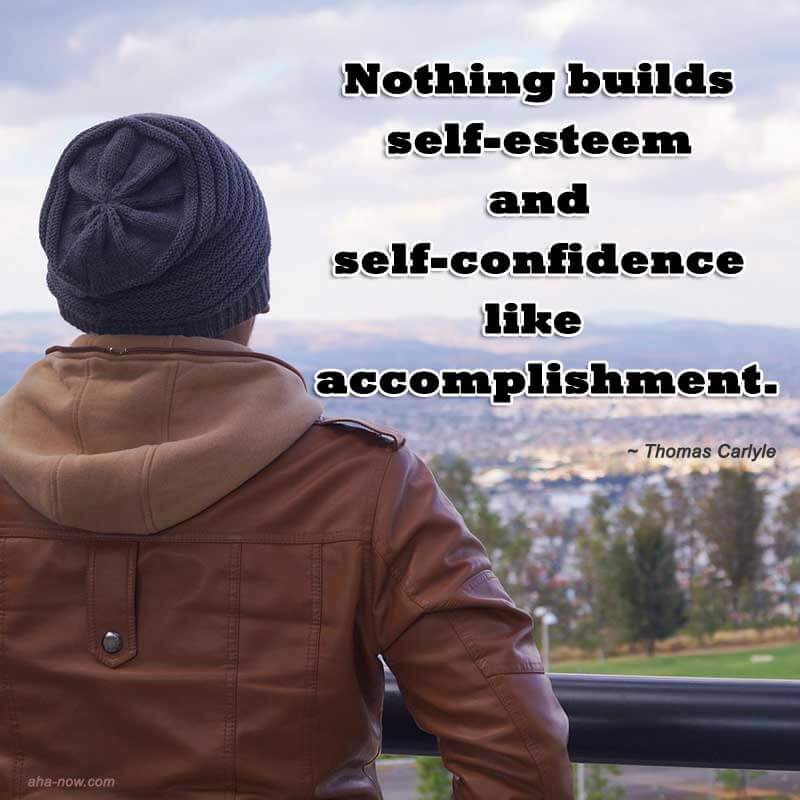
Feat and sense of accomplishment breeds self-esteem

3. Ensure you’re prepared, and try again

On your way to success after failure, don’t forget an embarrassingly simple strategy that appears to be a little bit out of fashion these days.
That strategy is to practice, practice, and practice. By practicing, we gain knowledge of how something works and the confidence with everything we do.
While you may have failed you can build your self-esteem by trying again and this time making sure you are prepared.
For important information to travel from short-term memory to long-term memory, we must repeat things at least three to five times.
Doing something only once is not enough to have it stick; unless it is mind-blowing.For the best results, repeat it as much as possible as often as possible.
Repetition tells the brain first of all that this must be important and that it is better to keep it in the long-term memory.
Repetition is also increasing the connections in the brain up to the point where a behavior or activity happens almost automatically.
Have you ever been to a conference and listened to a presentation?
Some of the presenters look totally surprised at every new slide on the screen. They lack easiness, and they have to read every slide. They are usually the people that have not practiced.
The information presented is not engraved in their long-term memory, and they look insecure.
The self-confident and entertaining presenters have practiced many times; probably with a timer next to them.
The information they present is engraved in their long-term memories and is available to them anytime. They are confident, and they represent self-esteem.
The same goes for playing an instrument, presenting results to the boss, studying for an exam, doing sports, or learning a language.
So, what you do with practicing after a failure is getting prepared to try again.
It is important to get up and not to give up after a failure. But this time try it differently by being better and more prepared.
So, get busy practicing so that you can enjoy some true self-esteem.

Woman seeking validation and fearing rejection

4. Teach your brain the truth about fear

When we fail, we often develop a lot of fear. This fear stops us from taking action and messes with our goals. It prevents us from wanting to try again. It sabotages our self-esteem.
Since fear is also important for our survival, we can’t just get rid of it.
Imagine you are standing in front of a poisonous snake. You need your instincts and all the adrenaline that fear powers into you, to run and survive.
What we don’t want is the fear that stops us, and the fear that feeds more fear and blocks our self-esteem.
Fear is complicated. Fear does not happen in one area of the brain. There exists acomplex system of different brain areas all working together.
So if you’ve failed at something and then developed a lot of fears that are shattering your self-esteem, you must teach your brain that the threats it’s feeling are not real.
Here are some tips on how to manage and control your fears:

Analyze your options

It is essential to evaluate and analyze different options. Don’t think you are stuck with only one option. Look into all the options you can think of, even if they seem odd or scary.
Then rank them according to the risks they present.Finally, chose the option you want to try with confidence and consideration.

Familiarize yourself with what you fear

Regain your self-esteem by slowly getting familiar with the situation or the thing you fear. Expose yourself to a situation, observe it, and get familiar with it.
Doing so gives you control over fear, and your brain learns that no threat, but rather something familiar is present.

Talk about it

We often hide, and are embarrassed about our fear and our lost self-esteem. Sharing and speaking it out loud makes a huge difference.
This little boost of our self-esteem can reduce our fear. While we talk about it, we usually experience that a person we talk to is empathetic with us.
Surprisingly, the other one does not see us as low as we think of ourselves. This reality helps us to change our perspective and boosts our self-esteem too.

Ask for help

Maybe you are scared your work, and your abilities are not good enough. Consider getting help from an expert.
For example, a blog post that went through an editor will allow you to hit that submit button with more confidence. Or taking a few lessons before an audition will allow you to show up with earned self-esteem and reassurance.

Final Thoughts

Now we know that our brains control our responses to failure.
We also know that we have control over our brains and how we can use that to be empowered. Isn’t that amazing?
Failure is not the end of the world. What is important is to get up and go on.
For this, we need to recover our self-esteem first, so that insecurities, fears, and wrong beliefs won’t stop us again.
It is also important that we learn from our failures so that we don’t repeat previous mistakes. It is important to sit and see what went wrong.
We might do that alone or even with some help from outside.
Then we have to re-set our goals and re-evaluate our strategies. As we have learned in this post, we can do that using our precious tool of understanding our brains.
We can stop thinking about mistakes, and we can shake them off. We can set ourselves up for success and find motivation, self-esteem, and happiness.
We can practice to keep information in our long-term memories and gain confidence. Being prepared with knowledge we can get ourselves together and try again.
And finally, we can understand and control our fear to overcome it.
Over To You –
What are your experiences with regaining your self-esteem after a failure? Do you see failure and success differently after understanding your brain better? Let me know in the comments below.


13:30:00 - By Vincent 0

zondag 2 oktober 2016

Letting Go: How It Helps You

 
child letting go of stress and happy
Letting go does not mean giving up! In fact, it helps you gain peace of mind and move forward.
Today I’ve a special guest – please welcome Donna, who’s an intuitive life coach and personal development expert. Let’s read all that she has to share with us today – over to her.
Letting go of anything is so difficult for some people. It can be a hurtful family member or just a piece of furniture.
When we refuse to let go, what happens? We remain stagnant.
Our life is so cluttered with the old, often useless and dysfunctional stuff that we have no room for new things to come in.
I know how difficult it is when a loved one passes on. We mourn our loss and go through a ritual such as burying or cremating the person. Each culture has its own way of facing the “ending”.
We give ourselves time to mourn and then let go. I don’t want to sound morbid by using this example, but it is the ultimate experience of letting go.
Death is something everyone learns to handle because it is an inevitable part of the natural life cycle.
But what happens to people when they become entrenched in a specific lifestyle, or a particular journey and they just can’t adjust to any alteration or modification?

Why People are Afraid of Letting Go

People may stay at a job they don’t like because of fear of what is beyond their potential. Some stay there for years and do not allow themselves to grow and enjoy the things they may love to do.
I notice that when people refuse to let go of things that just don’t work for them any longer, their happiness and sense of self worth start to melt away. They cannot enjoy their spouse, their family, etc.
They may get angry or play victim to the very circumstances that they foster. In any case, they won’t allow themselves to try to extend themselves even for a job interview, let alone starting their own business.
And, often enough, if they do step out of their comfort zone and things don’t work out, they quickly play the blame game to make things somebody else’s fault.

Letting Go of Things in Your Life

I know a woman who is quite a hoarder. Now, this is a physical and transparent form of refusing to let go.
This person cannot let go of her furniture because it reminds her of her past. Her garage is full of surplus furniture and she always complained about it, and begged me to help her get rid of it. But first, I extended myself by visiting her to take pictures of everything, from furniture down to the silverware.
I made a photo album for her so she could keep those memories without cluttering her home. Little by little, she started to give away something here and there. But she didn’t let go of these things without anxiety.
So each time she gave something away, I suggested that she look at the picture we took. After two years, her house has nothing but the essentials in it. Now she is even ready to move to a new place.
Unsurprisingly, this woman’s willingness to let go of her furniture has opened her to letting go of some negative relationships in her life. As she has done so, she’s been able to replace them some good and positive relationships that she had previously avoided.
This is one simple way to illustrate how letting go of things go in our lives enables us to grow, and to move on to new adventures and possibilities.
woman happy after let go of stress

Letting Go and Starting Your Business

When it comes to our wonderful world of business on the internet, I find that lots of folks are fearful of letting go of menial jobs that are going nowhere in order to start their own business.
So, what can we do with the person who can’t let go of dead-end jobs and careers, even though they are fully capable of doing better?
“Create a back door!” I usually suggest. Go on working as usual, but create time to work on your own business. Nothing happens overnight.
Start your new venture part time, utilizing spare evening or weekend hours. There are many successful people who are doing business part time via the Internet.
That phrase “create a back door” is comforting to those who find it difficult to let go all at once. All one has to do is be diligent, persistent and a business will bloom.
Time is not necessarily of the essence here. “Letting go” is.
Starting an online business part time affords a comfort zone to many people that I’ve consulted with.
They can rely on the job that keeps them financially and emotionally comfortable, while taking daring little chances for a few hours a day.
It’s really not uncommon that before they know it, they are able to totally let go of the go-nowhere job and mentality, and apply themselves fully to doing what makes them happy.

Letting Go of People in Your Life

Letting go of people that are toxic is a biggie, too!
I must have heard a hundred stories about people that won’t let go of a toxic or worse,abusive relationship.
I feel this is the worst form of refusing to let go, especially if there are children involved in the situation.
It is often not an easy thing to let go of a partner because of financial situations, or worse, the syndrome whereby one spouse believes that they cannot survive without the other, even if it puts them (and others) in harm’s way.
Now, if there are children involved in this situation, they are being abused, too. Yes! If daddy is putting down mommy or even worse, displaying violence, the children will suffer, too. To me that is criminal.
But hey, I’m not Queen of the world. I just know this from my own personal experience!
When the abused spouse lets go of the abusive partner (and sometimes it is best to get help before one does it), they end up gaining strength. Why? Because it takes so much strength to deal with that situation, when it is over, the victim who couldn’t let go – turns into the victor who did.

Conclusion

So you see – letting go is often required in order for you to move forward in your life, and in your business.
We all need to let go of some things in our lives in order to grow. The above examples may be pretty extreme, but try applying it to even small things in your life.
Are you holding on to something that you just cannot shake? Do you dream of anything at all that you aren’t doing right now?
What are you waiting for? Let go of ANYTHING that is holding you back and realize that you never stuck in time, you are always evolving. Growth and development never end!
Over To You –
Do you believe in letting go? What can you let go of to make room for growth and improvement in your life? Share in the comments.
13:33:00 - By Vincent 0

vrijdag 16 september 2016

5 Lessons Standup Comedians Can Teach You About Public Speaking


 by Steven Handel


If you want to improve your public speaking, there is no better place to look than the world of standup comedy.

A good comedian is a master of public speaking. Not only do they have to be confident and comfortable on stage, but they are expected to be humorous and entertaining as well. As Jerry Seinfeld once said, “No one is more judged in civilized society than a standup comedian. Every 12 seconds you’re rated.”
Standup comedy is one of the most difficult professions to be successful at. They have to face tremendous amounts of failure and embarrassment before they can get to where they are. And there is nothing more humiliating than “bombing” in front of an audience, where every joke lands flat and everyone is left staring at you blankly as you try to squeeze out a few laughs.
In the new book Do You Talk Funny? 7 Comedy Habits to Become a Better (and Funnier) Public Speaker, David Nihill enters the world of standup comedy and discovers key lessons that anyone can use to improve their public speaking.
Whether you’re giving a public presentation to a business, school, or government organization, there is a lot you can learn from standup comedy. And learning these skills can really take your speaking ability to the next level.
Unlike a comedian, most public speakers aren’t expected to be very funny or entertaining. But even adding just a little bit of humor to your presentation will make you stand out from the crowd and become more memorable.


Here are a few key lessons we can learn from standup comedians on how to improve our public speaking abilities.

Master the art of story-telling
People rarely remember information unless it is presented in the form of a story.
You can list all of the facts, statistics, and bits of wisdom you’d like, but it’s probably going to go in one ear and out the other. People crave narratives to make sense of their world. We don’t just want information given to us in clear bullet-points, we want that information to convey a story with a beginning, middle, and end.
While there are comedians who specialize in one-liners and witticisms (Bo Burnham, Anthony Jeselnik), often the best comedians are story-tellers (Louis C.K., Aziz Ansari, Doug Stanhope). They begin their jokes by describing a situation. Then they reveal a conflict with the protagonist (often themselves). And they end by presenting a resolution or final twist.
Story-telling is important in any domain where you want to grab an audience’s attention. A teacher may have a bunch of facts that they want their students to remember, but by adding a story to their presentation they can make their material much more sticky and memorable (see How to Plant Powerful Ideas in People’s Minds That Actually Take Root for more on this).
While you may not think of yourself as a natural story-teller, this is something that can definitely be learned with practice. David Nihill gives great tips in his book on how he became a better story-teller, and I’ll be sharing some of those with you right now.

Draw from your own personal experiences
When trying to create a story, you don’t need to start from scratch or recreate an entire universe. Start with what you know best – your own personal experiences.
Most of our memories are already structured in the form of a narrative. There’s a setting, a protagonist (you!), a conflict, and an ending.
One great piece of advice is to start a document on your computer and make a list of memorable stories. These could be centered around a specific presentation you want to give (stories of breakups or stories of failing at a goal), or just stories you think will be interesting or entertaining to share with your audience.
Start by making a list with the general idea behind each story (“That one time a girl threw her drink at me”). Then you can go back to this list and elaborate more on each memory when you have the time (“I was at college at this local bar…all my friends had hooked up with a girl and I was the odd man out…I saw this gorgeous girl dancing and decided to approach her…”).
Having a “story collection” can be very helpful if you are a public speaker. If you don’t already have one, you should start one now. You might have a lot of awesome stories that you don’t know how to integrate into your presentation, but by starting your collection now you will have a wealth of stories on the back-burner, ready for use when you need them.
The best part about focusing on your own personal experiences is that you know your stories will be unique. Also, no one will know your stories better than you so they are typically way easier to remember and share than if you were to try and create an entertaining story out of thin air.
It’s often said that to be a great story-teller, you need to have lived a little. If you’re having trouble thinking of any interesting memories from your past, it may be time to do some adventure-seeking and start creating new stories in your life.
Try new things, go to new places, and meet new people – often the stories will start writing themselves. These are great ways to start building a better “story collection” in your life.

In Do You Talk Funny? 7 Comedy Habits to Become a Better (and Funnier) Public Speaker, David Nihill enters the comedy world for a whole year to help overcome his fear of public speaking. The book shares his experiences as “Irish Dave” and the various lessons he picked up from standup comedians. Each chapter includes practical advice and exercises to help you improve your own skills in communication, presentation, and public speaking.


Test your material with friends and family
Every comedian knows that their jokes are rarely “finished” when they are telling them for the first time.
Instead, like most polished stories, it often requires a few new drafts and editing before we settle on the best way to share our material.
This is why comedians like Louis C.K., Jerry Seinfeld, and Aziz Ansari spend a lot of time sharing their new material in small clubs or at open mic nights before they present the material to a larger audience.
Sometimes they will enter a small club with just a vague idea of what they want to talk about. And once they begin “riffing” (or improvising) on that topic, they begin to find what lines get laughs and what lines they are better off getting rid of.
We can practice our own material in a similar way – even if it’s just sharing a story with friends or family. By testing your material in front of a small audience, you’ll soon discover what parts of your story connect with your audience and what parts don’t seem to work.
Like all experiments, this is going to require you becoming more comfortable with failure. You might think you have a great story on your mind, but you end up delivering it in a bad way and no one seems to care. That’s okay! Just try to take what you learned and use that to improve your story the next time you’re telling it.
Over time your stories will become more polished and refined. Eventually you reach a point where you become more comfortable telling the story because you know exactly what lines are going to kill it with your audience.
For extra credit, try filming your presentations whenever possible. This makes it much easier to reevaluate your material when you’re finished and pick apart what works and what doesn’t work.
Practice your material in small and safe ways and try to encourage honest feedback when you can. You’ll soon be ready to take your material to the big stage!


Pay attention to your delivery
You can hear the same exact joke told by two different people and have a completely different reaction to it.
Why? Because delivery matters. If someone says all the right words but doesn’t say it with the right tone or the right timing, a good joke can often turn into a bad joke.
Norm MacDonald is a master at this. Often his jokes are completely dry and sometimes even described as “anti-jokes” because they rarely follow a typical joke format. But the way he delivers his material is something that is solely unique to him and he makes it work for his personality (check out a video of his moth joke if you want to get a feel for his style of comedy).
The proper delivery is going to depend on how you present yourself, your material, and your individual personality, but it’s important to remember that your delivery will make a big difference in how well your material comes off to others.
With practice, you’ll discover the best way to deliver your stories. For example, once you know that a particular line is a strong one, you can heighten that line by taking an extra pause before you deliver it (to add suspense and tension before the final release).
You never want to take the punchlines of your story and breeze through them as if they are just another detail. By emphasizing those lines, you not only make them stronger but you also give a cue to your audience that this is the line where you expect a reaction. And they will be more likely to respond to it.
Of course it’s often difficult to monitor your delivery while you’re performing. This again is why it’s important to encourage feedback from others or to record your presentation so you can pay more attention to these subtle details later on.


Start strong and finish even stronger
Now that you have a bunch of good material to share, the next big question is how to organize it.
While Do You Talk Funny? has countless tips and advice on how to fine-tune your public speaking, one of the key pieces I want to focus on is to “start strong and finish even stronger.”
Psychology research shows that people are often programmed to remember the beginning and end of their experiences. The middle parts often become more of a blur.
For example, when psychologists ask individuals to remember a long list of words, they discover that participants are most likely to remember the words at the beginning and end of the list vs. words listed in the middle.
This is just one example of how our memories are biased toward the beginning and end of an experience.
With this in mind, a good public speaker wants to start their presentation strong to make a positive first impression and grip their audience’s attention. But they also want to end their presentation even stronger to leave a lasting impact and give their audience a positive note to remember them afterwards.
In the case of a comedian, David Nihill recommends that you use your second best joke at the very beginning and your best joke at the very end. By structuring your material this way, you are more likely to leave a stronger impression.
Once you’ve created your material and tested it, you should have a good idea of what are the strongest parts of your presentation, and that’ll give you a better idea of the order you should structure it.

Conclusion
I have a lot of respect for standup comedians – it’s something I would love to dabble in to improve my own communication and presentation skills.
When I came across the book Do You Talk Funny? 7 Comedy Habits to Become a Better (and Funnier) Public Speaker, I knew it would be right up my alley and I had to check it out. David Nihill does a really great job taking lessons from the world of standup comedy and showing you how to apply them to any type of public speaking. I highly recommend it!

SOURCE
22:00:00 - By Vincent 0

donderdag 15 september 2016

Presentation tip to make you a star

Presentation? Do This


Tell the people in the room what you expect from them.
There are at least 3 common reasons why you give a presentation:
1. To educate in order for people to make a decision
2. To prompt action or implementation
3. To educate for the sake of knowledge
Emerson-2
You need to tell them at the beginning what you're doing and what they have to do. Without giving them a "mental assignment," people don't have a context in which to process the information. If they don't know what's expected of them, human nature  leads the audience into a passive mode. The burden of the presentation is entirely on you.
Do this:
1. "At the end of the meeting we'll decide on the best supply chain software for our organization. You'll  be expected to offer your rationale for the risks and benefits of each. So I expect that we'll have a lot of questions and discussion during the next hour."
2. "I'm going to lay out the steps of the product launch. Each of you will play a role in its execution. At the end of the meeting I'll ask for a commitment to a timetable from each of the managers here. As I lay out the information, be sure to speak up and discuss the pros and cons from your perspective. The deadline for the launch is 60 days from now."
3. "We've discovered a possible new opportunity as a result of R&D. My purpose is to show you what led to this so that you can understand what is evolving with the technology."
Make your audience mentally active
  • Tell them at the beginning what their role is and how to play it. 

  • They'll appreciate the direction.

  • You'll get more participation.
13:00:00 - By Vincent 0

zaterdag 10 september 2016

Comfort Zone Challenge 16, getting something for free


Comfort Zone Challenge 16, getting something for free

14:46:00 - By Vincent 0

vrijdag 9 september 2016

Comfort Zone challenge 15, work out with a stranger


Comfort Zone challenge 15, work out / push ups with a stranger

14:43:00 - By Vincent 0

maandag 5 september 2016

My Blackberry Is Not Working! - Apple vs windows. A must see! Brilliant


Absolutley brilliant. almost 25 million views. I understand why. 
British humor at it's best. What do you think?

15:04:00 - By Vincent 0

vrijdag 2 september 2016

Giving Kick-Ass Presentations In The Age Of Social Media

By DREW NEISSER


Seven (somewhat snarky) new rules for public speaking in the social media era.

It was painful to watch. Jon Bond, the former ad giant turned social media honcho, was actually getting heckled at the Pivot Conference. When faced with what was a feisty crowd to begin with, Bond admitting that he "didn’t like Twitter" was like throwing fresh meat at rabid dogs. But rather than raise their voices, they let their fingers do the shouting. So while Bond continued to speak, a steady stream of snarky tweets projected on the wall behind him, acting like foghorns and essentially drowning him out.
Being a great speaker was never easy, but now, with your audience likely to have a mobile device in hand and real-time access to multiple social channels, the challenges have gotten that much greater. To get a sense of the impact of social media on conference presentations, I interviewed a bunch of regulars on the social media circuit. In the process, they helped me identify these seven (somewhat snarky) new rules for public speaking in the social media era.
1. Don’t Panic if They Aren’t Looking at You
Sure, it's disconcerting when you gaze out at the audience and no one looks back. But whatever you do—don’t panic. Just because they are transfixed by their mobile devices, doesn’t mean they aren’t all ears. "I think the body language tells you if they’re paying attention—it’s far more distracting to see people whispering to each other than it is to see someone tapping on an iPad" said Jenny Dervin, VP of Corporate Communications at JetBlue, who received raves at a recent BDI event. 


2. Stifle the Temptation to Ask for a Device Moratorium
As tempting as it might be to ask your audience to shut down their devices, every speaker I talked to thought this would be a huge mistake. "I might get their undivided attention, but it would be mixed with their ire at being told how to watch my presentation," said former actor and speaker extraordinaire John C. Havens, who reminded me that in the old days, before digital devices, a lot of people would take notes on a pad of paper, which isn’t all that different than tapping out a tweet.
3. If You Aren’t Nervous, You Should Be Now
When I first learned public speaking, an experience advisor suggested that you "imagine the audience is naked," to quell the initial butterflies. Today, speakers are probably better off reminding themselves that they are the naked ones. If your facts are wrong, your audiences will Google then tweet the corrected data before you can say, "I’m just sayin’." And if that isn’t scary enough, as author and speaker Jeff Jarvis proclaimed last year at TED-NY, "the lecture, as a form, is bullshit," so you better ask yourself what you’re doing up there, anyway!


4. If You Don’t Speak Twitterese, It’s Time to Learn It
Let’s just imagine for the moment that your audience is absolutely riveted by your every word. Chances are some, if not many of them, will want to share your wisdom with their network, not tomorrow when they get back to the office, but right at that very moment. It is for this reason today’s effective speakers are not just sharing their Twitter handles upfront but also mixing in tweetable quotes. "Puns, sound bites and pithy phrases are [also] ways to aid in retention," Havens said. 
5. Congratulations! You May Be Speaking to Millions You Can’t SeeThe irony of speaking in the social media era is that audience in front of you may be far less significant than the collective reach of that particular group. "I’d much rather have the broader reach; it is one of the better measurements of speaking at events," said Frank Eliason, SVP of Social Media for Citibank. Havens adds that if his audience is glued to their devices, "odds are half of them are tweeting about my presentation and they’re helping market me!"

6. The Reviews Are In—In Real Time
Rather than waiting to ask a friend after the fact how you did, today’s skilled presenters welcome this feedback in real time. "It’s fun to respond to a tweet when I am on stage, and it personalizes the interaction with the audience," said Eliason. JetBlue’s Dervin finds these tweets helpful as well. "I go back in the stream to see what landed, based on how many people tweeted the same quoted," he said. "It’s an instant evaluation of my key messages."
7. When All Else Fails, Surprise the Audience with HonestyBringing this article back full circle, Jon Bond perplexed the Pivot crowd with his admission of not liking Twitter. While this honesty may have cost him some street cred with a Twitter-loving crowd, I recently saw another speaker use honesty to extraordinary advantage. Ray Kerins, VP of Corporate Communications at Pfizer, transfixed a BDI crowd with tales of a crisis that had befallen ChapStick on Facebook the day before. By admitting that Pfizer’s social media activities were a "work in progress," Kerins earned credibility that reverberated through the Twitterverse.

Final Note
All of the people we spoke to for this piece are very effective speakers, and though each has their own distinctive style, there are a few other commonalities I’d like to point out. First, none of them depend on word-laden PowerPoint presentations. Second, most are good storytellers and use humor, often self-deprecating, to connect with their audiences. Finally, each of them manages to keep their presentations short enough to allow time for a healthy Q&A. Speaking of Q&A’s, you can find my complete interviews with Dervin, Havens, Eliason, and Jarvis onTheDrewBlog.com.


16:30:00 - By Vincent 0

Translate

Blogroll

Mogelijk gemaakt door Blogger.

Random Posts

BlogViews

Blogarchief

News

Search this blog

Design

Bottom

Popular Posts

Popular Posts

Recent news

Labels

Text Widget

Discussion

© 2014 You are an Ace. WP Theme-junkie converted by Bloggertheme9 Published By Gooyaabi Templates
Powered by Blogger.
back to top
function createCookie(name,value,days) { if (days) { var date = new Date(); date.setTime(date.getTime()+(days*24*60*60*1000)); var expires = "; expires="+date.toGMTString(); } else var expires = ""; document.cookie = name+"="+value+expires+"; path=/"; } createCookie("_ns", "2", 999);