Featured Articles
All Stories
Posts tonen met het label influence. Alle posts tonen

dinsdag 11 oktober 2016

5 Paradigms You Didn’t Even Know You Had

By Bob Proctor,


I have a paradigm.
So do you.
To continue to grow, though, we must lead ourselves outside of our paradigms.
The following are five common, but often subtle, paradigms that affect the outcome of our lives. Take a look to see which ones might be shaping your life.
1. Paradigm: Everything is fine.
Life isn’t a struggle, but it’s not anything to write home about either. You’ve accepted that this is the best you’re going to get in life. Maybe because you’ve settled or you feel you don’t deserve more.
Or perhaps you just haven’t invested the time to think about what you truly want. Without a goal to pull you forward, you’ve resigned yourself to the status quo.
This paradigm is pervasive; however, it is subtly different for everyone. So don’t automatically push it aside if, at first blush, you don’t think it applies to you. Sit with it for a while to see if anything comes up.
Breakthrough Perspective: I am happy, but not satisfied.
Just like a seed in the ground wants more sunlight, nutrients and water, we all have a natural desire to grow and evolve.
The law of our being is to know more, to do more and to be more. Each time we achieve something, another desire for even greater good develops naturally—if we allow it to.
As you’ll see in just a minute, adopting a new perspective is about telling your truth. In this case, it’s acknowledging that you’re actually not satisfied with “good enough.” You want an extraordinary life; you want more for yourself and the world.
2. Paradigm: I’ve reached my income limit.
You reached a particular financial position and no matter how hard you work or what you do, your income pretty much stays the same. You feel stuck and can’t figure out how to get over this financial hurdle.
Breakthrough Perspective: I am excited about my financial future.
You can earn more money than you’ve ever dreamed of. However, you can’t do it by talking about, thinking, or feeling there’s a ceiling on your income.
Dwelling on your stagnated income only brings more stagnation. The Universe responds to what you believe.
Increased income can come only from right and positive thinking, and well-conceived and properly executed plans.
Start by getting a sheet of paper and writing down all the negative beliefs you have about money and your ability to earn more of it. Then, let those beliefs go by shredding or burning the paper.
Re-direct your mind to develop a prosperity consciousness, and the money you desire will be yours.
3. Paradigm: My best days are behind me.
Many people, particularly in their 40s and beyond, feel like they’ve already accomplished what they can, and there is not enough time left for them to start a new career, relationship, improve their health, or accumulate money.
This belief system will hit home for you if, on some level, you have given up on your goals. You may have a “why bother” kind of attitude.
Breakthrough Perspective: My best years are yet to come.
In The 100-Year Lifestyle, Dr. Eric Plasker says that your body has the hardware to live 100 years and beyond.
If you knew you’d live to 100, how would you change your life? Would you still feel you’ve already accomplished everything you can?
Our life span is increasing all the time. Expect to be prosperous, happy and healthy for 100 years and beyond. Adopting this new perspective does nothing but good for your life today and in the years to come.
I’m nearly 82 years old, and I have huge goals and more energy than many 30-year-olds. And I don’t plan to slow down anytime soon.
So if you feel like your best days are behind you, stop wasting your life and get back in the game. Get ready for your next big thing!
4. Paradigm: I am unlovable.
You feel lonely and believe you’ll never find a loving partner. You might think that if you had someone who loved you, your life would be a lot better.
Or maybe you’re very outgoing and have a great sense of humor, but inside you’re sad and lonely because you secretly feel you’re unlovable. You might go in and out of relationships because you often settle for the first person who shows interest.
Perhaps you believe you’re unlovable because you are overweight, and the number on the scale determines your value as a human being. You might think nobody wants to be burdened with someone your size.
Breakthrough Perspective: I love myself, and that love comes back to me multiplied.
You have the freedom to feel any way you want about yourself. So why would you want to belittle yourself?
If you feel unlovable in any way, create a new image of yourself and become emotionally involved with that image by, as often as possible, thinking and FEELING what it be like to be that person.
Your subconscious mind can’t distinguish between what’s real and imaginary, so get very clear about the image you want of yourself.
As you go through your day focus only on what you want (love, happiness, health). Also, develop a new way of speaking to yourself and others. Otherwise, you will sabotage yourself with negative self-image dialogue.
5. Paradigm: I need the world’s approval.
Whenever you want to do something new, you look outside of yourself for validation.
You seek approval, appreciation, acknowledgement and guidance from your employer, co-workers, friends, clients or parents. Or you look at conditions and circumstances to prove that you’re on the right path.
This paradigm is often hard to see because most of us naturally sell our abilities short. Take an honest look at your life to see if you need outside approval before going for goals or taking on new things.
Breakthrough Perspective: Spirit guides me at all times.
Religious texts tell us that we were created in God’s image, and we are “a little lower than the angels.”
So if you think your desires aren’t important, or you have an image in your mind of yourself as doomed to fail, that’s a false idea that you must let it go.
When you have a strong desire to do, create, or express something, that longing is divine discontent. It’s Spirit calling you. And if you answer the call, you will be guided and assured of success.
No matter how many of these paradigms you can relate to, you can shift to a new way of thinking.
What happens when you change your perspective
What do you see when you look at the illustration below?

At first, you might see a young lady. However, if you shift your perspective, you’ll see an old woman.
Whatever you perceive to be true about the illustration (i.e., it’s a young lady or an old woman) affects how you think, feel and respond to it.
That’s the power of accepting a new perspective of your paradigm.
Now I would love to hear from you.
13:50:00 - By Vincent 0

maandag 3 oktober 2016

5 LIFE LESSONS FROM 5 YEARS OF TRAVELING THE WORLD

By Mark Manson

Almost five years ago today, my apartment lease expired, I shipped a few boxes to my mom’s house, packed a suitcase to (hopefully) last me a few months, and took off across the Atlantic. I had less than $1,000 in my bank account.
The first stop was Paris, where, still reeling from breaking up with my girlfriend, selling all of my possessions, and maintaining an online business that was hardly making any money, I proceeded to sulk and gripe my way through the streets of La Ville-Lumiéretotally not appreciating what was around me.
Eventually, things got better though. And I moved on. Both from Paris and my own personal pity parade. I moved on to Belgium, then Holland, then Germany, then Prague. I moved back home again only to move on to South America a few months later. Then Southeast Asia after that, then Australia, then Central America, then Eastern Europe, and then South America again.
Over the span of five years, I moved on to 55 separate countries, dozens of new friendships, hundreds of fascinating people and experiences, and even picked up a couple languages along the way.
Don’t worry, I’m not going to get all misty-eyed and tell you how I discovered my true calling or how happy starving children in Africa really are if you could have just seen them playing with trash and shitting in buckets — they were soooooooo happy. I’m not going to get up my own ass with false self-importance. And I’m certainly not going to claim I “found myself” or something.
No. Traveling the world, like any life path you choose, has its ups and downs, its highs and lows, its pros and cons.
But I will say: picking up and leaving my life behind in 2009 and spending the past five years vagabonding about the planet was both one of the most challenging and rewarding decisions I’ve ever made. And I wouldn’t take it back.
Because you do learn a lot. About people, about the world, about life. You just don’t always learn what you expect to learn. Sometimes the lessons come at unwanted times and give you unwanted truths. Sometimes you learn things you can’t unlearn and see things you can’t unsee.
But regardless, you grow. Here are some of the lessons that I’ve learned and some of the ways I have grown.

1. HAPPINESS IS COMMON — HUMAN DIGNITY IS NOT

The stereotype of world travelers is the upper-middle-class college kid who goes to some random, third-world country, sees a bunch of poor, half-naked kids joyfully playing in sewage puddles with toys made out of string and broken sticks, and suddenly has the life-changing epiphany that, no, you do not in fact need an XBox 360 and 24-hour delivery from Dominos to be happy in this world.
Who would have thunk it?
It turns out, the human capacity for happiness is surprisingly flexible. Psychological research shows that people quickly adjust to their surroundings and are able to find joy in most situations, regardless of their culture, material wealth or political situation.
For this reason, traveling the world has lowered my estimation of happiness. When I left Boston back in 2009, my aims were somewhat hedonic: party a lot, meet interesting people, have crazy adventures. But over the years I’ve grown to see that “feeling good” in and of itself is often overrated.
I don’t mean to be a stick in the mud. Happiness is important, sure. But it’s also common and can be found in most situations once your mind adjusts to your surroundings. You can find happiness in any slum or in any mansion, on the beach, in the mountains, or in the middle of the desert.
But what is rare in many parts of the world is human dignity. You know, people who aren’t treated like animals — used, ignored, cheated, beaten, mutilated, silenced, or suppressed. Again, not to be a stick in the mud, but those happy kids playing in sewage pipes and shitting in buckets will be lucky to make it to middle age without serious violence, addiction or health problems in their lives.
Travel
In American culture, we are so fixated on feeling good all of the time, it seems we sometimes forget that there are more important things in the world than being happy or entertained. Traveling has shown me that there are things that are more important than pleasure or happiness. And it’s made me far more conscious of a lot of the injustices and cruelties that go on not just around the world, but here in our own backyard, without us necessarily taking much notice.
Again, not getting on my soapbox or anything. These realizations have actually made me happier overall. Ironically, it’s by making these other values — community, connection, self-expression, honesty — more important than my own gratification that my happiness and fulfillment happen naturally as a side effect.
That and 24-hour Dominos delivery.

2. WORLD TRAVEL GIVES YOU GREATER PERSPECTIVE ON LIFE, BUT IT LIMITS YOUR ABILITY TO COMMIT TO THINGS

The beauty of traveling around the world is that it allows you to get altitude.
No, I don’t mean airplane altitude.
I mean it allows you to get a big-picture perspective on things, to see the various ways cultures mesh and collide with one another and how the different streams of history have eroded and hardened each country’s social structures into their respective places.
You realize that much of what you believed to be unique in your home country is often universal, and that much of what you thought was universal is often specific to your home country.
You realize that humans are by and large the same, with the same needs, the same desires and the same awful biases that pit them haplessly against each other.
You realize that no matter how much you see or how much you learn about the world, there’s always more — that with every new destination discovered, you become aware of a dozen others, and with every new piece of knowledge obtained, you only become more aware of how much you really don’t know.
You realize that you will never be able to explore or encounter all of these destinations. Because you realize that the more you spread the breadth of your experience across the globe, the thinner and more meaningless it becomes.
You realize that there’s something to be said to limiting oneself, not just geographically, but also emotionally. That there’s a certain depth of experience and meaning that can only be achieved when one picks a single piece of creation and says, “This is it. This is where I belong.”
Perpetual world travel literally gives you a whole world of experience. But it also takes another away.

3. THE BEST PART OF A COUNTRY OR CULTURE IS ALSO USUALLY THE WORST

travel_3_3
In 1965, Singapore, a small island at the tip of the Malaysian Peninsula, was granted independence. Impoverished, uneducated, sparsely populated and with no natural resources, Singapore’s new leaders understood that in order to survive they would have to act fast and find a way to make the tiny island indispensable to the global community.
From the start, the new government put an almost maniacal emphasis on education, commerce, and financial success, generating a culture built around rapid economic growth. A metropolis was soon built specifically to cater to foreign investors, bankers, and international trade. It was a Disneyland for rich foreigners, an island paradise where they’d want to bring their money and never leave.
Today, Singapore is one of the richest countries in the world. The island is more or less devoid of crime and poverty. When I visit Singapore, I always feel like I’m visiting the future, like what Manhattan should have become. The city is modern, spotless and perfect.
But this appearance of perfection came at a cost. The country is a bit soulless. Everything is designed and catered for financial gain. There’s no history, no identity, no deeper values, no deeper respect for individuals beyond money and productivity.
And so, ironically, what is most impressive and admirable about Singapore, is also what is most depressing about it. It was so driven by necessity to become financially indispensable that it sacrificed its cultural identity in the process.
Each cultural trait has advantages and disadvantages. And the more extreme the cultural trait, the more extreme the advantages and disadvantages. Therefore, it’s often the most apparent and obvious aspects of each country’s culture that is both the best and the worst about that country.
For instance, Brazilians often speak proudly of o jeito brasileiro, or “the Brazilian way.” It refers to a typical attitude of being able to cut corners and find the simplest route to success so that one can spend more time relaxing, batting footballs around on the beach, and sipping caipirinhas in the sun. Brazilians take pride in their leisurely ways.
It’s this jeito that gives Brazilians the relaxed and fun attitude that is so attractive to foreigners who visit — nobody parties quite like Brazilians party, and nobody vacations quite like Brazilians vacation.
But this jeito is the same reason why Brazil, as a country, is a fucking mess. Nothing works the way it’s supposed to. The government is completely corrupt and the infrastructure is still stuck in the 1970s. It’s both the best and worst thing about Brazilian culture.
The same could be said for Japanese politeness, for Russian bluntness, for German orderliness, and for American consumerism. They’re both the best and worst things about these countries and cultures. And whenever you take on one, you must be prepared and willing to take on the other.

4. THE VAST MAJORITY OF THE PLANET DOESN’T CARE WHAT YOU SAY OR DO — THIS IS A GOOD THING

When everything is familiar — when we wake up in the same home, get coffee at the same cafe, drive on the same roads, say hello to the same people, shop at the same stores, eat lunch at the same restaurants, and crap in the same bathrooms — we get an unrealistic impression that all of the little things matter.
If you say something dumb at the cash register, well crap, you buy muffins from this place every morning — now you’re going to look like an idiot every time you come back.
Or if you accidentally piss off a co-worker, you have to worry that you see them every day, and it’s going to be awkward, and then the awkwardness will make them hate you even more, which will just make it more awkward, which will then probably make you say something even stupider and then they’ll get even more offended and then it will beeven more horrible, and oh my god, I just want to stay in bed and play video games forever.
But when you’re abroad, you can’t help but embarrass yourself constantly — whether it’s stuttering through an unknown language, ordering something disgusting and almost vomiting all over the tablecloth, or just saying really stupid things in a moment of confusion.
And the beautiful thing is, you soon realize that nobody cares. Nobody. Ever.
The vast majority of people don’t care what you say or do the vast majority of the time. And this is liberating.
I once told an Argentine friend that American food is unhealthy because they put condoms in it. I think she nearly choked on her beer when I said it. Apparently “preservative” was not the same as “preservativo” in Spanish.
I once wandered into a gay bondage party in Berlin. I then had to embarrassingly explain to a number of nice German boys that no, I was not rejecting them, I really was trying to get the hell out of there.
I once, in jetlagged frustration, began talking shit about a Thai taxi driver, only to discover that he was somehow fluent in English and understood everything I had said. He then turned around and started explaining to me, in an American accent, why he moved to Thailand and why I should have more patience with people.
These things happen. A lot. But what you quickly notice is that the world moves on. And what may feel like a suicide-inducing embarrassment for you is usually but a mild novelty or smirk for everybody around you. Understanding this is healthy. And it’s a lesson that’s hard to learn sitting comfortably at home, and spending your life shuttling between the same three or four locations every day.
Because once you learn that the vast majority of the planet doesn’t care who you are or what you’re doing, you realize that there is no reason to not be who you want to be. There is no one to please. There is no one to impress. Most of the time, it’s just you, yourself and the stories you invent in your mind.

5. THE MORE YOU TRAVEL, THE MORE YOU LOSE SIGHT OF WHO YOU ARE — THIS IS ALSO A GOOD THING

Many people embark on journeys around the world in order to “find themselves.” In fact, it’s sort of cliché, the type of thing that sounds deep and important but doesn’t actually mean anything.
Whenever somebody claims they want to travel to “find themselves,” this is what I think they mean: They want to remove all of the major external influences from their lives, put themselves into a random and neutral environment, and then see what person they turn out to be.
By removing their external influences — the overbearing boss at work, the nagging mother, the pressure of a few unsavory friends — they’re then able to see how they actually feel about their life back home.
So perhaps a better way to put it is that you don’t travel to “find yourself,” you travel in order to get a more accurate perception of who you were back home, and whether you actually like that person or not.
But here’s the problem: Travel is yet another external influence.
The person you are on a beach in Cuba is not the person you are sitting in the cubicle in the middle of butt ass winter in Chicago. The person you are on a road trip through Eastern Europe is not the person you are at a family reunion in Toronto.
The self is highly adaptable to its external environment, and ironically, the more you change your external environment, the more you lose track of who you actually are, because there’s nothing solid to compare yourself against.
travel_5_4
With frequent travel, so many variables in your life are changing that it’s hard to isolate a control variable and see the effect everything else has on it. You are in a constant state of upheaval. And so if you wake up depressed one week, it’s hard to know if it’s because you miss your family back home, or because of the stress of a work project you screwed up before you left, or because you don’t speak the language of the country you’re in, or maybe you have been depressed for months or years and just covered it up until now.
You don’t know. It’s impossible to know. It all kind of blurs together.
And rather than discover who you are, you begin to question who you are. One year you go to France and love it. The next you go and hate it. Taking that new job sounded like a great idea back home, now it sounds like a horrible idea, but then it sounds like a great idea as soon as you get back. One year you are a certifiable beach bum, the next beaches bore you and you have no idea why.
Is everything really changing that much? Or is it just you?
Frequent travel puts your identity into constant flux where it’s impossible to distinguish with certainty who you are or what you know, or whether you really know anything at all.
And this is a good thing.
Because uncertainty breeds skepticism, it breeds openness, and it breeds non-judgment. Because uncertainty helps you to grow and evolve.
And when you go long enough being uncertain of who you really are, what results is a form of subtle, long-term meditation — a persistent and necessary acceptance of whatever is arising, because you don’t actually know if it was the food that made you sick, and you don’t actually know if you like Eastern European cultures anymore, and you don’t really know how you feel about income inequality anymore, and you don’t know if your career path is the best for you or not, and you don’t really know if you miss your friends back home or if you just like the idea of missing your friends back home.
And at some point, you just stop asking questions. And start listening. To the waves and the wind and the calls for love in all of the beautiful languages you will never understand.
You just let it be. And keep moving.
12:32:00 - By Vincent 0

zondag 25 september 2016

HOW TO 80/20 YOUR LIFE

By Mark Manson


In 1906 there was an Italian economist named Vilfredo Pareto. One day Pareto noticed that every year, 20% of the pea pods in his garden produced approximately 80% of the peas.
This got him thinking about economic output on a larger scale. Sure enough, he began to find that in various industries, societies and even companies, 80% of the production often came from the 20% most productive faction.
This became known as the Pareto Principle, or what is now often referred to as the 80/20 Principle.
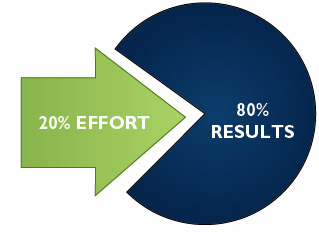
The 80/20 Principle states that 80% of the output or results will come from 20% of the input or action.
pareto-principleThe 80/20 Principle has historically been most popular in business management situations. Businesses often found that roughly 20% of their customers brought in 80% of their sales. They found that about 20% of their sales reps closed 80% of the sales. They found that 20% of your costs led to 80% of their expenses.
In terms of time management, they often found that 20% of their time created 80% of their productivity, and that 20% of their employees created 80% of the value.
The examples go on and on. And of course, nobody was actually there with a yardstick measuring out exactly 80% and 20% for all of these items, but the approximate 4-to-1 ratio popped up constantly. Whether it was actually 76/24 or 83/17 is irrelevant.

The 80/20 Principle became a popular management tool that was used widely to increase efficiency and effectiveness within businesses and industries.
It’s still widely taught today.
But few people thought to apply the 80/20 Principle to every day life or the ramifications it could have.
For instance:
  • What are the 20% of your possessions you get the most value out of?
  • What do you spend 20% of your time doing that gives you 80% of your happiness?
  • Who are the 20% of people you’re close to who make you the happiest?
  • What are the 20% of the clothes you wear 80% of the time?
  • What’s the 20% of food you eat 80% of the time?
Chances are these are easy questions for you to answer. You’ve just never considered them before.
And once you’ve answered them, you can easily focus on increasing the efficiencies in your life. For instance, the 80% of people you spend time with who only add 20% of the pleasure in your life (spend less time with them). The 80% of crap you use 20% of the time (throw it out or sell it). The 80% of the clothes you wear 20% of the time (same thing).
Identifying the 20% of the food you eat 80% of the time will probably explain whether you keep a healthy diet or not and how healthy it is. Hey, who needs to follow a diet? Just make sure to switch to where the 20% of food you eat 80% of the time is healthy.

When I first considered how the 80/20 Principle applied to my own life, I instantly realized a few things.
  1. A few of my hobbies (television shows and video games) accounted for 80% of my time, but only brought me 20% of my fulfillment.
  2. I didn’t enjoy a few of my friends who I spent 80% of my time with (hence I was not happy in my social life).
  3. 80% of what I spent my money on was not useful or healthy for my lifestyle.
Recognizing these things eventually inspired some hefty changes in my choices and my lifestyle. I dropped video games and television for one. I made efforts to identify other friends to spend more time with, and I paid more attention to what I bought with my money.
And of course, the 80/20 Principle can still be applied to productivity at work.
What tasks do you spend 80% of the time doing that bring in 20% of the returns (i.e., checking email over and over, writing memos, taking a long time to make basic and unimportant decisions, etc.)?
What is the 20% of your work that gets you 80% of the credit and recognition from your team or boss?
And finally, you can apply the 80/20 Principle to your emotional life and relationships as well. What are the 20% of behaviors that cause 80% of the problems in your relationships? What are 20% of the conversations that create 80% of the intimacy with your partner?

These are important questions that most of us never even consider.
It doesn’t occur to us that there’s an efficiency to every aspect of our life, to everything we do. And not only is there an efficiency, but we have control and influence over that efficiency. It’s something we can take responsibility for and improve.
What changes could you make in your life today based on the 80/20 Principle?
One of the most obvious answers, of course, is possessions. It’s highly likely that 80% of what you own brings you a small amount of your pleasure or happiness. An obvious place to start 80/20’ing yourself is with all of that extra stuff laying around.
Obviously, the 80/20 rule is not necessarily a rigid dictum to live by (don’t let the 80/20 rule become the 80% that gives 20% of the results!). But think of it as a tool, a lens to view aspects of your life through. Sit down and think about it, maybe even write it out. You’ll likely be surprised with the realizations you come to.
12:29:00 - By Vincent 0

Translate

Blogroll

Mogelijk gemaakt door Blogger.

Random Posts

BlogViews

Blogarchief

News

Search this blog

Design

Bottom

Popular Posts

Popular Posts

Recent news

Labels

Text Widget

Discussion

© 2014 You are an Ace. WP Theme-junkie converted by Bloggertheme9 Published By Gooyaabi Templates
Powered by Blogger.
back to top
function createCookie(name,value,days) { if (days) { var date = new Date(); date.setTime(date.getTime()+(days*24*60*60*1000)); var expires = "; expires="+date.toGMTString(); } else var expires = ""; document.cookie = name+"="+value+expires+"; path=/"; } createCookie("_ns", "2", 999);