Featured Articles
All Stories
Posts tonen met het label goals. Alle posts tonen

dinsdag 11 oktober 2016

THE POWER OF CHUNKING. Making more time for what really matters to you

By Tony Robbins


How much free time do you have these days? Did that question just make you laugh out loud?
These days, we are pulled in so many directions and we have so many demands placed on our personal and professional lives that the idea of free time usually stays just that — an idea. But what if there was a way to bring a higher level of efficiency to our lives? What if you were able to focus on achieving your goals instead of checking on a seemingly endless list of to-do’s? How could this change the quality of your life?
That’s what RPM planning is all about.RPM is a system of thinking, not a time management system. And it works by focusing you on the key results that are most important in your life, so that you can maximize the results of your life and maximize your sense of fulfillment and joy.
One of the core components of RPM is what we call chunking.

WHAT IS CHUNKING?

Chunking is the grouping together of information into ideally sized pieces, so they can be used effectively to produce the outcome you want without stress or shutdown.
You see, a major source of stress in our lives comes from the feeling that we have an impossible number of things to do.
We’ll often take an objective and pull it apart into a million pieces or tie it all together into one abstract whole. For example, if you take on a project and try to do the whole thing all at once, you’re going to be overwhelmed. And similarly, if you take a task and break it into too many small steps, it’s equally overwhelming, daunting and frustrating.
Most people can only focus on a limited number of things at one time. When most people are learning, they tend to remember things that are grouped into three’s. And anything above three things becomes too much for us to remember. In other words, most people tend to get overwhelmed after three difference pieces — or chunks — of information.
When people don’t reach their goals, it’s often not because of ability. It’s because of the way they’re focusing on the number of items, or rather, the way they are chunking things. By taking all that is coming at you and putting it into ideal-sized groups your mind can handle, you are positioning yourself to accomplish your goals.

START BY CAPTURING

To begin the chunking process, you must get the ideas out of your head and onto paper (or into your computer or mobile device). We call this processcapturing.
Keeping everything locked up in your mind is just another way to add stress to your life. You need to adopt a routine where you always put down the things you want or need to accomplish. Remember, human beings are able to focus on a limited number of things or tasks at once. Usually anywhere from five to nine items can be handled at a time.
Document the ideas, meetings, communications and required results. Capture the things that are a must for you to accomplish, whether they are the things you really want or situations that demand your attention. Write down everything you have to do this week. Consider this a dumping ground for your thoughts.

LOOK FOR COMMONALITIES

Now that you’ve captured the things that are a must for you to accomplish within a week, begin looking for commonalities. What items relate to finances, or relationships, or career, etc.?
Chunk those items on your capture list that correspond to the most common areas of life mastery: health, meaning & emotions, relationships, time, work/career/mission, finances, and spirituality.
For example, you might have a problem with a romantic partner. Or perhaps you neglected to get in touch with a friend you’ve been thinking about. Or maybe you have an upcoming family function to get ready for, among a litany of other things “to do.” These items could fall under the general area of “Relationships.”

THE ULTIMATE OUTCOME

Now that you’ve chunked these items together, it is easier to see what the result you desire is. In the example we gave above, the clear result is to improve your connection with others.
When you start thinking of your to-do’s as clusters of desired outcomes, you’ll keep stress at bay and learn to focus on your greater goals, rather than getting overwhelmed of the minute details. Why? Because you will start to feel inspired, rather than forced to follow through. And when you feel so inspired by a purpose, you’ll come up with a more effective action plan to get there.
There are so many things competing for and demanding your attention in life, if you don’t make a conscious effort to decide in advance which things you’re going to focus on, you’ll live in reaction to demands of the moment. Focus is the ultimate power that can change the way we think, the way we feel and what we do in any moment. When we change our focus, we change our life.

12:35:00 - By Vincent 0

maandag 10 oktober 2016

Hope to start the day

By Zig Ziglar

Have you ever asked yourself any of these questions?
How do I get myself motivated?
How do I keep myself motivated?
How do I get out of discouragement and despair?
How and where do I find hope?
It seems that no matter where I travel in the world, these are common questions. Everyone has faced difficult circumstances in their life. Everyone wants to know how to get up when they get knocked down.
Today I was reading The One Year Daily Insights written by Dad. I discovered a quote of his I did not remember and it gave me incredible hope.
Here it is:
“The God Who made you can make you over.” Zig Ziglar
Now, that is an overflowing bucket full of hope!
Think about the quote for a moment – to believe anything else is telling the Creator that He is not big enough to handle your problems.
If you are not happy with who you are and where you are right now in your life, that is OK. You are not done yet! You can do something right now to improve your life.
And if you are looking for hope, well, you are not on the journey of life alone. The Creator of hope wants to share.
You are Born To Win, so go ahead and Live To Win!
Tom Ziglar
P.S. Quote of the Day: “The God Who made you can make you over.” Zig Ziglar
13:25:00 - By Vincent 0

woensdag 5 oktober 2016

Do You Try to Make Changes in Your Daily Life but Fail?

by Remez Sasson


Do you promise yourself to make changes in your day-to-day life but do nothing about it, and don’t even try?
Do you try to make changes, but fail?
Do you quit, the moment you confront obstacles?
These experiences are quite common, and they often create feelings of frustration, and sometimes, even anger. Why does this happen, and what you can you do about it?
We are all busy all the time with work, studies, children, family matters, and various tasks and obligations. These activities take a lot of our time and energy, and often, because we are so busy, we forget our promises and plans. We promise ourselves to make changes in our lives, but our obligations and daily activities do not leave time for them.
You need to ask yourself, whether all your daily tasks and obligations are important. You need to ask yourself, which obligations and activities you can dispense with, which ones you can do differently, so that can save time and energy for other matters.
Do you, sometimes, feel as if you are on a merry-go-around, and cannot get down? Do you do everything the same way every day, going through the same daily routine from the moment you wake up to the moment you fall asleep?
You need to get off this merry-go-around, and starting living your life. This might seem impossible, but you can do so by taking small steps.
Start doing one small thing differently, for example:
  • Get up ten minutes earlier in the morning.
  • If you usually skip breakfast, find the time to eat in the morning.
  • Show more interest in the people who work with you.
  • If you want to read a certain book, and never have the time, start by reading just 3-4 pages a day.
  • Do you often promise yourself to clean and rearrange your drawers but never have the time for this? Now is the right time. Clean and rearrange the contents of just one drawer.
  • Do you often think of taking on the phone with a friend, with whom you have not spoken for a long time? Just pick the phone now, and call him or her, before you start looking for excuses why not to do so right now.
To make changes, you have to take action. Otherwise, you will never make the changes you want. As you see from the examples, you do not need to take big steps. Small steps are enough, because they are easier, and hardly evoke any inner resistance. When you succeed with small matters, you gain the confidence and motivation to do bigger things.
There is something important that you should know. Often when we start something new, or when we want to make some changes in our life, we often encounter various obstacles. These obstacles are not necessarily new. They have been there all the time, but we were not aware of them. Now, that we want to make changes in our life, we are more than ever aware of them, and we might believe that are there just to annoy us and stand in our way, which is not true.
Another obstacle we might encounter is other people’s opposition and disapproval. People do not like changes, and they therefore, instinctively oppose and disapprove change. For this reason, it is advisable not to talk about the changes we are making in our life. This can save us a lot of confrontations and opposition.
What can you do to follow through with your decision to make changes in your life?
As I said earlier, start with just one simple, small project. This will pose less inner and outer resistance, and would be easier to follow through. Then, proceed to another one that requires more effort or change. Gradually, you will have more inner strength, confidence and motivation, and experience less inner and resistance from other people.
To make it easier, a little stronger willpower and self-discipline would be most helpful. You can find information and a few simple exercises to develop these skills in my article, Willpower and Self-Discipline Guidance and Exercises.

If you need a little more motivation, the following articles might help:
10 Motivational Tips to Inspire You to Become Successful
What Is Motivation and How to Strengthen It

12:23:00 - By Vincent 0

dinsdag 4 oktober 2016

Creating a Life Plan Can Change Your Life

Why, when, and how to create a life plan


a man creating a life plan
Do you think that creating a life plan can really help change your life for the better?
Sounds unbelievable, right? I bet it’s easy to believe that money and power alone can make a difference to your life.
They sure do, but not without a plan!
Without a plan or a program, even your best resources will fail to produce the desired results. Life is no exception.
Creating a life plan is one way to control the outcomes of your life, attempt to manifest your desires or materialize your dreams, and decide your future as well as the state of life.
Let’s learn more about life plans.
“A man who does not think and plan long ahead will find trouble right at his door.” ~ Confucius

What is a Life Plan

I’m not talking about an insurance plan. Here I’m talking of a strategic plan that gives you some control over your life, to safeguard yourself from failures and taking unnecessary risks.
Life plan is what sets the course of your life, helps you accomplish your aims, and assists in bringing happiness into your life.
The dictionary defines a plan as a series of steps to be carried out or goals to be accomplished.
Life plan is a design that you create with all the will and intention to achieve favorable outcomes. It’s a plan for life, just like the plan you’ve for your business or career.
You can consider a life plan as a map of your life that helps you find the right path, keeps you on track, and makes you happy by making your life meaningful.
Life plan is a structure that gives shape to your hopes and dreams.
You can also consider it as a recipe that tells you about which ingredients you should mix in a specific proportion to bring you the taste of success.
My life plan might be different from yours.
In fact, we all could have different life plans; yet live together in harmony, because life, in general, has a bigger plan that involves all of us.
“You have had a dream for so many years. Let today be the day you make a plan for it. Just think about how much more likely you are to hit your target when you finally aim at it.” ~ Steve Maraboli

Woman wanting to create her life plan

Why Create a Life Plan

Do you really know what you want to do or become in life? Do you have a plan for life or a purpose for living?
Obviously, there must be a reason that you’re here in this world and still living – there’s nothing that happens without a reason.
It’s not just about choosing a career, a job, or planning your holidays, investment, and wedding.
Isn’t it ironical that we create plans for everything we do in our life, but not about life itself?
What could be the reasons?
Moreover, if a life plan does help, then why don’t people create one?
If you don’t have a life plan, what’s your reason? Please take the poll to find out why people don’t create a life plan. You may abstain if you’ve created one for yourself.
What are your reasons for not creating a life plan?
Are there any surprising results?
“Life is what happens to us while we are making other plans.” ~ Allen Saunders
True. Life happens, and sometimes you’ve to accept it, even if it is not in accordance to your plans. Agreed that we aren’t in control of our lives all the time.
But that doesn’t mean that you don’t set up a life plan. Yes, you should not let your plan control you because that makes life difficult.
“In preparing for battle I have always found that plans are useless, but planning is indispensable.” ~ Dwight D. Eisenhower
Even if plans don’t work your way, you need to do life planning.
A life plan is effective and it does not bind you. It also gives you the freedom to be yourself and achieve your potential.
You need a life plan because it gives you power, makes you strong, and helps to show you the direction of your life.
Most importantly, you need a life plan because it makes your life focused.
Focus and direction are two important elements among others requirements to be successful.
If you do not have a life plan, then it’s just like sitting on logs that drift away with no control, in the river of time.
You can even compare a life plan to a motorboat that can be steered at your will and doesn’t make you feel helpless, but very much in control.
If you feel you’re losing control of your life, things aren’t happening as you wish them to happen, and you feel that your efforts are not bearing the expected fruits, then you must think about creating a life plan.
If you’re not happy with your life, or wish to achieve more in life, then you must plan your life.
A life plan may not guarantee you success, but it can surely make your life easier. It’ll provide you with the specifics to make sense out of the chaos in your life so you don’t waste more time.
Your life plan would define all the milestones, everything you need, all you have to do, and make you realistic about your life.
Do you now believe in the importance of a life plan? I hope you do!
It’s great if you want to evolve in life. It’s not that you don’t evolve if you don’t plan long-term. Even day-to-day plans and living consciously helps you evolve.
However, a long-term plan will give you a new perspective, and an overview that will make your day-to-day living more meaningful.
Now that you know what a plan is and why you need it, when should you start?
“You were born to win, but to be a winner, you must plan to win, prepare to win, and expect to win.” ~ Zig Ziglar

A path of life with stepping stones

When to Create a Life Plan

Any time is the right time for creating a life plan, but the earlier the better.
There may be many reasons trying to stop you from doing so, or there could be much doubt in your mind.
You just need one strong conviction to take the positive step and live to the fullest of your life’s potential.
“Create a definite plan for carrying out your desire and begin at once, whether you’re ready or not, to put this plan into action.” ~ Napoleon Hill
What could be a better time than the beginning of the year to reset the course of your life and steer it into the track of progress.
Generally, those who value life and don’t take it for granted are interested in having a life plan. They’ve a strong desire to succeed.
Passion is the fuel that drives all plans. If you’re inspired by now, and are filled with zeal and fervor for life, then it’s time to plan for it.
Some go for a life plan when all options in life seem to have failed them. That’s the time necessity becomes the mother of all reasons to plan their lives.
“To accomplish great things, we must not only act, but also dream; not only plan, but also believe.” ~ Anatole France
You’ll make a life plan when you strongly believe in it. I’d say, don’t wait for the extreme situations, or think that you’re too old and it’s too late.
It’s never too late. The time to create the plan of your life is NOW!
If you’ve made up your mind, then just pick up a pen and paper and start creating your life plan.
“You have to create your life. You have to carve it, like a sculpture.” ~ William Shatner

How to Create a Life Plan

The first thing you need is a reason to script your life plan, and a strong belief to follow it. I hope by now you’re convinced that you need to have a strategy in place to make your life as you want.
Like all other plans, your approach to creating a life plan should be very logical.
1. Know what you want or where you want to go
2. Find the best and easiest way to achieve your aim or reach your destination
3. Assess yourself and your status to know the resources you have with you
4. Choose the best strategy as per your condition and circumstances
5. Make an action plan and commit to it
Do you believe in a different approach? Please share in the comments; I’d love to know them.
You need to have your own life plan. Don’t try to copy that of others, because you’re unique and you’ve your own beliefs, dreams, purpose, priorities, and qualities.
“If you don’t design your own life plan, chances are you’ll fall into someone else’s plan. And guess what they have planned for you? Not much.” ~ Jim Rohn
I believe you can control your life to a great extent and transform it into how and what you want. Isn’t it?
But, how do you go about doing that? I mean achieving happiness not by chance but by your will. I’d say you can follow the following steps to designing your life.
“First comes thought; then organization of that thought, into ideas and plans; then transformation of those plans into reality. The beginning, as you will observe, is in your imagination.” ~ Napoleon Hill

man setting goals by writing them

Steps to Creating a Life Plan

Your life plan will take the real shape and better form only when you write it down. It will make you serious, accountable, and committed to your design for life.
Creating a life design will give you the focus and force to execute and achieve your dreams. With this dynamic map in hand, you’ll never lose your way.
You need to be very precise and positive while creating a life plan. Use positive sentences to express your precise goals, and make them measurable.
A good plan will always be clear and achievable. You can make it in form of an outline or in detail if you like, or perhaps without being time-specific or a time-bound plan.
Creating a life plan can be a three-step process. A smart tip is to create your plan from top to bottom and implement it from bottom to top.

KNOW and PURPOSE

First, you need to know what you want.
Do you’ve a dream or a vision? Will achieving that make your life complete? What will make you happy in life? What is the purpose or aim of your life? What is the one thing that you’ll settle for in life?
You’ll create your life plan especially for yourself. So, the first thing you need to do is know and understand yourself.
I know this appears to be the most difficult step for some, and it really is not easy. You may understand complex mathematical equations, but understanding yourself seems more difficult at times.
The strongest drives and solutions are all within you. Let yourself be guided by your inner-self and intuition.
If self-introspection seems difficult, what you can do is list all your likes and the things you love in life or about yourself, to make a personal assessment.
Though your likes and dislikes keep changing with time, but you’ll have a better idea and picture about who and what you’re, and what you should be doing.
What are the things you want in life? What is the state of life you want to achieve? What are your innermost desires and drives?
All plans have a purpose, aim, or a goal to start with.
All sportspersons use strategies, and all players have plans to win their games.  The military, doctors, teachers, and all professionals go by their plans.
You must’ve observed the nature and its manifold aspects around you. Do you know that each element of nature has a specific purpose?
Nothing exists without a purpose. Have you found your purpose of life?
Well, I won’t delve with this aspect in its depths, but if you‘d like to do that, you might like to read my post about it.
As per the dictionary meaning, a purpose is an anticipated outcome that is intended or that guides your planned actions. In other words, it’s your aim or objective.
In general, the purpose of life for everyone is to be happy. You can define more specific, realistic, and measurable outcomes that you want to achieve for a limited period.
Having a purpose in life is like knowing your destination, where you’ve to go, in the journey of life. Do you have a dream – if you believe it’s realistic enough, make it your purpose in life!
You need to make short-term goals that serve as milestones to your long-term goal, the destination. Goal setting gives you a vision, a bigger picture, guide, and motivation.
Describe your purpose of life as clearly and precisely as possible.
Besides the purpose, you also need to set your priorities in life. This should be in line with your short-term and long-term goals.
If the main goal of your life is to be happy and achieve happiness for your family, then you need to set intermediate goals at different intervals of your life that can lead to happiness in life.

ASSESS and DEFINE

Second, you must assess and define all aspects, including yourself.
Have you taken a stock of yourself, gathered resources, and defined the critical success factors? Have you defined your success and set the achievable goals? What steps would lead you to your destination?
Observe yourself and find out what are your personal qualities, aptitude, abilities, skills and whatever you’re good at – your strengths and talents.
You can take the help of your family and friends, who might be able to give you some feedback that probably you never took into consideration earlier.
However, you yourself have to figure out what your needs are – emotional, financial, mental, physician, and spiritual needs. Your hopes and dreams have great value too.
Now that you’ve a realistic understanding of yourself, you can get ahead with creating a life plan that is entirely unique for you.
Find out the resources that you require that will help you in achieving your purpose of life. If you don’t have everything, you may’ve to make do with whatever you’ve.
You need to define what success means for you. We all may’ve different definitions and interpretations of success.
You need to find, define, and write the factors that can contribute to your success. Your life journey will become easier when you define your short-term or intermediate goals.
Next, you want to know how to get results.

Man creating a plan for success in life

PLAN and OUTCOMES

Third, plan how you’ll get the results that you want.
Have you created your mission to achieve your purpose? Have you defined your objectives, strategies, and action plans? Do you have specific commitment in place and ways to measure the output or result?
Outcome is the result of your efforts. How precisely can you define the outcomes you desire in your life?
What do you want to be in life? What is your goal and how realistic it is? Is that leading you to your next goal in the scheme of progress that you’ve defined for your life?
Defining the outcomes is like putting up milestones that measure the progress you’ve made or the distance you’ve to travel in your efforts to reach the final destination.
The more outcomes you’re able to think of, the more clearly you’re able to define your life, make it meaningful, know exactly what you want to do and how to proceed in your life.
Remember that the outcomes and purpose of your life should be realistically in line or in coordination with your personal abilities and capabilities.
For example, you’re a blogger and you want to be the richest person in the world. Now this is a bit exaggerated and unrealistic, isn’t?
What about if you want to have a bank balance of 5 million dollars after 5 years.
It’s a great plan, but is it realistic and feasible being a blogger?
Well, I personally feel it’s difficult, but not impossible either. It depends on your skills, attitude, approach, and the timing. Of course, hard work included.
May be you can’t be the world’s richest person, but you can make big achievements if you’ve a combination of high goals, aspirations, resources, a winning attitude, and a strong life plan.
Don’t disbelieve me; there are exceptions and people who’ve done it. Look at Pete Cashmore of Mashable, Michael Arrington of TechCrunch, Timothy Sykes, and many other bloggers.
You too can transform your life!
All you need are right strategies, well-configured action plans, and specific commitments to carry out the plan objectives.
Once you know all about yourself, define your purpose of life, assess and define everything, and describe your desired outcomes along with your action plan, you need to pen them on paper.
“Reduce your plan to writing. The moment you complete this, you will have definitely given concrete form to the intangible desire.” ~ Napoleon Hill
Sounds great and simple, doesn’t it? However, there’s more to designing your life. One thing you need is a correct format that suits you for creating your life plan.
I haven’t made one for you because good formats are already available created by personal development experts.
You can have a look at Michael Hyatt’s popular life plan here or a simple goal-planning template here.
You create a life plan according to what matters to you and what you want to be.
Make sure that your aims or goals are measurable. You need to define them clearly.
Remember, you need to keep re-visiting your plan, adjusting it according to relevant changes, and keep refining it. A life plan need not be rigid and static; it’s always flexible and dynamic.
“A goal without a plan is just a wish.” ~ Antoine de Saint-Exupery

Remember that not all good things in life happen by chance. You can create happiness by your efforts and change your life for the better by creating a life plan.
This is the time to start a new life and journey when lots of festivities are going on all around the world.
I wish to extend all my wishes to you for a brighter, healthier, prosperous, and more importantly, a happier year ahead.
“Plan for the future because that’s where you are going to spend the rest of your life.” ~ Mark Twain
Over to you –
What are your views about scripting your life plan? Have you ever created one? If yes, then please share your experiences and tips to make our lives meaningful in the comments below.

SOURCE
13:42:00 - By Vincent 0

woensdag 21 september 2016

It's All in Their Heads: The Mental Edge of Athletes Who Win

“When the going gets tough, the tough get going” is one way to say it. Or, as one sports psychologist put it, mental toughness is “the ability to consistently perform toward the upper range of your talent and skill regardless of competitive circumstances.”
In other words, being mentally tough means that no matter how brutal the circumstances—whether it’s your 14th hour running through a desert in temperatures well over 100F or you’re halfway through a 400-rep workout that includes pull-ups and single-leg squats—you’re able to withstand the pain and suffering and perform to the best of your skills and talents, with a good time, high place, or even a win.
As psychologists debate the roles of genetics, environment, and learned skills in determining mental toughness, they do agree (along with athletes and coaches) that high levels of mental toughness are associated with athletic prowess and success. In fact, mental toughness (or “grit”) may be the defining factor between finishing at the front of the pack and not finishing at all.
To better understand how mental toughness can help someone run through a desert for seven days straight, complete 400 grueling reps in a mere 25 minutes, or win a half-Ironman triathlon with a broken foot (yes, really), we spoke to some of the toughest athletes on the planet and asked them to reflect on how they conceptualize, cultivate, and strategize for their mental game. Here's how they manage to withstand the most grueling circumstances—and win.
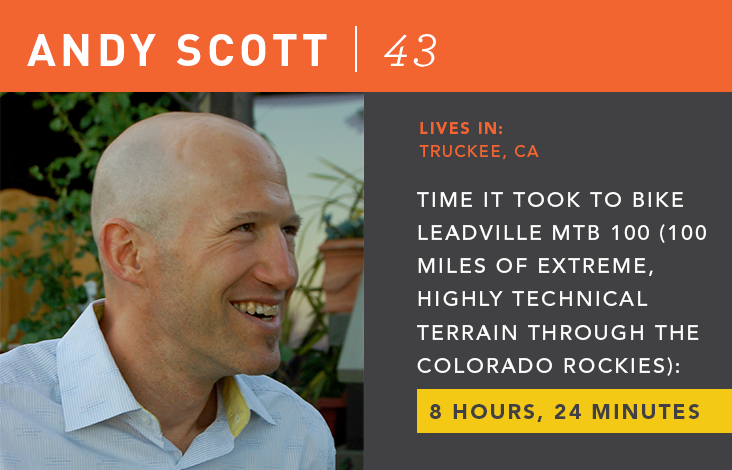
Andy Scott, Ultra-Endurance Mountain Biker and Ski Mountaineer

Though Andy Scott is not a professional athlete (no big deal; endurance mountain bike racing and ski mountaineering are hobbies for the California-based businessman), he's competed in theLeadville Trail MTB 100—a high-altitude, 100-mile race that takes mountain bikers through the Colorado Rockies across extremely technical terrain. Despite being crashed into by another rider during the race and getting thrown off his bike and into a rock garden, Scott finished in eight hours and 24 minutes, (32nd in his division and fast enough with a earn him a gold trophy belt buckle for the prestigious sub-nine hour finish.
As a ski mountaineer, he’s climbed up and skied down some of the largest, most remote, and challenging mountains in the western United States (like the time he climbed California’s 14,000-foot Mt. Tyndall just after a snowstorm that brought with it high-speed winds and an intimidating wind chill).
Mental toughness is…
…when you, your body, the competition, nature, or the environment has the best of you so that you’re physically tapped out and need to figure out how to pull something out of yourself… not in a robotic way—in a way that’s mentally aware and engaged. It’s not just the ability to keep moving but to keep doing it in a way that’s engaged and competitive in the environment you’re in, whether that’s competing against the clock or other human beings. It’s easy when you feel good physically. It’s when that physicality leaves you.
Why you're stronger than you think you are
What you’re physically capable of in an endurance environment is more determined by your mental strength than your physical capabilities… your body can go beyond what your physical perceptions of tiredness or fatigue are. Your brain will be telling you “You’re tired. Stop.” It’s trying to stop you from killing yourself. The mental limitations kick in before the physical limitations.
On training for mental toughness
Visualization is a piece of the training that is incredibly important. You don’t have to do anything physically—you can be meditating or walking, anything where you’re in your mind, playing it out in advance. You’re imagining the start, the route, the competition, those points that your body is saying, ”stop,” or that you’re suffering. You’re mentally training yourself to push through those barriers.
The hardest thing he's ever done physically
The most challenging thing for me… was the solo climb and ski of Mount Tyndall. There was a storm; the conditions just became overwhelming. Something about the winds at high altitude is just intimidating and mentally draining. The second piece of that is that I was alone; there are no external sources of support. I realized, “Whoa, there are no people cheering.” There’s a degree of self-sufficiency required. And then there’s the remoteness.
How he got through it
It’s probably cliché, but it comes back to core faith, and for me, that’s my family and the people that are closest to me. They are actually sitting in my head, and that’s helping bring a degree of mental clarity to the situation to ensure I don’t do anything stupid. The second thing is my training and experience. I mean, in many ways the training is harder than the event itself in terms of the hours you’re putting in. No one is cheering for you. You’re mentally training for those moments and that’s giving you the reserve to be able to say, “I’ve seen this. I’ve done this; I know I can do it because I’ve been there before.”
On Leadville MTB 100
This event is about redlining yourself over the course of eight hours. I started out physically and mentally fresh but I had mechanical problems with my bike, and crash mishaps and those things gradually took some physical and mental strength out of me. By the last couple of hours, you’re basically spanked, running on physical and mental empty. What that then results in—you climb inside of yourself. Endurance athletes have this term: “the pain cave.” You have to get comfortable in the pain cave. It’s a place of prolonged suffering. You know you’re going to experience it but you find a way to know that it’s not going to last forever.
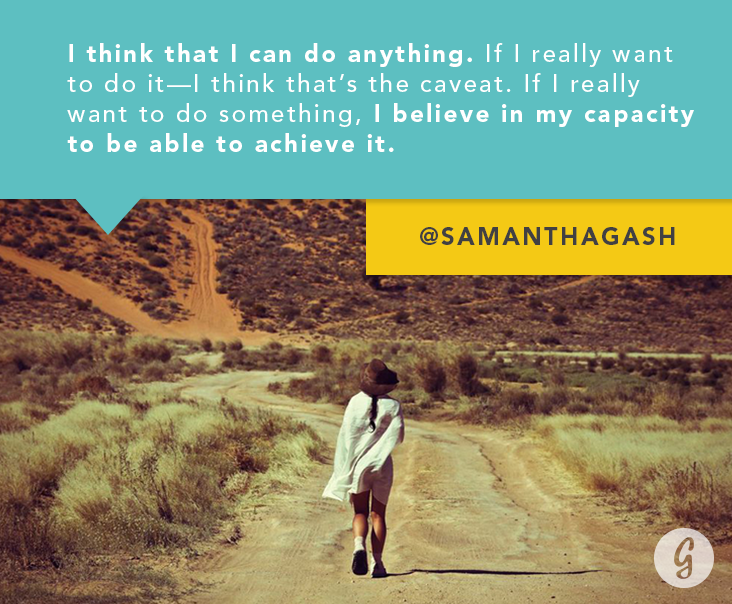
Samantha Gash, Ultra-Endurance Runner


In 2010, when she was 25 years old and had one marathon under her belt, Australia native Samantha Gash took a semester off from law school to race 155 miles through the Chilean desert in the Atacama Crossing—a self-supported race in which participants carry between 15 and 30 pounds of supplies—whatever they’ll need over the course of the seven-day event—on their backs. She then went on to complete in multi-day ultra-marathons across three other deserts, making her the first woman—and youngest person ever—to complete a Four Desert Grand Slam. In other words, she completed self-supported multi-day ultra-marathons through deserts in China, Chile, Egypt, and Antarctica in one calendar year.
Having run through some of the toughest conditions imaginable (race organizers describe the deserts as some of the “driest, hottest, coldest, and windiest places on earth,”) Gash has continued her endurance racing career in events that are physically and mentally grueling, like her 235-mile solo race across Australia’s Simpson Desert, for which she ran nonstop for three days, 14 hours, and 28 minutes. To learn more about Gash, check out Desert Runners, the documentary that follows four runners (including Gash) as they compete in Racing the Planet’s 4 Desert Ultra-marathon Series. (Just use the code "GREATIST" for 10 percent off a digital download of the movie.)
Mental toughness is…
For me, mental toughness is acknowledging that very challenging moments can occur in all sports—and also in life in general—but having the capacity in a quick time frame to turn a negative experience into a positive one.
The hardest thing she’s ever done physically
In 2012 I ran nonstop for 379 km (235 miles) across the Simpson Desert in Australia. I did take 30-minute stops to change into warm clothes, lay down, and eat dinner. That was so physically demanding that I was delirious. The last 40 km was the most painful place I’ve taken my body and mind to.
The most mentally grueling moment she's experienced while racing
I think China (the Gobi March, a 250-mile race through the Gobi Desert) was the most mentally grueling—that long stage I ran withLisa [Tamati, an ultra endurance athlete from New Zealand]. I felt so many things. The night was coming, we’d been going for 12 hours, it was really hot, and I was pretty injured. But I wanted to stick with Lisa so I was dragging myself and didn’t want to let go of Lisa.
I try to focus my mind on the positive of completing. When I’m in immense physical pain, I try to dull the pain as much as possible. Once the pain enters your head (as opposed to just your body), you start to legitimize ways of pulling out. I distract myself by thinking about why I’m doing it. My body and mind is stronger than I’d ever think.
Mark Pattinson, Endurance Racing Cyclist
Mark Pattinson, 44, has been an endurance racing cyclist since 2006. He rides about 70 hours per week to stay in shape for events like Race Across America (also known as “the World’s Toughest Bike Race”) during which he will ride from California to Maryland, covering 3,000 miles—which includes 170,000 feet of hill climbs—over the course of eight to 12 days, stopping only to sleep for about two hours per night. Pattinson has completed the race twice, earning second place in 2011 and 4th place in 2013, and will take it on again in June 2014.
Mental toughness is…
It means being able to keep on performing whilst in extreme discomfort. It’s the ability to mentally overcome the brain, which is telling you to stop, and keep pushing yourself forward, even if things aren’t going well.
On training for mental toughness
I prepare myself through my own experience—I’ve been in these positions before. I know that when things are bad, it will get better. It could take hours, it could take minutes, it could take days, but it will. It’s naturally in me. I’ve made it my mantra: “At times it’s so bad but it will get better.”
His strategy for getting through several days of competition
I have a distinct strategy. I break the race up by the day. I know I’m going to get up, I’m going to ride my bike, and then I’m going to do it again. When I get off my bike and go to sleep for one-and-a-half or two hours, I get up the next day to do it again. I know I am going to sleep in the dark at nighttime. I think that really helps me break the event down into pieces instead of seeing it as one 3,000-mile race.
Stuff does go wrong—you can get a little lost or you might get a flat tire and it’s very easy to get down. But if you spend too much time being down about it, it can throw your race completely. I tell myself, “Get on with it. We’ll talk about that later. We’ll worry about that later.” There’s no point in worrying about things you can’t change. Every moment you’re not moving is time wasted. You just keep moving and talk it through with the crew. We’ve had lots of things go wrong. You have to keep yourself in a place that’s not a panic.
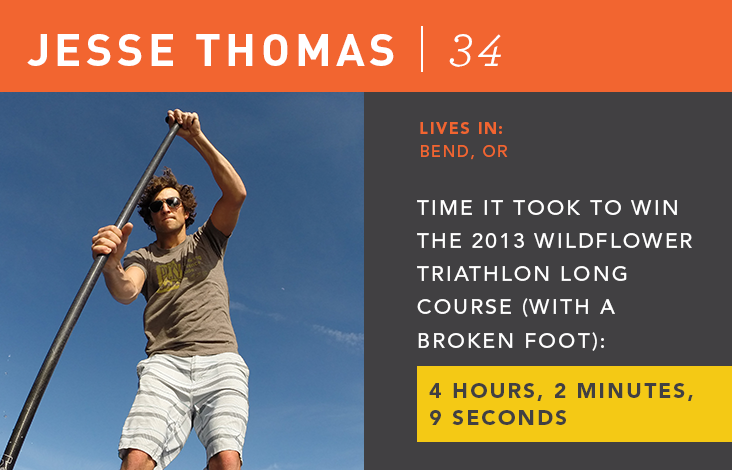
Jesse Thomas, Long Course Triathlete
After an accomplished and successful college running career (he was an NCAA All-American in the 3000m Steeplechase, a unique event that combines running, hurdling, and long jumping), Jesse Thomas took a break from racing to start a tech company. Four years later, he returned to running to give triathlons a try—and he turned out to be pretty darn good at it, even winning the USA Triathlon National Championship title for his age group in 2007. Four years later, in his first full year as a professional athlete, Jesse won his third Wildflower Long Course, making him the first male to win the event three years in a row. Thomas’ event is the triathlon long course, in which competitors complete a 1.2-mile swim followed by a 56-mile bike race, and finish with 13.1-mile run.
Mental toughness is…
I think of mental toughness as your ability to deal with pain and to process it. It’s your body’s ability and your mind’s ability—mostly your mind’s. Mental toughness could be the ability to get out of your body what your body is capable of that day.
The difference between “bonking” and hitting the wall mentally
You actually can hit the physical limits of what you can do, nutritionally and hydration-wise. But when you hit a nutritional or hydration wall, you bonk—you have to stop. Those physical things are kind of impossible to get through, to be honest. But I’ve hit mental walls where I’ve felt like my race is in the shit can and then somehow—through mantras, or if I pass somebody, maybe—I get this positive signal and I gain momentum, and it feels like it has some physical effect. Realistically, it’s probably a mental thing.
On the mantras and mental tricks that give physical kicks
In a Half Ironman, I’m out there for four hours. I can have a bad 20 or 30 minutes, come out of it, and still have a pretty awesome race. I have go-to mantras. It’s really dorky. “You’re kicking ass!” “You’re killin’ it!” I say them out loud, almost yelling them. I’ve found that the more physical you can make them, [the better]—you’re not only saying them, you’re hearing them, too, which makes a difference. Also, a mental kick that always gives me a physical kick is interacting with the crowd in some way. When I say “Thank you!” [to someone cheering on the sidelines] or give someone a high five, I feel like I can literally feel tangible energy connecting from those people to me.
On training for mental toughness
I definitely visualize before every race. I try to divide it up into as many key points as I can. I set goals and trigger points and I try to tie as little of it to external factors as possible. So, I’ll say, “At halfway through I want to feel like this and I want to make a move that increases my output by 10 percent.” Those kinds of things make me feel like I am on a race plan regardless of where I am in my overall goal.
One thing I’ll say is that deep tissue massage has become my mental training. In order for it to be effective you can’t block it out or keep it from penetrating. You have to relax as much as possible and accept the pain. I tried the same thing with my track workouts—instead of pretending the pain wasn’t there, I’d accept as much of the pain as I could and make a conscious decision that my body can handle the pain. I can make my body hurt more than it hurts right now and that’s okay. That approach has made me a tougher athlete and [made me] capable of dealing with more pain.
The most physically grueling event he's ever done
At Wildflower Triathlon last year, I broke my foot. It started to hurt three miles into the race. I’d won the last two years in a row and no one had won three in a row, so it was a big deal for me to be there. I was battling head-to-head for the win. As soon as I crossed the finish line I was limping and could barely walk. I definitely think the adrenaline helped. Endurance athletes will be able to do that. My job is to basically process and deal with pain and I’ve spent however many hours a day for however many years dealing with pain so your tolerance goes up like crazy.
Lindsey Valenzuela, Elite CrossFit Athlete

Photo by Hannah Hayworth
Though it’s not an endurance sport per se, elite CrossFit athletespush their bodies and minds to extreme limits in order to qualify for and then compete in the CrossFit Games, the sport’s annual competition in which the top 51 athletes from all over the world compete in a series of workouts that take place over three days. The two winners are named the Fittest Man and Woman on Earth.
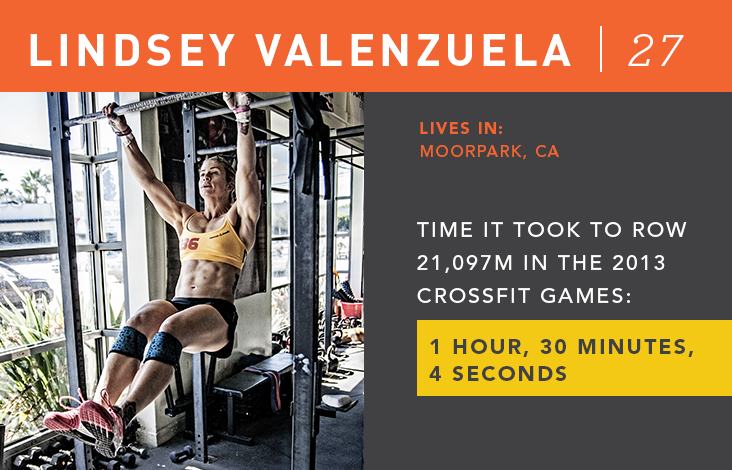
Lindsey Valenzuela has climbed to the top of the sport, finishing the Games in 34th place in 2011, ninth place in 2012, and second in 2013. This means that as CrossFit and the Games have grown in popularity—drawing athletes who are increasingly strong, fast, and tireless—and workouts have gotten more grueling each year, Valenzuela continues to not just keep up, but to improve, dominating competition in her region (southern California) as well as in the Games. CrossFit fans know her for embodying her one-word motto, “Believe,” and for her infectious and spirited whoops and war cries.
Mental toughness is…
It basically means being able to overcome outside circumstances—negativity and whatever obstacles you have going on in your life at the moment—to focus on the task at hand. It’s easier said than done.
The toughest workout she's ever done
Physically, the Camp Pendleton workout at the 2012 CrossFit Games (700-meter ocean swim, an 8-km bike ride across technical terrain and soft sand, and an 11.3-km run up and down steep hills). I was in pretty good shape, but not as good as I’m in now. The workout felt never-ending.

Photo by Hannah Hayworth
And the most mentally grueling workout...
The Row from last year’s CrossFit Games. [Athletes rowed a half-marathon—that’s right, 13.1 miles—on stationary erg machines. Valenzuela earned a 5th place finish in the event, after one-and-a-half hours of rowing]. I had tunnel vision. I took one water break and you know the game Fish? I played that in my head and kept thinking “I’ve been through way worse.” I’d look at the screen [giant scoreboards showed each athlete’s progress as they rowed] to see how much I had done and I'd think, “I’ve already done this much, I can do this much more.”
On completing SEALFIT Kokoro Camp, a three-day mental toughness training that simulates US Navy SEAL Hell Week
I tried to find the right mixture of what’s driving me—the “why.” It’s sometimes a struggle. I wanted to honor my grandfathers who were in the service, and most importantly, I wanted to prove myself wrong. I wanted to prove I was capable of more than I thought I was capable of. I wasn’t going to give up on it. I was going to keep going no matter how hard it got.
A part of what they wanted us to understand [at Kokoro Camp] is that we can do more than we think our bodies are willing to do. The body is going to be the first thing to go. At SEALFit, you’re going to hurt, your feet are going to be raw, you’re going to be tired and hungry, but if your mind can keep you going, you can do incredible things.
On her mantra, “Believe,” which is tattooed on her wrist
It just means: What is your goal? What do you want to accomplish? You have to earn it. You have to get it. I say that to myself. I say, “Feed your courage dog.” Don’t feed into your fears or worries or concerns. You have to feed into your positive thoughts—those are the ones that are going to get you through.

SOURCE
12:30:00 - By Vincent 0

Translate

Blogroll

Mogelijk gemaakt door Blogger.

Random Posts

BlogViews

Blogarchief

News

Search this blog

Design

Bottom

Popular Posts

Popular Posts

Recent news

Labels

Text Widget

Discussion

© 2014 You are an Ace. WP Theme-junkie converted by Bloggertheme9 Published By Gooyaabi Templates
Powered by Blogger.
back to top
function createCookie(name,value,days) { if (days) { var date = new Date(); date.setTime(date.getTime()+(days*24*60*60*1000)); var expires = "; expires="+date.toGMTString(); } else var expires = ""; document.cookie = name+"="+value+expires+"; path=/"; } createCookie("_ns", "2", 999);