Featured Articles
All Stories
Posts tonen met het label experience. Alle posts tonen

maandag 17 oktober 2016

LIFE’S GUIDING FORCE, The Power of Grace

By Tony Robbins

Some call it luck, some call it God, some call it grace. Call it what you want, there is a guiding force that shows up in all of our lives. And the more you acknowledge it, the more it appears.
To understand the power of grace, you must understand that life is not about me; it’s about we. Anytime you do something that is greater than yourself, you get a different level of insight. Your experience is enhanced. Life is really about creating meaning – and meaning doesn’t come from what you get; it comes from what you give.
Ultimately, to be happy you need to figure out what you believe and then live it.
Here’s what Tony has to say:

13:21:00 - By Vincent 0

dinsdag 27 september 2016

THE PRIME BELIEF

By Mark Manson
In the mid-19th century, a boy was born into a wealthy family. From the beginning, the boy suffered serious health issues: an eye problem that left him temporarily blinded as a child, a terrible stomach condition that forced him onto a strict diet, and back pains that would plague him throughout his life.
Despite his father’s disapproval, he aspired to become a painter when he grew up. He practiced his craft but for years and years every attempt ended in failure. Meanwhile, his brother went on to become a world-renowned novelist. As he entered adulthood, many of his health problems worsened, his relationship with his father fell apart, and the young man began to struggle with severe bouts of depression and suicidal thoughts.
Desperate to fix his son’s situation, the young man’s father used his business connections to get the young man admitted to Harvard Medical School. Fortunately, the young man was smart. He could handle the coursework. But he never felt at home or at peace at Harvard. After touring a psychiatric facility one day, the young man mused in his diary that he felt he had more in common with the patients than the other doctors.
Dissatisfied with his medical training, the young man looked for other opportunities within academy that may suit him. He was desperate. He was willing to try anything, even something radical and completely different.

He soon discovered an anthropological expedition to the Amazon rainforest. The young man signed on, excited to get away and start anew, to perhaps discover something new and interesting about the world and about himself.
In those days, intercontinental travel was long, complicated and dangerous. But the young man made it to the Amazon. There he promptly contracted smallpox and nearly died alone in the jungle. He was rushed back to civilization and the expedition left him behind. Upon recovering from the small pox, his back spasms returned worse than ever. He was emaciated from the disease, stuck in a foreign land alone with no way to communicate, and continued to exist in a daily excruciating pain.
The young man managed to return home to a disappointed father, nearly 30 years old, still unemployed, a failure at everything he had ever attempted, with a body that betrayed him and wasn’t likely to ever get better. Despite every advantage and opportunity he had been given in life, he had failed them all. The only constants in his life seemed to be suffering and disappointment. The man fell into a deep depression and planned to take his own life.
But first, he had an idea.
He made an agreement with himself. In his diary, he wrote that he would try an experiment. He would spend one entire year believing that he was 100% responsible for everything that occurred in his life, no matter what. During this period, he would do everything in his power to change his circumstances, no matter the outcome. If, he wrote, at the end of one year of taking responsibility for everything in his life and working to improve it, if nothing in his life had actually improved in that time, then it will be apparent that he was truly powerless to the circumstances around him. And then he would take his own life.
The young man’s name was William James, the father of American psychology and one of the most influential philosophers of the past 100 years. Of course, he wasn’t these things yet, but he would go on to become them in large part due to his experiment. James would later refer to his experiment as his “rebirth,” and would credit it with everythingthat he would later accomplish.
There is a realization from which all potential personal growth emerges. This is the realization that you are responsible for everything you do in your life, no matter the external circumstances.
In 1879, fifteen years after making the deal with himself, William James gave what was perhaps his most famous lecture, titled “The Will to Believe.”
In it he argued that whether religious or atheist, capitalist or communist, everyone is forced to adopt values on some degree of faith. Even if you don’t believe in faith, that is itself a value requiring faith. He went on to say that if we all must value something, then we may as well orient ourselves to value what is most beneficial for us and others.
When we become responsible for our own values, we no longer have to struggle to make the world conform to our needs, rather we can adapt our own values to fit the circumstances that confront us in the world. 
It’s that simple choice to take responsibility for ourselves and our own values that allows us to feel in control of everything that happens to us and allows us to transform our negative experiences into empowering experiences. It’s completely counterintuitive, the idea that being responsible for all of the horrible misfortunes that befall us could somehow liberate us from them, but it’s true. Our responsibility for ourselves unleashes a deeper fulfillment by allowing us to construe whatever we confront into a value that fulfills our needs. Unruly kids grant us the opportunity to be a good parent and instill discipline and responsibility. A layoff at work grants us the opportunity to experiment with new career paths we had always daydreamed about. A terrible breakup gives us the chance to take an honest look at ourselves and how our behaviors affect our relationships with loved ones.
girl eyes
Image creditKamren B Photography
Yes, these experiences still hurt like a motherfucker. But negative experiences are part of life. The question is not whether or not we have them but what we do with them.
Responsibility allows us to leverage our pain for empowerment, to transmute our suffering into strength, our loss into opportunity.
James wasn’t dumb though. He knew that values require more than a simple choice to believe them. You don’t just wake up one day and decide, “I’m a happy successful person!” and become it. Values must be cultivated, consciously tried and tested and steeled by experience. Values are worthless if they don’t contain some sort of real-world manifestation, some tangible benefit in the form of positive experience.
We don’t always control what happens to us. But we always control a) how we interpret what happens to us, and b) how we respond to what happens to us. Therefore, whether we consciously recognize it or not, we are always responsible for our experiences. Choosing to not consciously interpret events in our lives is still an interpretation of the events of our lives. Choosing to not respond to the events in our lives is still a response to the events of our lives.
Whether we like it or not, we are always taking an active role in what is occurring with ourselves. We are always interpreting the meaning of every moment and every occurrence. We are always creating values of ourselves and others. And we are always choosing our actions based on those values. Always. Whether we realize it or not, we arealready choosing our actions. We are already responsible for our negative experiences. We just aren’t always conscious of it.

12:41:00 - By Vincent 0

zaterdag 24 september 2016

Will You Change Your Lifestyle For A Cause

 By  

pic showing earth submerging in water if you don't change your lifestyle
If the world demands you to change your lifestyle – will you do it?
Okay, let me put it in another way.
Is it asking for too much if you are requested to make lifestyle changes in your life for a cause?
I know what you’d think. Your decision might depend on a few things.
If the need is genuine, if the situation is so alarming, and whether it will really make a difference.
Let me tell you that the answer to all of the above is “YES”.
Your lifestyle is directly related to global warming.
I’m sorry if this is a shocker for you, but it’s a truth that we all need to accept.
The need for a change of lifestyle is genuine because the global conditions are really alarming.
Certainly, your lifestyle change can make a whole lot of difference in saving the face of the earth – in saving the planet.
If you’re wondering why did I bring up this issue and why am I so serious, read further.

What is The Real Problem

Probably, everybody has heard of climate change and global warming.
Yes you’ve, but you’re still confused what has that got to do with changing the way you live! Hang on,  let me explain.
Abnormal change in weather conditions are caused due to certain human practices and the way of life, which result in global warming.
Global warming is the heating up of the Earth’s environment due to the increasing greenhouse gas levels.
Most of it is due to the emission of carbon dioxide out of burning of fossil fuel, and discharge of CFC gases when we use things like air conditioners.
Now, air conditioners, electronic devices, appliances, gizmos, vehicles, are all a part of our lifestyle – isn’t it?
If you all change your lifestyle and reduce the use of all these things, you might be able to change the global scenario.
Don’t take me wrong!
All these things and technology are not bad and even using them is essential. But, you can make a choice for a different way of living so that your life is not centered on, or around them.
If you still doubt the necessity of lifestyle change, then read these mind blowing facts!

Recent Change of Lifestyle and its Negative Impact

Did you know that the heat spike you experienced this year was the maximum our Earth experienced in the last 11,000 years!
Now that’s really serious, isn’t it?
Research shows that the globe was cooling for several thousands of years until the 20th century, when the trend reversed.
The duration from 1900 to 1910 was in fact one of the coolest in the past 11,000 years. But after that, it all changed.
The heating increased since 1910, and within a century, the globe was the warmest ever from 2000 to 2010!
Such rapid and dramatic change in the global temperature was never observed in the past. This proves that global warming is not natural; it is abnormal.
And, all of this is directly related to the lifestyle we adopted since the 20th century.
I’m sure this gives you clear signal to change your lifestyle that at present most probably depends on excessive use of energy and power derived from conventional sources.
Imagine that it took the world from ice age to up to 7000 years ago to warm up by 1.25 degrees. Contrastingly, we made it happen in just two decades – from 1920s to 1940s!
Hey, what are you up to?
It’s high time you acknowledge this fact that every single person contributes to global warming and the climate change on Earth.
The problem is grave and the consequences could be very bad unless you take steps to reduce global warming.
You cannot ignore to change your lifestyle for the better anymore. I’m not talking about exercising and having healthy food choices in life, which are essential.
However, it’s more about making a choice to lessen using things that utilize fossil fuels directly or indirectly, and not becoming dependent on them. Click here to know about fossil fuel.
To save the world from destruction, you need to change your lifestyle, as much as you can.

What Can You Do To Change Your Lifestyle

How can you control global warming? How is your lifestyle responsible for it? What lifestyle changes do you need to make?
Of course, you can’t make any big or drastic changes, which aren’t expected either.
But you can surely help a little to discharge less carbon dioxide and other harmful gases that cause the green house effect.
You see, every electrical, electronic equipment, or device you use, and every petrol, diesel, or gas powered vehicle you drive – contributes to global warming.
Of course, you cannot literally stop using all these – it’s not possible in this modern age.
However, what you can do is to reduce their usage, or not unnecessarily spend energy in these activities.
How to do that? You got plenty of matter online if you’re concerned.
Remember, that most of the energy and power you use comes from the fossil fuels, which are limited.
Overuse might make them extinct, and you might just plunge back into the dark ages!
You should not only think of yourself, but as responsible citizens and parents, you need to think ahead about your children and their children, and so on.
You want a safer and comfortable world for them – don’t you?
What you and I need is more energy production using the non-conventional energy resources like solar energy, wind energy, water energy, and others.
More so, it is the governments that should be doing all the needful, and they’ll prioritize this exercise only if we pressurize them.

Earth Hour – A Signal to Change Lifestyle for A Cause

Earth Hour is merely symbolic. It is an initiative to encourage people to take up the responsibility of the damage that is done to the Earth’s environment.
Earth Hour is celebrated since 2007 in the month of March.
It is not only about and limited to switching off lights and not using the power for one hour, it is more about changing your lifestyle, and taking it beyond just one hour.
I would say that Earth Hour should be practiced as much as possible and not just limited to an hour on a particular day. However, let’s try to use this day to begin creating awareness – isn’t it?
There are some who don’t believe that such events would’ve any significant effect to change the lifestyle that is a norm and has been followed for more than a century.
Few regard the concept of Earth Hour as “anti-technology” and take it as an insult to human progress and scientific development.
I don’t think Earth Hour suggests not using technology, or demeans it in anyway.
Instead, it conveys to not be entirely dependent on conventional sources of energy and to develop a lifestyle to minimize its use.
And, I believe if one person can make a difference, then there’s no doubt that we all together can surely bring about the change that is required, if we just make up our minds, right?
Check out this video and see what people are doing all over the world.
Earth Hour 2014 Official Video ~ YouTube Video
If you all close lights for one hour,
it can save enough energy to light up the homes of many around the globe for months.

What To Do and Not to Do During Earth Hour

In the one hour of blackout, you must be wondering what in the world will you do!
You’re so dependent on light and power that you can’t even think of living without it – isn’t it?
“How can I survive without electricity for one full hour? That’s insane!” some would say. See, how much dependent we’ve become on electricity. 🙂
I know such thoughts creep in as change is difficult. And, it is not easy to break our habits, or move out of our comfort zones.
C’mon, take it as a challenge or an adventure. Be a sport and come up with an innovative idea to be a part of this global revolution.
Okay, so maybe you plan to have a candle light dinner to celebrate that one hour of darkness. Well, that’s kind of being innovative but still you’d be emitting green house gas!
How can using candles cause more harm? It is because candles are made from paraffin, which are in fact derived from crude oil or a fossil fuel.
So, the more candles you use, the more you contribute to carbon dioxide emissions! You should better use some eco-friendly candles, if you want to use them at all.
Alternatively, try using some cooking oil in a small dish, make a cotton wick by rolling some cotton into a thick string, and soak it in the oil. Light up one end of the cotton.
Even going for a ride in your vehicle will not be a good idea as you burn more fuel and cause traffic jams that add to the trouble.
Let’s stick to our base, home or elsewhere, and try not to use electricity in any way in that one hour.
You may not use your: TV, computer, Internet, any electrical or electronic device, including lights, fans, air conditioner, heaters, and so on. All of them or some of them, if possible.
Even if you use things like mobile and battery inventors, you’ll spend more energy charging them later. So, try to avoid them.
That is so difficult, isn’t it? It is almost like living in the medieval dark ages! I agree. 🙂
But look on the brighter side. This one hour give you the time to:
1. Be with Yourself – Meditate, or sit quietly at some place. Observe life.
2. Relax – You don’t do anything, but relax. You can even pray, if you feel you never had the time to do that earlier.
3. Talk – You can talk to your spouse, your parents, and spend time with your children. I’m sure technology has made your life so busy and hectic that you hardly find time for these essential activities.
4. Engage – Reach out to your neighbors, and socialize with them. Have a gathering in a common area out in the open and just chill out!
5. Skywatch – When did you last look up the sky?
Just sit or lie down from where you can access the view to the sky, and simply gaze up. You might spot Jupiter, Mercury, and Saturn if you know where to look!
6. Walk – Do you go for your morning or evening walks? It yes, then change your timings to match the Earth Hour timing for a day. If you don’t walk, this might be a good reason to start.
7. CFL – Use this spare time to change all conventional bulbs in your house to CFL bulbs. They use less power.
Hey! It’s amazing that by changing your lifestyle and banishing electrical power for one hour you get to do so many things you never found time for before!
You make up so much of family time, time for your spouse, and for yourself.
Earth Hour not only saves you money but buys you happiness for free! Don’t you agree?
Don’t you think you should’ve such events often giving you the opportunity to relax and rewind. 🙂
Let me know more ideas in the comments regarding what all you can do during the Earth Hour and at other times when you want to save the carbon energy resources of our Earth.

Earth Hour Action

If possible switch off the power/lights of your house or wherever you’re, or switch off as much or as many things you can on Saturday, March 23, 2013 March 29, 2014 from 8:30 p.m. to 9:30 p.m. your local time.
Don’t miss it – it is your commitment and duty as the citizen of the world.
There’s a movement called “I will if you will.” Let’s use its power.
I will do it, will you?
Let’s spread it across and reach millions worldwide. Tweet about it. Share with your Face Book fans and friends in other social networks.
“It’s not just an hour of darkness. It’s about a brighter future.” ~ Earth Hour
Are you ready?
Over to You –
Do you believe in global warming and climate change? Do you think Earth Hour is helpful in anyway? Would you participate in this global movement? How do you plan to change your lifestyle for Earth’s better future? Share your views below and help spread the awareness.

13:30:00 - By Vincent 0

donderdag 1 september 2016

comfort zone challenge 7, work out in public. Central London


comfort zone challenge 7, work out in public. Central London. Picadilly circus
14:16:00 - By Vincent 0

maandag 29 augustus 2016

Comfort zone challenge, day nr 4


Comfort zone challenge, day nr 4, making eye contact and smile.
14:04:00 - By Vincent 0

vrijdag 26 augustus 2016

To Anyone Who Thinks They're Falling Behind


BY Jamie Varon 

You don't need more motivation. You don't need to be inspired to action. You don't need to read any more lists and posts about how you're not doing enough.


We act as if we can read enough articles and enough little Pinterest quotes and suddenly the little switch in our brain will put us into action. But, honestly, here's the thing that nobody really talks about when it comes to success and motivation and willpower and goals and productivity and all those little buzzwords that have come into popularity: You are as you are until you're not. You change when you want to change. You put your ideas into action in the timing that is best. That's just how it happens.
And what I think we all need more than anything is this: permission to be wherever the f*ck we are when we're there.
You're not a robot. You can't just conjure up motivation when you don't have it. Sometimes you're going through something. Sometimes life has happened. Life! Remember life? Yeah, it teaches you things and sometimes makes you go the long way around for your biggest lessons. You don't get to control everything. You can wake up at 5 a.m. every day until you're tired and broken, but if the words or the painting or the ideas don't want to come to fruition, they won't. You can show up every day to your best intentions, but if it's not the time, it's just not the f*cking time. You need to give yourself permission to be a human being.

Sometimes the novel is not ready to be written because you haven't met the inspiration for your main character yet. Sometimes you need two more years of life experience before you can make your masterpiece into something that will feel real and true and raw to other people. Sometimes you're not falling in love because whatever you need to know about yourself is only knowable through solitude. Sometimes you haven't met your next collaborator. Sometimes your sadness encircles you because, one day, it will be the opus upon which you build your life.

We all know this: Our experience cannot always be manipulated. Yet, we don't act as though we know this truth. We try so hard to manipulate and control our lives, to make creativity into a game to win, to shortcut success because others say they have, to process emotions and uncertainty as if these are linear journeys.
You don't get to game the system of your life. You just don't. You don't get to control every outcome and aspect as a way to never give in to the uncertainty and unpredictability of something that's beyond what you understand. It's the basis of presence to show up as you are in this moment and let that be enough.
Yet, we don't act in a way that supports this lifestyle. We fill every minute with productivity tools and read 30-point lists on how to better drive out natural, human impulse. We often forget that we are as we are until we're not. We are the same until we're changed. We can move that a bit further by putting into place healthy habits and to show up to our lives in a way that fosters growth, but we can't game timing. Timing is the one thing that we often forget to surrender to.
Things are dark until they're not. Most of our unhappiness stems from the belief that our lives should be different than they are. We believe we have control—and our self-loathing and self-hatred comes from this idea that we should be able to change our circumstances, that we should be richer or hotter or better or happier. While self-responsibility is empowering, it can often lead to this resentment and bitterness that none of us need to be holding within us. We have to put in our best efforts and then give ourselves permission to let whatever happens happen—and to not feel so directly and vulnerably tied to outcomes. Opportunities often don't show up in the way we think they will.

You don't need more motivation or inspiration to create the life you want. You need less shame around the idea that you're not doing your best. You need to stop listening to people who are in vastly different life circumstances and life stages than you tell you that you're just not doing or being enough. You need to let timing do what it needs to do. You need to see lessons where you see barriers. You need to understand that what's right now becomes inspiration later. You need to see that wherever you are now is what becomes your identity later.
Sometimes we're not yet the people we need to be in order to contain the desires we have. Sometimes we have to let ourselves evolve into the place where we can allow what we want to transpire.
Let's just say that whatever you want, you want it enough. So much so that you're making yourself miserable in order to achieve it. What about chilling out? Maybe your motivation isn't the problem, but that you keep pushing a boulder up a mountain that only grows in size the more you push.
There's a magic beyond us that works in ways we can't understand. We can't game it. We can't 10-point list it. We can't control it. We have to just let it be, to take a f*cking step back for a moment, stop beating ourselves up into oblivion, and to let the cogs turn as they will. One day, this moment will make sense. Trust that.
Give yourself permission to trust that.

16:46:00 - By Vincent 0

donderdag 25 augustus 2016

Making Connections Outside Your Social Comfort Zone

By JENNIFER HANFORD


“Life begins at the end of your [social] comfort zone.”

~ Neale Donald Walsch
Many people treat social media as simply another way to communicate with friends or personal acquaintances. In other words, they engage, but only with people within their comfort zones. Of course, there is nothing wrong with doing this. However, in my opinion, they miss out on making connections with a world full of potential friendships, collaborations and possible business opportunities.
In my own experience, I discovered how much I enjoy making connections with people from all over the world. I often compare my casual social media interactions to cocktail parties. In an article I wrote last year for Doina Oncel, one of my “virtual” friends, I touch upon how easy it is for anyone to get involved in social media. Making connections with people from a variety of experiences and niches can be a life-enriching experience. When you are willing and open to taking chances – and stepping outside your social comfort zone – you may find opportunities you never knew existed.
So, are you ready to dip your toe into the social media waters – or dive in headfirst? These are a couple of ideas to get you started.

Making connections through online chats

One of the quickest ways I know of for making connections is by participating in Twitter chats. Hundreds of chats take place on Twitter every week and the variety of topics seems to offer something for everyone. [Click on this link to see a current list: Twitter Chat Schedule]. When you participate regularly and relevantly in the conversations, you begin to feel a camaraderie with other chatters, and most are open to connecting. The best part? If you lose interest or become offended by particular chat topics, you can easily bow out.
Another good place to meet and converse online is on LinkedIn. In Connecting 101: LinkedIn, I provide some best practices for making connections on LinkedIn, including the benefits of joining LinkedIn groups. Closed groups often offer moderated chats with relevant topics for its members, but good discussions take place within open groups as well. Making connections on LinkedIn may be more complicated than on Twitter, depending on how open others are to accepting invitations. It never hurts to ask though.

Making connections through blogging

Blogging for your business involves a lot of time and effort, but the rewards make it worthwhile. Hubspot’s 2013 State of Inbound Marketing Annual Report provides promising statistics for businesses that blog:
  1. 43% of marketers generated a customer from their blog this year.
  2. 79% of companies who have a blog report a positive ROI for inbound marketing this year, compared with just 20% of those companies that do not have a blog.
Bloggers who focus on making connections usually experience increased visibility and exposure for their posts. Blogging communities, such as Triberr, bring groups of bloggers (known as “tribes”) together to share and offer feedback on blog posts. Just like Twitter chats, there are hundreds of tribes with people who blog about anything and everything. Triberr also gives you the opportunity to start your own tribe if you prefer.
Another effective way to increase readership for your blog is through contributing to other blogs and/or accepting guest blogs on your own site. If you have the time and opportunity, you may find it beneficial to publish blogs about different topics in which you also have knowledge. This is a great way of making connections outside your social comfort zone, as well as expanding your readership.

What are some of the ways you go about making connections outside your social comfort zone on social media? I would love to hear about them, or tweet me @jennghanford anytime!
Resources:
Doina’s Infinite Solutions: How Social Media Brings Worlds Together
16:30:00 - By Vincent 0

woensdag 24 augustus 2016

WHY YOU CAN’T TRUST YOURSELF

By Mark Manson


Bertrand Russell famously said, “The whole problem with the world is that fools and fanatics are so certain of themselves and wiser people so full of doubts.”


Over the years, I’ve hammered on the importance of becoming comfortable with uncertainty and ambiguity, in questioning all of your most cherished beliefs and dreams, on practicing skepticism, and doubting everything, most importantly yourself. Throughout these posts, I’ve hinted at the fact that our brains are fundamentally unreliable, that we really have no clue what we’re talking about, even when we think we do, and so on.
But I’ve never given concrete examples or explanations. Well, here they are. Eight reasons you can’t trust yourself, as demonstrated by psychology.

1. YOU ARE BIASED AND SELFISH WITHOUT REALIZING IT

There’s a thing in psychology called the Actor-Observer Bias and it basically says that we’re all assholes.
For example, if you’re at an intersection and somebody else runs a red light, you will probably think they’re a selfish, inconsiderate scumbag putting the rest of the drivers in danger just to shave a couple seconds off their drive.
On the other hand, if you are the one who runs the red light, you’ll come to all sorts of conclusions about how it’s an innocent mistake, how the tree was blocking your view, and how running a red light never really hurt anybody.
Same action, but when someone else does it they’re a horrible person; when you do it, it’s an honest mistake.
We all do this. And we especially do it in situations of conflict. When people talk about someone who pissed them off for one reason or another, they invariably describe the other person’s actions as senseless, reprehensible, and motivated by a malicious intent to inflict suffering.1
However, when people talk about times when they inflicted harm on someone else, as you might suspect, they can come up with all sorts of reasons about how their actionswere reasonable and justified. The way they see it, they had no choice to do what they did. They see the harm experienced by the other person as minor and they think that being blamed for causing it is unjust and unreasonable.
Both views can’t be right. In fact, both views are wrong. Follow-up studies by psychologists found that both perpetrators and the victims distort the facts of a situation to fit their respective narratives.
Steven Pinker refers to this as the “Moralization Gap.”2 It means that whenever a conflict is present, we overestimate our own good intentions and underestimate the intentions of others. This then creates a downward spiral where we believe others deservemore severe punishment and we deserve less severe punishment.
This is all unconscious, of course. People, while doing this, think they’re being completely reasonable and objective. But they’re not.

2. YOU DON’T HAVE A CLUE ABOUT WHAT MAKES YOU HAPPY (OR MISERABLE)

In his book Stumbling on Happiness, Harvard psychologist Daniel Gilbert shows us that we suck at remembering how something made us feel in the past and guessing how something will make us feel in the future.
bridge-on-cloudy-day
For instance, if your favorite sports team loses the big championship game, you feel awful. But it turns out your memory of how awful you felt doesn’t add up to how bad you felt at the time. In fact, you tend to remember bad things being much worse than they actually were and good things being much better than they actually were.
Similarly with projecting into the future, we overestimate how happy good things will make us feel and how unhappy bad things will make us feel. In fact, we’re often not even aware of how we’re actually feeling in the present moment.
This is just yet another argument for not pursuing happiness for its own sake. All the data indicate that we don’t even know what happiness is, nor are we able to control what we do with it if we actually achieve it.

3. YOU ARE EASILY MANIPULATED INTO MAKING BAD DECISIONS

You ever run into those people on the street downtown handing out “free” pamphlets or books, and then as soon as you take one, they stop you and start asking you to join this thing or that thing or to give them money for their cause? You know how it makes you feel all awkward and uncomfortable because you want to say ‘no’ but they just gave you this thing for free and you don’t want to be an asshole?
Yeah, that’s on purpose.
It turns out, people’s decision making can be easily manipulated in a variety of ways, one of which is by giving someone a “gift” before asking for a favor in return (it makes receiving that favor far more likely).
Or try this, next time you want to cut in line somewhere, ask someone if you can cut and give a reason — any reason — just say, “I’m in a hurry,” or “I’m sick,” and it turns out, according to experiments, that you’re about 80% more likely to be allowed to cut in line than if you just ask giving no explanation. The most amazing part: the explanation doesn’t even have to make sense.3
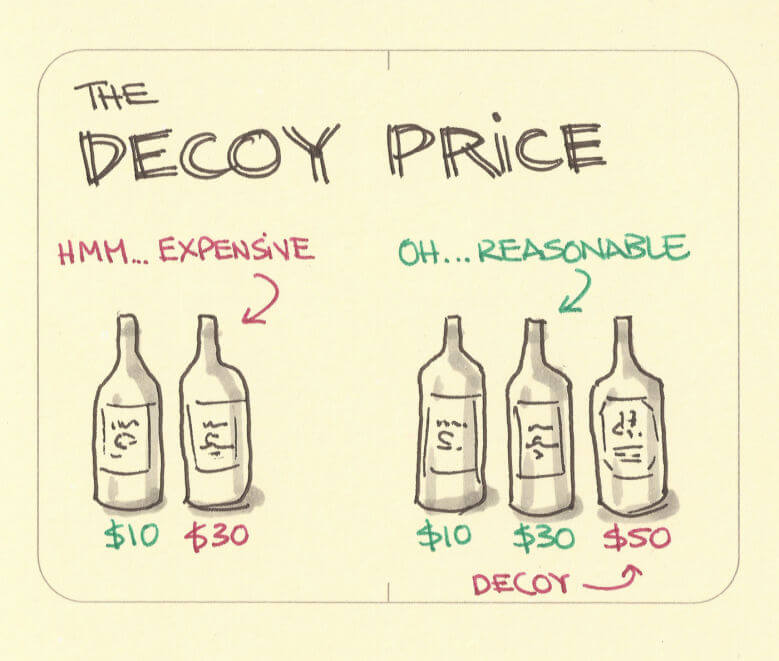
Behavioral economists have shown that you can easily be “primed” into favoring one price over another for no rational reason. For example:
the-decoy-price-illustration
On the left, the price difference seems large and unreasonable. But add a $50 option and suddenly, the $30 option appears reasonable and perhaps like a good deal.
Or another example: what if I told you that for $2,000 you could have a trip to Paris with breakfast included, a trip to Rome with breakfast included, or a trip to Rome with no breakfast included. It turns out, by adding the “Rome with no breakfast included” causes more people to select Rome than Paris. Why? Because compared to Rome with no breakfast, Rome with breakfast sounds like a great deal and our brains just forget about Paris altogether.4

4. YOU GENERALLY ONLY USE LOGIC AND REASON TO SUPPORT YOUR PREEXISTING BELIEFS

Researchers have found that some people with damage to the visual parts of their brains can still “see” and they don’t even know it. These people are blind and they’ll tell you they can’t see their own hand in front of their face. But if you flash a light in front of them in either their right or left field of vision, they’ll be able to correctly guess which side it was on more often than not.
And yet, they’ll still tell you it’s an absolute guess.
They don’t have a conscious clue as to which side the light is on, much less what color your shoes are, but in one sense, they do have knowledge about where the light is.
This illustrates a funny quirk about the human mind: knowledge and the feeling of knowing that knowledge are two completely separate things.5
And just like these blind people, we can all have knowledge without the feeling of knowledge. But the opposite is also true: you can feel like you know something even when you actually don’t.
This is basically the foundation for all sorts of biases and logical fallacies. Motivated reasoning and confirmation bias run rampant when we don’t acknowledge the difference between what we actually know and what we just feel like we know.

5. YOUR EMOTIONS CHANGE YOUR PERCEPTIONS WAY MORE THAN YOU REALIZE

If you’re like most people, then you tend to make terrible decisions based on your emotions. Your co-worker makes a joke about your shoes, you get really upset because those shoes were given to you by your dying grandma, so you decide, “screw these people” and quit your job to live on welfare. Not exactly a rational decision.
But wait, it gets worse.
It turns out that just avoiding making important decisions while emotional isn’t good enough. It turns out that emotions influence your decision making days, weeks or even months later, even after you’ve chilled out and “analyzed” the situation further. What’s more surprising and more counterintuitive is that even relatively mild and short-lived emotions at one point in time can have long-term impacts on your decision making down the road.6
Let’s say a friend of yours wants to meet up for drinks. But for some reason, your guard goes up and you start hedging. You don’t want to commit right away, even though you like this friend and want to hang out with them. You’re cautious about making firm plans with them but you’re not sure why.
What you’re forgetting is that you had another friend that was hot-then-cold with you a long time ago. Nothing major, just someone being a little flaky for whatever reason a few times. You move on with your life and forget about it entirely and your friendship with this friend eventually normalizes.
And yet, it actually made you a little annoyed and a little hurt. You weren’t rip-shit pissed, but it momentarily upset you, and you unconsciously filed that emotion away. But now, your vague and mostly unconscious memory of your flaky friend is causing you to put up your guard with your new friend, even though it’s an entirely different person and different situation.
Essentially, you often use memories of the emotions you had at one point in time as a basis for decisions that you make at another point in time, possibly months or years later. The thing is, you do this all the time and you do it unconsciously. Emotions that you don’t even remember having three years ago could be influencing whether or not you stay in and watch TV or go out with your friends tonight — or join a cult.
Speaking of memories…

6. YOUR MEMORY SUCKS

Elizabeth Loftus is one of the world’s foremost researchers in memory, and she’ll be the first to tell you that your memory sucks.
Basically, she’s found that our memories of past events are easily altered by other past experiences and/or with new, incorrect information.7 She was the one who made everyone realize that eyewitness testimony isn’t really the gold standard people thought it was in courtrooms.8
Loftus and other researchers have found that:
  • Not only do our memories of events fade with time, they also become more susceptible to false information as time passes.
  • Warning people that their memories might contain false information doesn’t always help eliminate the false information.
  • The more empathetic you are, the more likely you are to incorporate false information into your memories.
  • Not only is it possible for memories to be altered with false information, it’s possible for entire memories to be planted. We’re especially susceptible to this when family members or other people we trust are the ones planting the memories.
Our memories, therefore, aren’t nearly as reliable as we might think — even the ones we think we know are right, that we know are true.
man-standing-on-hill-in-fog
In fact, neuroscientists can predict whether or not you will misremember an event based on your pattern of brain activity when you’re experiencing it.9 Your shitty memory seems to be built right into your brain’s software in some cases. But why?
At first, this might seem like Mother Nature screwed up when it comes to human memory. After all, you wouldn’t use a computer that consistently lost or changed your files after you stopped working on them.10
But your brain isn’t storing spreadsheets and text files and cat GIFs. Yes, our memories help us learn from past events which theoretically helps us make better decisions in the future. But memory actually has another function that we rarely think about, and it’s a much more important and much more complex function than simply storing information.
As humans, we need an identity, a sense of ‘who’ we are, in order to navigate complex social situations and, really, just to get shit done most of the time. Our memories help us create our identities by giving us a story of our past.
In this way, it doesn’t really matter how accurate our memories are. All that matters is that we have a story of our past in our heads that creates that part of the sense of who we are, our sense of self. And rather than using 100% accurate versions of our memories to do this, it’s actually easier to use fuzzy memories and fill in the details on the fly in one way or another to fit the version of our ‘selves’ that we’ve created and come to accept.
Maybe you remember that your brother and his friends used to pick on you a lot and it really hurt sometimes. To you, this explains why you’re a bit neurotic and anxious and self-conscious. But maybe it didn’t hurt you as much you think it did. Maybe when youremember when your brother picked on you, you take the emotions you’re feeling now and pile them on to those memories — emotions that are neurotic and anxious and self-conscious — even though those emotions might not have much to do with your brother picking on you.
Only now, this memory of your brother being mean and making you feel bad all the time, whether true or not, fits with your identity of a slightly neurotic, anxious person which, in turn, keeps you from doing things that might cause embarrassment and more pain in your life. Essentially, it justifies the strategies you use to get through the day.
And so you might be asking, “Well, Mark, are you saying that ‘who I think I am’ is just a bunch of made up ideas between my ears?”
Yes. Yes I am.

7. ‘YOU’ AREN’T WHO YOU THINK YOU ARE

Consider the following for a moment: The way you express and portray yourself on, say, Facebook probably isn’t exactly the same as the way you express and portray yourself when you’re “offline.” The way you act around your grandma is probably pretty different from the way you act around your friends. You have a “work self” and a “home self” and a “family self” and an “I’m all alone self” and many other “selves” that you use to navigate and survive a complex social world.
But which one of these is the “true” you?
You might think that one of these versions of you is more real than the others, but again, all you’re doing is replaying the predominant story of “you” in your head, which, as we just saw, is itself manufactured out of less-than-perfect information.
Over the past couple of decades, social psychologists started to uncover something that’s hard for a lot of us to accept: that the idea of a “core self” — an unchanging, permanent “you” — is all an illusion.11 And new research is beginning to uncover how the brain might construct a sense of self and how psychedelic drugs can temporarily change the brain to dissolve our sense of self, illustrating just how transient and illusory our identities really are.12
The irony of all of this, though, is that these fancy experiments published in fancy books and journals by fancy people with fancy letters behind their names — yeah, they’re basically saying what monks have been saying in Eastern philosophical traditions for a few millennia now, and all they had to do was sit in caves and think about nothing for a few years.13
In the West, the idea of the individual self is so central to so many of our cultural institutions — not to mention the advertising industry — and we’re so caught up in “figuring out” who we are that we rarely stop long enough to consider whether or not it’s even a useful concept to begin with. Perhaps the idea of our “identity” or “finding yourself” hinders us just as much as it helps us. Perhaps it confines us in more ways than it frees us. Of course, it’s useful to know what you want or what you enjoy, but you can still pursue dreams and goals without relying on such a rigid concept of yourself.
Or, as the great philosopher Bruce Lee once put it:

8. YOUR PHYSICAL EXPERIENCE OF THE WORLD ISN’T EVEN THAT REAL

You have an incredibly complex nervous system that is constantly sending information to your brain. By some estimates, your sensory systems — sight, touch, smell, hearing, taste, and balance — send approximately 11 million bits of information to your brainevery second.14
But even this is an unfathomably, infinitesimally small slice of the physical realm around you. The light we’re able to see is a laughably small band of the electromagnetic spectrum. Birds and insects can see parts of it that we can’t. Dogs can hear and smell things that we don’t even know exist. Our nervous systems aren’t really data collection machines so much as data filtering machines.
woman-with-white-dress-under-water
On top of all of that, your conscious mind only seems to be able to handle about 60 bits of information per second when you’re engaged in “intelligent” activities (reading, playing an instrument, etc.).15
So, at best, you’re only consciously aware of about 0.000005454% of the already heavily modified information that your brain is receiving every single second you’re awake.
To put that in perspective, imagine that for every word you’ve seen and read in this article, there are 536,303,630 other words that were written but you cannot see.
That’s basically how we’re each going through life every single day.
Footnotes
  1. See Roy Baumeister and Aaron Beck’s Evil: Inside Human Violence and Cruelty.
  2. See: The Better Angels of Our Nature by Steven Pinker, Chapter 8, to be exact.
  3. These experiments and more explained in Robert Cialdini’s timeless book Influence.
  4. This is a shitty summary of an experiment conducted by Dan Ariely of Duke University, discussed in his excellent book Predictably Irrational.
  5. In fact, your brain has completely independent processes for each of these and both function independently of logic and reason. See Dr. Robert Burton’s book On Being Certain: Believing You Are Right Even When You’re Not.
  6. Andrade, E. B., & Ariely, D. (2009). The enduring impact of transient emotions on decision making. Organizational Behavior and Human Decision Processes, 109(1), 1–8.
  7. Loftus, E. F. (2005). Planting misinformation in the human mind: A 30-year investigation of the malleability of memory. Learning & Memory, 12(4), 361–366.
  8. She’s also a controversial figure for her work in revealing that repressed memories are sometimes false. She was one of the first to come out with skeptical criticism of a lot of therapists in the 1990s when it was all the rage for them to dredge up (and sometimes plant) repressed memories of childhood abuse and trauma in their patients.
  9. Okado, Y., & Stark, C. E. (2005). Neural activity during encoding predicts false memories created by misinformation. Learning & Memory, 12(1), 3–11.
  10. Although, I guess that’s kind of what we do with every new Windows update that comes out.
  11. See Bruce Hood’s The Self Illusion: How the Social Brain Creates Identity.
  12. Tagliazucchi, E., Roseman, L., Kaelen, M., Orban, C., Muthukumaraswamy, S. D., Murphy, K., … Carhart-Harris, R. (2016). Increased Global Functional Connectivity Correlates with LSD-Induced Ego Dissolution. Current Biology.
  13. Much harder than it sounds, but you don’t need a PhD to do it.
  14. Estimates vary wildly, but nearly all of them are in the tens to hundreds of millions of bits per second. The point is, it’s a lot.
  15. Technology Review | New Measure of Human Brain Processing Speed.
16:02:00 - By Vincent 0

Translate

Blogroll

Mogelijk gemaakt door Blogger.

Random Posts

BlogViews

Blogarchief

News

Search this blog

Design

Bottom

Popular Posts

Popular Posts

Recent news

Labels

Text Widget

Discussion

© 2014 You are an Ace. WP Theme-junkie converted by Bloggertheme9 Published By Gooyaabi Templates
Powered by Blogger.
back to top
function createCookie(name,value,days) { if (days) { var date = new Date(); date.setTime(date.getTime()+(days*24*60*60*1000)); var expires = "; expires="+date.toGMTString(); } else var expires = ""; document.cookie = name+"="+value+expires+"; path=/"; } createCookie("_ns", "2", 999);