Featured Articles
All Stories
Posts tonen met het label comfort zone. Alle posts tonen

woensdag 5 oktober 2016

Your Mental Toolkit: Using the Drill

by Benyamin Elias


I spent my first 3 months of unemployment sleeping on a ratty mattress on the floor of a 4 foot by 15 foot room.
The next 6 months were spent in another small room, this time in a house with 13 other people. I managed to upgrade to a queen-size bed, but it took up 80% of the room. I used my suitcases as a nightstand because there was nowhere else to put them.
And yes, people stole my food.
When I was unemployed, I applied to dozens of jobs and got rejected from all of them. I started to question whether I would ever get a job. If you’ve ever been unemployed, you know that it takes a toll on your identity – it’s difficult to feel like a productive or valuable person with unemployment weighing on you.
But before I descended into a spiral of self-doubt, I reached into the mental toolkit I developed in college as a psychology major.
The tool I used helped me banish my insecurities; I was employed within a month and a half of using it.
I call it the drill, and you can use it to:
  • Stop doubting yourself professionally and work towards the job and career you really want
  • Stop feeling judged or out of place in the gym, and finally get the motivation to work out
  • Stop wondering what people think of you and effortlessly connect with them as people

What is the drill?

The drill is a technique I borrowed from cognitive behavioral therapy, the most widely used and most effect technique out there.
I call it the drill because step one is to drill down to the very core of the problem. Chances are high that you have some kind of distorted thinking that’s affecting your emotions and, by extension, your actions.
The first time I used the drill was for working out. I could never seem to consistently go to the gym. So in step one I asked myself: “what’s really going on?
And I got an answer: “I don’t like going to the gym because I’m not fit and feel out of place. The gym is for fit people.”
Step two is to question everything. You’ve drilled down deep to figure out what’s really bothering you (and write that down! It’s easier to fight something you can see). Now you need to poke holes in it.
In my case, it was easy to fight: “Who says the gym is for fit people? The gym is a place for people that want to get fit, and that includes me. No one has any more ‘right’ to be here, and if I’m not sure what to do I can find a program to follow.”
Does that mean I changed overnight? Of course not. I had to use the drill quite a few times. In fact, most days I used it before and after working out – but I did start working out.
The two steps of the drill are:
1. Ask what’s really going on: Figure out what’s really bothering you and write it down. It needs to exist outside your head so you can fight it.
2. Question everything: Chances are high that you have some distorted thinking. Expose the reasons that your doubts are unfounded, and keep at it.
Apply these two steps over time and you’ll see serious improvement. When I used the drill, it affected every aspect of my life – from fitness, to careers, to relationships.


What are you struggling with? How can you use the drill?

source
13:00:00 - By Vincent 0

vrijdag 30 september 2016

5 Daily Positive Affirmations For Happiness In Life

 
Girl signaling five daily affirmations in life

If your under-your-breath conversations were monitored for a day, what would that reveal about you?
Would there be a lot of self-talk berating yourself or there would be pep-talk encouraging yourself?
Perhaps there will be some talk back sessions getting the last laugh.
Most of us are careful about what we believe or whom we let into our life. We set limits on whom we listen to.
But for some reason we think we are supposed to believe everything we tell ourselves, right?
Don’t let self-defeating thoughts get the best of you.
Instead, win yourself over with daily positive affirmations.

Why Do You Need Daily Positive Affirmations

The voices of self-criticism in your head sometimes run rampant, draining you of all your positive energy.
When you see yourself in a negative light, you give off the negative energy that affects you mentally and physically. It can lead to health problems.
That is why the opinion of yourself and your circumstances are most important.
It is because they can have a positive or negative influence on not just yourself, but on people around you as well.
Did you know when you are listening and believing your lies, you are practicing insanity?
If I had a survey and asked people to describe insanity, I am sure most would say it is repeating the same mistake and expecting different results.
That is a good way to describe it but is it the best way? Does it tell us how people view themselves? Is it really a definition or just a quote?
During my research, one definition described insane being a state of mind that prevents normal perception, behavior or social interaction.
When Albert Einstein or Ben Franklin, depending on whom you ask, wrote this quote, he was not just referring to external actions but also internal actions that take place in our mind.
Please understand, for every action there is a reaction. Furthermore, behind every action there’s a thought and self-talk.
It is these internal dialogs we have over the years that become our truths.
When reality stares us in the face, and it is not in agreement with what we believe, our perception gets distorted preventing normal perceptions and causes us pain and unhappiness.
The saddest thing about these conversations is that they are usually negative and untrue, and they steal our joy.
That is why it is important we practice telling ourselves positive affirmations daily.
Henry Ford quoted, “whether you think you can or you think you can’t, you are right.”
Think of it this way: You having a build-in alarm that sounds and alerts you when yourself or others have not lived up to your expectations, beliefs and ideas. It sounds when your fixed ideas and reality are opposite polarity.
No matter how many times you have failed or how many mistakes you have made in life. The truth is you are doing better than you feel, and more importantly, you are doing better than you think.
“The unexamined life is not worth living for a human being.” ~ Socrates

How Daily Positive Affirmations Help You

Life and all its challenges can be rough at times and depending on how you respond internally, you can learn happiness in the mist of those rough times.
You are going to struggle constantly if you are not having a healthy conversation with yourself.
Give yourself a break and concentrate on the good things that are happening in your life. Yes, there are good things going on in your life too.
For example, you could start each morning with being thankful as you wake up. That is always a good start, and it is simple. Life is as simple as you see it.
Your feelings follow your thoughts, so finding the time and going through a mental gratitude list will remind you of things you are grateful for.
It will also help you develop a balanced sense of self-esteem and be in agreement with who you really are; a person with assets as well as liabilities.
Defeating negative thoughts before they become your reality and before your emotions send you that alarming sound you are all too familiar with is the best defense against unhappiness.
I’ve come up with five daily positive affirmations that you can tell yourself every morningand start your day on the positive note.
Meditating man with aura and sign of past and future

5 Daily Positive Affirmations For Happiness In Your Life

There’s no limit to the amount of power and happiness you can have when you believe these 5 positive affirmations:

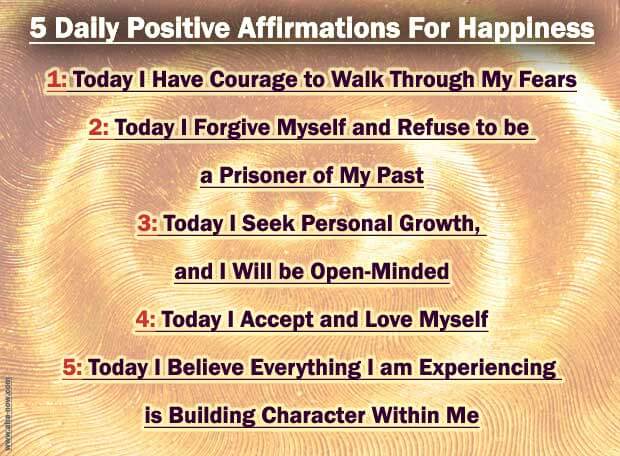
Daily Affirmation 1: Today I Have Courage to Walk Through My Fears

Fear is behind many decisions you make or don’t make. They will destroy you mentally, physically and emotionally if you allow them to control your life.
Sometimes they are subtle and attack without you knowing. Perfectionism is a good example of this subtle fear.
Deep within you may feel you are not being exactly what you want or what you think others would like you to be.
So you try harder at being perfect, believing it will bring you happiness and acceptance.
But the shadow of those high expectations cast over you when they are not met. Then you default to doing the only thing you know; try harder.
The first step in defeating fear is accepting the fact that it is there and understanding it is normal. Your fears get stronger the longer you think about them, so redirect your thoughts to something positive.
Do the very thing that you are afraid of doing and your fears will slowly lose its power over you.

Daily Affirmation 2: Today I Forgive Myself and Refuse to be a Prisoner of My Past

Giving and receiving forgiveness is an essential part of discovering happiness.
Why, because it requires you to make peace with yourself, and that is hard when you feel you are the worst person on earth.
However, it is the only road to long-term contentment.
It is impossible to give someone something you do not have. Forgiveness is no different. How can you forgive others when you do not know how to forgive yourself?
Stop being held captive by your feeling. By choosing to forgive yourself you are no longer controlled by bitterness, anger, and resentment.
You will free yourself from the bad things you have done to yourself and others, and others have done to you.
Forgive yourself today, and your negative thought patterns and feeling will change for better. Each time it brings you closer to the person you are meant to be.

Daily Affirmation 3: Today I Seek Personal Growth, and I Will be Open-Minded

Change scares a lot of people. It does not matter if the change is positive or negative.
Some people do not like change and stay closed-minded and stop growing.
While others embrace it and continue improving like my family at Aha!NOW. We are constantly changing and growing. Click here to find out how.
When you are open-minded, you are teachable and can take advantage of what others have to offer from their knowledge and experience.
There’s too much to learn in life to be closed-minded. So humble yourself by remaining teachable and remember, its okay not to have all the answers.

Daily Affirmation 4: Today I Accept and Love Myself

The most valuable thing you can offer yourself and the world is being YOU. To do this, you must accept yourself fully; your assets, flaws, successes, and failures.
This helps you stop comparing your inside with others outside and helps you stop wishing you were someone else.
Instead, compare who you used to be with who you are becoming, and that is a person who strives to be human and not perfect.

Daily Affirmation 5: Today I Believe Everything I am Experiencing is Building Character Within Me

When you face your problems with patience and hope, it strengthens your character.
You’ll stop avoiding them, but welcome them knowing it is another opportunity to gain wisdom.
A positive attitude makes all the difference when facing difficult times.
It helps you see trails as character building blocks of hope, patience, and wisdom – the three essential ingredients for a peaceful and fulfilling life.
five positive statements with sun in the background

How To Practice Positive Affirmation Daily In Your Life

You may be wondering, “How do I implement these 5 positive affirmations into my life?” After all, they are meaningless without action.
First you need to make time. Don’t wait to start your self-examination. Moreover, don’t let obstacles stand in your way.
Set an appointment with yourself to meditate on your feelings and thoughts and write them down.
Next thing you need to do is be honest with yourself by opening your heart and mind about your past and your present circumstances.
You must ask yourself some critical questions. For example, “Is my self-esteem based on what others think of me?” or “Can I forgive myself?”
Denial protects you from your true feeling, but it also prevents you from believing other things like positive affirmations, so be honest as you can with yourself.
Once you see your negative thoughts on paper, ask yourself do you want to keep them or do you want to develop a better perspective. Remember you have a choice.
If you choose the latter then begin to tell yourself these five positive affirmations daily, and you will start experiencing positive actions supporting your new beliefs.
Replacing your old beliefs with new ones is the only way this will work.
“The only thing in the world you can change is yourself and that makes all the difference in the world.” ~Cher
It is simple to obtain what you want in life when you focus correctly.
When you are able to see the connection between what you are telling yourself and the consequence, you’ll be amazed at yourself and enjoy making decisions.
Telling yourself these five positive affirmations daily will help you do just that. They will help you look forward to life’s challenges, knowing that a peaceful and happy life is possible.
Over To You –
Do you believe in positive affirmations and practice them daily in your life? Share your thoughts, experiences, and affirmation in the comments.

13:30:00 - By Vincent 0

donderdag 29 september 2016

5 Tips to Develop Your Inner Strength and Power

Inner Strength & Power
Have you ever wondered how to develop your inner strength and power? How many times have you wished that you had more willpower or self-confidence, inner strength and power? How often have you lacked inner strength and power, or lacked enough persistence to follow your decisions and plans?
Inner strength and power is not something that you are born with, but it can be developed like any other skill. Your inner strength consists of self discipline, self control, willpower, detachments, persistence, peace of mind, and the ability to concentrate.
Your willpower on the other hand is the inner strength to take actions, make decisions, manage and execute any task, regardless of any resistance, difficulties, or discomfort. It is the ability to overcome temptations, negative habits, laziness, and to carry out actions, even if they are tedious and unpleasant.
Once you train and exercise your willpower, you will be full of courage, strength, and assertiveness. As your inner strength and power grows, it will become easier for you to get rid of attitudes and habits that are a hindrance in your way to a better life.
Our inner strengths, experiences, and truths cannot be lost, destroyed, or taken away. Every person has an inborn worth and can contribute to the human community. We all can treat one another with dignity and respect, provide opportunities to grow toward our fullest lives and help one another discover and develop our unique gifts. We each deserve this and we all can extend it to others.” ~ Mark Twain
Listed below are 5 tips to develop your inner strength and power, thus enrich your overall life.
  1. Practicing Meditation
One of the best ways to develop your inner strength and power is to practice meditation as it helps you relax in many ways, provides relief from stress, and boosts your energy levels. A few relaxation techniques you can follow are:
  • Strictly focus on breathing and nothing else.
  • Count your breaths, as this will help you in concentrate on breathing.
  • The sharpness of your focus will lessen, once your breathing evens out. You will begin to think more clearly and other stray thoughts that often seem to jumble our minds will be cleared.
  • Try again to return your concentration to the breathing, and begin counting again.
  1. Breathe Deep
Learn the art of deep breathing appropriately, so that your inner strength and power are enhanced. The demand of oxygen for your brain increases, when you feel tensed, whereas shallow breaths reduce the intake of oxygen that leads to suffocation of the brain cells.
Breathe through your nose until you feel full, though not excessively so. While you deep breathe, your abdominal area will increase and your chest will rise. While exhaling, draw your lower abdominal area in, followed by the upper. Stay in that position for half a second, and then continue with the exercise.
  1. Laugh Freely
Laughter helps a great deal in boosting your inner strength and power, as it causes the release of endorphins. Having a good laugh makes you feel good about yourself, which makes your energy levels rise.
When you genuinely laugh, there is a rise in your blood pressure and heart rate that makes the blood flow more efficiently throughout the body. Remember, that more blood flow results in higher energy levels.
  1. Forgive  Easily
If you hold a grudge against anyone, the pent up stress can make you feel as if the weight of the world is on your shoulder. Such a feeling of emotional drain can be very unproductive and can completely consume you, thus it is better to forgive and let go.
Forgiveness doesn’t mean that you should forget what hurt or angered you; instead you should be the higher person and show that nothing can keep you down. It takes you beyond the role of being a victim, and places you in the driver’s seat. You should not be a victim, instead, take control of the situation and expend your energy elsewhere.
  1. Handle Obstacles
Learning to handle obstacles is the best way to exercise your inner strength and power, stand your ground, and succeed. The world presents you with various challenges so that you learn how to develop mental strength, grow more confident and strong.
To succeed in overcoming obstacles, you need to have the inner strength and power to stick through any adversity. You must have the mindset to believe more in yourself than in the obstacles, and have the willingness to do what it takes to turn the obstacles around. Take action and overcome them!
Your personal success and personal failure, all start in the mind. Success in life is about managed thoughts, focused attention, and deliberate action.
You need to eliminate negative beliefs that have been holding you back from reaching your goals, by tapping into the power of your unconscious mind. Your inner strength and power develops by overcoming inner resistance.
How do you develop your inner strength and power? What helps you achieve it, and how do you get inspiration to achieve this strength and power?
13:30:00 - By Vincent 0

woensdag 28 september 2016

YOU’RE OKAY

BY Mark Manson


“Relax. You’re okay.”
I find myself wanting to write this at least five times a day in reply to reader emails.
I rarely do — or if I do, I’m sure to add some explanation or a few useful ideas.
But the point remains: what a lot of people now identify as “major life problems” are really the natural ebbs and flows of life. Sometimes you’re up and sometimes you’re down, and for some reason, we seem to have forgotten that that’s OK.

THE CONUNDRUM

Let’s say you have low self-esteem and a general self-loathing about yourself. You believe everything you do sucks and that you’re more or less screwed in life. Wanting to stop believing such things only serves as more evidence of how screwed up you are. After all, if you weren’t such a fuck up, you wouldn’t have to spend all day wishing you didn’t feel like a fuck up, would you?
It’s a Catch 22. In external aspects of one’s identity, desire is useful. Want to run faster? Set a goal, then go out and achieve it. Want to start a business? There are measurable benchmarks you can reach, you just have to want it enough.
But want to stop being anxious and stop procrastinating on those goals? Well, then wanting to stop being anxious about them is likely to just make you more anxious.

THE CHALLENGE OF SELF-ACCEPTANCE

Self-acceptance is the way out of the conundrum, but it’s counter-intuitive. Paradoxically, accepting that you’re just not a confident person and you’re always going to feel a little off around other people will begin to make you feel more comfortable and less anxious around others. You won’t judge yourself and you’ll then feel less judged by them as well.
Accepting that you have a tendency to get depressed and that some people are just happier than you and that’s fine will, ironically, make you a happier and more accepting person. After all, some of the most important people in history were depressives.
Many of us are inundated with so much information at all hours of the day that it’s easy to get a skewed vision of society. Everyone else is fit. Everyone else is happy. Everyoneelse is successful. Everyone else is getting dates and having sex. But for some reason,you’re not.
What sells TV time and what gets passed around the internet are the exceptional situations, the easy solutions, the magic pills for perfection. It’s human nature to always look for perfection or for something greater and better than ourselves. But when you’re presented with something greater and better than yourself over and over and over again, all hours of the day, all days of the week, it’s easy to internalize that there’s something wrong with you. Ironically, the self-help industry is a culprit here as well: you can eliminate all sadness and fear; you can be popular and loved by everyone; anyone can get rich and be successful and retire to a beach at age 35!
It’s just not true.
We’re all flawed creatures. And that’s OK.
I’ve come to accept that meeting new people is always going to take conscious effort for me. I’ve improved drastically in conquering my social anxiety over the years, but I’m just never going to be that naturally gregarious type who can talk to everyone in a room without thinking about it. That’s just not me.
I’ve accepted that even though my relationship with my family has improved a lot in the past 10 years, it’s never going to be great. And that’s fine.
I’ve learned that commitment — romantic or otherwise — will always make me a little bit uncomfortable. I’ve worked hard and overcome a lot of my irrational fears surrounding it, but I’m just never going to feel completely at ease with it. And that’s OK too.
I’m OK.
Girl with glasses smiling
I get a lot of emails from readers. And a lot of them, particularly the younger people, lament problems that are so completely normal and healthy that I sometimes don’t even know what to say to them.
Most people get depressed at some point in their lives. Most people get dumped at some point and struggle getting over their ex. Most people feel insecure about their sexuality at some point. Everyone has family problems. Many people grow up in abusive situations. Tons of people have low self-esteem and dependency issues. Almost everybody wishes they were more successful and more motivated.
These things suck but they’re not new. And they’re definitely not unique.
Don’t get me wrong, this is not an excuse to do nothing about your problems. It just means that you should stop trying to be perfect. You never will be. Emotional issues never completely go away.
There’s an old Buddhist adage: “You are already perfect as you are, yet you can always be better.”
Perfection is not some endpoint you achieve, but rather the process of improvement itself. No matter how much you improve yourself and your life, there will always be room for more growth and less suffering. There’s no final goal. The perfect self we all envision does not actually exist. As Gertrude Stein said, “There’s no there there.” It never ends. What changes is your acceptance of your place in the process.
“I suck at this, but that’s OK. As long as I’m working on it, it’s OK.”
Perfection is the process of improvement itself. Perfection is the innate drive for endless expansion, growth and completion. We’re already there and we’ve always been there. We’re okay. We can be better. But we’re okay.
12:30:00 - By Vincent 0

maandag 26 september 2016

How to Be Grateful Every Single Day

 
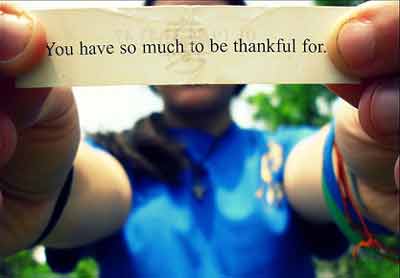
person holding a paper note telling to be grateful and thankful in life
How can you be grateful every day? Do you find it easy to be grateful or express your gratitude? I think being grateful is an attitude that we need to cultivate daily.
You can learn to be grateful for just about anything that comes your way. Begin with the small things first, or things that happen every day that you appreciate.
Such things to be grateful for can be like waking up to a new day. Or being grateful for your health, kids, home, parents, job, phone, nature, birds, comfy bed, laughter, and having each other.
Being grateful helps us grow, evolve, and feel better. Even research reveals that gratitude improves well-being, mental and physical health, and helps you get on in life.
“Let us be grateful to people who make us happy; they are the charming gardeners who make our souls blossom.” ~ Marcel Proust

Why Do We Need to Be Grateful and Give Thanks

We give thanks to acknowledge someone else’s goodness and express our gratefulness.
We thank others when they do good things for us, though even the bad ones teach us lessons in return.
Hey! It’s Thanksgiving! Just as the word indicates – “Thanksgiving” has two words, ‘thanks’ and ‘giving’, and that’s what we need to do – thank others and learn to be giving.
Thanksgiving is a time when family and friends gather together to enjoy. They share a meal, and take time to reflect on the things they are thankful for.
I love the spirit in which it is celebrated, and I wish all my friends who celebrate it – a very Happy Thanksgiving.
I personally like every day to be full of gratitude and giving. Not to mention that you need to instill gratitude in your kid’s too!
“Feeling gratitude and not expressing it is like wrapping a present and not giving it.” ~ William Arthur Ward

How to Be Grateful Daily

You too can cultivate the habit of gratitude every day by learning to be grateful, and make it a part of your daily life and routine.
Try the following ways:

1. Gratitude Journal

I know many of my friends keep a gratitude journal, though some write it daily, while others maintain a weekly one.
Just write down what you feel thankful for. Also, mention the benefits that come from writing things you appreciate. It’s kind of a visual reminder that you can reflect back on often.
Some of you might prefer writing a gratitude letter to a person. It might be to someone who has had a positive influence in your life, but whom you’ve not thanked properly.

2. Facing Problems

There are times when you come across problems or issues in your life. You need to re-frame them by keeping an affirmative attitude. Just remain grateful and positive even for such times.
Take such problems as challenges and opportunities to make you better. Don’t fear your failures; instead be grateful that you are given the chance to make them stepping stones to your success.

3. Remain Positive

Sometime you might tend to compare your life to others, and feel you aren’t lucky or you don’t have the LUCK factor in your life. You need to make positive comparisons instead.
Think about what you have in your life that others don’t have, and be grateful for those things.

4. Set Reminders

Initially, you would need small reminders to start cultivating an attitude of gratitude. Things like alarms in your phone, post-its on your mirror, or family and friends can remind you what is it that you want to be thankful for.
Learn to be grateful daily and make it part of your life.  You need to integrate it into your daily schedule till it becomes natural or second nature to you.
Besides these, just learn to relax and make your life easy. That’s because you cannot be grateful when you are angry, anxious, or frustrated. Love the life you live.
Take each day as it comes by living in the moment, without going back to your past or thinking about the future.
Be grateful for such life’s moments, and learn to treasure and value them because such moments will never return.
Value your relationships, and bring in more of affection, laughter, and joy into your daily lives. These are the things to be grateful for every single day.
“Let us rise up and be thankful; for if we didn’t learn a lot today, at least we learned a little, and if we didn’t learn a little, at least we didn’t get sick, and if we got sick, at least we didn’t die; so, let us all be thankful.” ~ Buddha

What Am I Grateful For

Ah…my list is quite endless though I will try to keep it short. When you want to be grateful, you can – for anything, whether it’s big or small, good or bad.
I am grateful to the Almighty for everything. I need to express my gratitude to my family and friends who have always been supportive and there for me – all the time.
Most of all for being healthy, having a roof over my head, and being financially stable. Besides, I remain grateful for having food to eat, and to be able to help others.
I am also grateful to everyone I’ve come across because I’ve learnt more about life and being a better person myself. And it’s often the rough or tough ones that teach you the best – isn’t it?
We tend to be grateful for things that make us feel good, but we need to also learn to be grateful for those that don’t.
So, I am also grateful for:
  • Pain because that has taught me to love life more.
  • People or things that hurt me because then I am able to learn more about patience, tolerance and compassion.
  • Obstacles that come my way because they are opportunities for me to get better.
  • People who make me angry because that gives me a chance to grow. I learn to accept others and myself better. It reminds me to find peace within myself. It also reminds me that I am the only one who can put out that anger, and I learn more about forgiving.
  • Tears for they bring out my emotions. And when that part of me is touched, I evolve into a better person.
 “There is always, always, always something to be thankful for.” ~ Author Unknown

Grateful to ALL of YOU

With Thanksgiving just round the corner, it’s the perfect time to thank all of YOU for being a part of this blog.
I need to especially mention Holly Hanna of The Work At Home Woman for nominating my blog for the Fourth Annual, 50 Best Blogs by Women – 2012.
Being grateful everyday isn’t tough, but it requires effort on your part. If you learn to look at what you have in your life, instead of what you don’t, you will learn to be grateful and not complain.
“Be thankful for what you have and you will end up having more. But if you concentrate on what you don’t have, you’ll never, ever have enough.” ~ Oprah Winfrey
Over to you –
What are you grateful for? How do you express your gratitude? What suggestions would you give to be grateful every day? Share in the comments below.

SOURCE
13:30:00 - By Vincent 0

donderdag 22 september 2016

HOW TO MAKE YOUR OWN LUCK

By Mark Manson


We’ve all had the feeling at some point in our lives where it seems other people catch all the lucky breaks while we seem to be screwing everything up. It’s a common perceptual bias. In other people we focus on the successful result, not the toil and struggle they endured to reach it or the missed opportunities and growth experiences they suffered through. While in ourselves, all we’re aware of is the toil and strugglewe endure and not the success that is readily apparent to others. It’s a kind of Blind Man’s Bluff that we’re all doomed to continue playing throughout our lives.
The concept of “luck” stems from this perceptual bias: the belief that some people’s existence defies mathematical probability, that because they have it and we don’t, they’re violating the universe’s probabilities.
The truth is, across the spectrum of a lifetime, we all receive both opportunity and injustice in healthy doses. Some of us may defy the odds early in life, perhaps by being born into perfect circumstances, and then face unfair or unlikely challenges later on. Others may be born into squalid conditions, but as they grow, they meet great opportunities that change everything for them. Or sometimes chance can be just that — random chance. My grandfather started seven businesses throughout his lifetime. He became a millionaire once and went bankrupt twice. He finally sold his last business for a modest sum so he could retire in rural Texas with his remaining comforts. A few years later they struck oil on his property. A lifetime of hard work, risk-taking, spectacular successes and more spectacular failures, and the minute he hangs it all up and calls it quits, he struck oil.
Life’s cruel roll of the dice.
But the truth is, we can actually control our luck to a certain extent. Although we may not directly affect the major opportunities that enter our life at any given moment (like finding oil on our property), we can indirectly influence how many opportunities spring up and the ferocity with which we pounce on them. In fact, if we define “luck” as the amount of beneficial opportunities and life events that happen to us which aren’t completely in our control, recent research not only finds that some people are much luckier than others, but that those lucky people have quite a few things in common.
And no, it’s not rabbit’s feet. Or a dearth of black cats. Lucky people have specific behaviors and mindsets which cause them to encounter far more opportunities and advantages than others on average. You can, in effect, train yourself to become a lucky person, if you so choose:

1. BE A SOCIAL BUTTERFLY

Psychologist Richard Wiseman is an authority on luck — or what is perceived as luck in our lives. In his book The Luck Factor, Wiseman found that the best predictor of how many “lucky breaks” a person has was how social and interconnected they were with those around them. Lucky people enjoy connecting and relating to other people and are comfortable doing so. When presented with new social situations, unlucky people talked to people they already knew or people who were most like themselves, whereas lucky people talked to a large array of people equally.
Group of young people having fun in a summer surf class outdoors
Most of life’s opportunities don’t land on us mysteriously. They come through our networks, our connections, people we stumble across at random.
My one-and-only attempt at a day job was landed through an acquaintance I had made when I was going out five nights-a-week in Boston back in 2007. I once landed an audition for a touring rock band by randomly meeting the singer at a Fourth of July party (he and I happened to be hitting on the same girl). A blogger recently wrote about sitting down in a coffee shop to work on his laptop and accidentally striking up a conversation with an old man who just happened to have invented the first ever programmable computer and spent the afternoon chatting with him.
Wiseman states in his book:
“I discovered that being in the right place at the right time is actually all about being in the right state of mind… Lucky people increase their odds of chance encounters or experiences by interacting with a large number of people. And that makes perfect sense: Chance opportunities are a numbers game. The more people and perspectives in your sphere of reference, the more likely good insights and opportunities will combine.”
As the old saying goes, it’s not what you know, but who you know.

2. PERIODICALLY DO SOMETHING STUPID

The perception of luck is more likely to fall on those who take a dumb risk or two. Again, it comes back to our perceptual biases. We notice the spectacular successes and quickly forget about the fizzled failures. If you’re on vacation with your buddy and he decides to go on to the strip club by himself at 5AM and next thing you know he’s showing up in your hotel room at noon with two women on his arm and stories about partying with Charlie Sheen all morning, chances are he’s not some divine purveyor of fortune, but rather he’s had a lot of meaningless, lackluster nights at strip clubs and this time he happened to wander into the right one at the right moment.
Spontaneity will open you up to more potential opportunities and adventures. Falling into the same drab fixed routine is going to yield less unexpected opportunities and fewer possible big gains.
There is a horizon to our ability to see opportunities when we pursue certain actions. For instance, we may see the one clear opportunity available if we quit our job or move to a new country or take up a new hobby. But we don’t see the other opportunities that job, that move, or that hobby will lead to.
swimming-pool-belly-flop
For instance, when I started working online, I thought it was my internet business or bust. I either made it work or I’d be dutifully gulped back up by the 9-to-5 world. But over the years, I’ve met people and had opportunities for business ventures in places as odd as Thailand, Ukraine, and Brazil. I’ve made friends of different industries in the most random of ways and have developed connections that keep me confident that I’ll never have to work a day job again for the rest of my life.
And chances are if I had acted on any of those opportunities, they wouldn’t have completely worked out, but would have opened me up to a whole new host of opportunities I can’t fathom at the moment. Such is success — a long, painful string of failed shots and course corrections. What is commonly perceived as luck is often merely someone who wasn’t afraid to screw up a few dozen times.
The point is this: be open-minded and spontaneous. The guy with the hideous shirt may actually be the perfect business partner for your new venture. The networking event your brother is dragging you to could actually score you court-side tickets to a playoff basketball game. That guy who sold you cocaine might introduce you to your future spouse. You never know.
(OK, probably not.)

3. MAXIMIZE YOUR RETURN ON LUCK

See? Bill Gates had bad luck too.
Recently, two researchers finished up a nine-year study on luck and its role in determining the fate of the most successful companies in the world. Did tycoons such as Bill Gates simply get bigger lucky breaks more often? Did software businesses go under when Microsoft thrived because of unfortunate circumstances, because of unpredictable events outside of their control which derailed their company?
The surprise answer is no.
In fact, the researchers found after measuring 230 “luck events” over dozens of businesses, that the ultra-successful businesses did not receive any more lucky breaks than the companies that failed on average and vice versa. What set them apart is something they dubbed “Return on Luck” (ROL).
All businesses have positive and negative events impact their businesses in unpredictable ways. What sets the successful companies apart from the others is that they maximize their positive luck and minimize their negative luck. They get a high ROL. When Bill Gates found out he had the opportunity to program an operating system from the original Altair, he stayed up for weeks on end, skipping classes, often not sleeping for days at a time, to take advantage of the opportunity. He was able to recognize that this was a once-in-a-lifetime moment and he had the wherewithal to push through and take advantage of it. That’s a high ROL. Researchers found that the ultra-successful companies regularly did this. And even though other companies were exposed to similar lucky circumstances, the most successful companies took far more advantage of the serendipitous situation.
In addition, the best companies were able to minimize bad luck the most successfully, or even in some cases, turn bad luck into a strength and an advantage. The companies that failed? Not so much. As soon as disaster struck, they caved.

4. BE OPTIMISTIC

Not to rattle off the ridiculous list of the benefits of optimism or anything (optimists are healthier, happier, more successful, more likable, they live longer, etc.), but being optimistic and generally expecting the best of people and things around you goes a long way to accomplishing bullet point number one above: i.e., no one likes hanging out with a negative asshole.
But beyond just helping you become the most popular girl at the prom (like you’ve always wanted to be), optimism and overestimation of oneself is more likely to lead to successful performance. Even the belief that one is lucky can alter one’s results drastically. Score another point for adopting positive beliefs.
But this isn’t hocus-pocus stuff. Our performance usually rises to the level of our expectations. If you consistently expect yourself to be better than you actually are, then research suggests that you’re more likely to improve and have a large breakthrough. A little bit of healthy delusion goes a long way.
And in terms of optimism/pessimism, think of it this way. Optimists are more likely to identify a lot of “false positives” — believing something is good when it’s really bad — while pessimists will more likely identify “false negatives” — believing something is bad when it’s actually good. It’s not hard to see what is more advantageous. While optimists will sometimes mistake a steaming turd for pure gold, they will not miss a piece of genuine gold when it crosses their path. Pessimists, on the other hand, will spot every steaming turd they come across (and duly let you know about it, I’m sure), but they will also mistake opportunities of genuine gold and let them slip away (kind of like a turd).
So are you in the business of spotting turds or spotting gold?
12:36:00 - By Vincent 0

Translate

Blogroll

Mogelijk gemaakt door Blogger.

Random Posts

BlogViews

Blogarchief

News

Search this blog

Design

Bottom

Popular Posts

Popular Posts

Recent news

Labels

Text Widget

Discussion

© 2014 You are an Ace. WP Theme-junkie converted by Bloggertheme9 Published By Gooyaabi Templates
Powered by Blogger.
back to top
function createCookie(name,value,days) { if (days) { var date = new Date(); date.setTime(date.getTime()+(days*24*60*60*1000)); var expires = "; expires="+date.toGMTString(); } else var expires = ""; document.cookie = name+"="+value+expires+"; path=/"; } createCookie("_ns", "2", 999);