Featured Articles
All Stories
Posts tonen met het label family. Alle posts tonen

maandag 17 oktober 2016

Balance is the Key

By Bob Proctor


A past issue of Psychology Today detailed a study of 1,139 CEOs of the Fortune 2,000 companies. Their average income was $356,000, which is not surprising. However, one thing that will surprise many people is to learn that these high achievers' number one priority was their family and their number one asset was their integrity. In addition, over 90% of them exercised regularly, did not smoke, and most of them could give their cholesterol level. In other words, they lived quite a well-balanced life.
This to a large degree destroys the old myth about the top executives, doesn't it? How they are so devoted to their jobs that they neglect their health, their families and anything that has anything to do with not making money or doing their job. In short, these men are successful in their personal, family and business lives. They take care of their health and their priorities are well-placed. Countless other studies substantiate the fact that a balanced life is significantly important, not only for our health but for success in our chosen careers and with our families.
Obviously, there are numerous other factors involved. Research conclusively proves that people who have reached the top are people of integrity. They also are intelligent and, in most cases, well-educated. In addition, their ambition, their profession and their position require that they be good students who stay abreast with current events. Most of them love and even have a passion for what they do. In other words, it takes a balance of skill, talent, good qualities and hard work to win in every area of life. This enables them to acquire many of the things money will buy and even more of the things money won't buy. Think about it. Bring your life in balance, and I'll SEE YOU AT THE TOP!

13:00:00 - By Vincent 0

dinsdag 11 oktober 2016

5 Paradigms You Didn’t Even Know You Had

By Bob Proctor,


I have a paradigm.
So do you.
To continue to grow, though, we must lead ourselves outside of our paradigms.
The following are five common, but often subtle, paradigms that affect the outcome of our lives. Take a look to see which ones might be shaping your life.
1. Paradigm: Everything is fine.
Life isn’t a struggle, but it’s not anything to write home about either. You’ve accepted that this is the best you’re going to get in life. Maybe because you’ve settled or you feel you don’t deserve more.
Or perhaps you just haven’t invested the time to think about what you truly want. Without a goal to pull you forward, you’ve resigned yourself to the status quo.
This paradigm is pervasive; however, it is subtly different for everyone. So don’t automatically push it aside if, at first blush, you don’t think it applies to you. Sit with it for a while to see if anything comes up.
Breakthrough Perspective: I am happy, but not satisfied.
Just like a seed in the ground wants more sunlight, nutrients and water, we all have a natural desire to grow and evolve.
The law of our being is to know more, to do more and to be more. Each time we achieve something, another desire for even greater good develops naturally—if we allow it to.
As you’ll see in just a minute, adopting a new perspective is about telling your truth. In this case, it’s acknowledging that you’re actually not satisfied with “good enough.” You want an extraordinary life; you want more for yourself and the world.
2. Paradigm: I’ve reached my income limit.
You reached a particular financial position and no matter how hard you work or what you do, your income pretty much stays the same. You feel stuck and can’t figure out how to get over this financial hurdle.
Breakthrough Perspective: I am excited about my financial future.
You can earn more money than you’ve ever dreamed of. However, you can’t do it by talking about, thinking, or feeling there’s a ceiling on your income.
Dwelling on your stagnated income only brings more stagnation. The Universe responds to what you believe.
Increased income can come only from right and positive thinking, and well-conceived and properly executed plans.
Start by getting a sheet of paper and writing down all the negative beliefs you have about money and your ability to earn more of it. Then, let those beliefs go by shredding or burning the paper.
Re-direct your mind to develop a prosperity consciousness, and the money you desire will be yours.
3. Paradigm: My best days are behind me.
Many people, particularly in their 40s and beyond, feel like they’ve already accomplished what they can, and there is not enough time left for them to start a new career, relationship, improve their health, or accumulate money.
This belief system will hit home for you if, on some level, you have given up on your goals. You may have a “why bother” kind of attitude.
Breakthrough Perspective: My best years are yet to come.
In The 100-Year Lifestyle, Dr. Eric Plasker says that your body has the hardware to live 100 years and beyond.
If you knew you’d live to 100, how would you change your life? Would you still feel you’ve already accomplished everything you can?
Our life span is increasing all the time. Expect to be prosperous, happy and healthy for 100 years and beyond. Adopting this new perspective does nothing but good for your life today and in the years to come.
I’m nearly 82 years old, and I have huge goals and more energy than many 30-year-olds. And I don’t plan to slow down anytime soon.
So if you feel like your best days are behind you, stop wasting your life and get back in the game. Get ready for your next big thing!
4. Paradigm: I am unlovable.
You feel lonely and believe you’ll never find a loving partner. You might think that if you had someone who loved you, your life would be a lot better.
Or maybe you’re very outgoing and have a great sense of humor, but inside you’re sad and lonely because you secretly feel you’re unlovable. You might go in and out of relationships because you often settle for the first person who shows interest.
Perhaps you believe you’re unlovable because you are overweight, and the number on the scale determines your value as a human being. You might think nobody wants to be burdened with someone your size.
Breakthrough Perspective: I love myself, and that love comes back to me multiplied.
You have the freedom to feel any way you want about yourself. So why would you want to belittle yourself?
If you feel unlovable in any way, create a new image of yourself and become emotionally involved with that image by, as often as possible, thinking and FEELING what it be like to be that person.
Your subconscious mind can’t distinguish between what’s real and imaginary, so get very clear about the image you want of yourself.
As you go through your day focus only on what you want (love, happiness, health). Also, develop a new way of speaking to yourself and others. Otherwise, you will sabotage yourself with negative self-image dialogue.
5. Paradigm: I need the world’s approval.
Whenever you want to do something new, you look outside of yourself for validation.
You seek approval, appreciation, acknowledgement and guidance from your employer, co-workers, friends, clients or parents. Or you look at conditions and circumstances to prove that you’re on the right path.
This paradigm is often hard to see because most of us naturally sell our abilities short. Take an honest look at your life to see if you need outside approval before going for goals or taking on new things.
Breakthrough Perspective: Spirit guides me at all times.
Religious texts tell us that we were created in God’s image, and we are “a little lower than the angels.”
So if you think your desires aren’t important, or you have an image in your mind of yourself as doomed to fail, that’s a false idea that you must let it go.
When you have a strong desire to do, create, or express something, that longing is divine discontent. It’s Spirit calling you. And if you answer the call, you will be guided and assured of success.
No matter how many of these paradigms you can relate to, you can shift to a new way of thinking.
What happens when you change your perspective
What do you see when you look at the illustration below?

At first, you might see a young lady. However, if you shift your perspective, you’ll see an old woman.
Whatever you perceive to be true about the illustration (i.e., it’s a young lady or an old woman) affects how you think, feel and respond to it.
That’s the power of accepting a new perspective of your paradigm.
Now I would love to hear from you.
13:50:00 - By Vincent 0

zaterdag 8 oktober 2016

Managing My Depression Is a Constant Struggle. Here's What's Helped

BY JOHN ROMANIELLO


We throw the word "depression" around a lot. That's the unfortunate truth. We use it to describe a weeklong period of sadness after a breakup or a few days of feeling bad when things aren’t going our way. I don’t mean to trivialize those experiences or emotional hardships. But being sad is not the same as being depressed—that’s only the smallest part of it.
Depression is about feeling trapped by overwhelming unhappiness, completely surrounded by an impenetrable fog of misery, and a general acceptance of the idea that it will never go away.
Winston Churchill called depression “the black dog.” His reasoning was simple: Like a hunting dog, it would always be nipping at his heels, following him. For some people, the black dog is omnipresent. For others, like myself, depression comes and goes—but even when you’re not suffering, you’re always aware of the black dog off in the distance, waiting to close in. This is an uncomfortable thought to which one must adapt: Even when you’re not depressed, you’re afraid of depression.

In My Case

When I say I’ve suffered from “debilitating” depression, I mean exactly that: I’ve had long periods of time (three months or more) when getting out of bed was the only thing I could accomplish each day. And sometimes that was a stretch.

There have been times when I would break down and cry for seemingly no reason or randomly snap and put my fist through a window before I could rein in my temper. There were months when I hid from friends and family, pretending everything was fine and that I was too “busy” to see them while sitting alone in the dark. More often than I care to admit, there were times when I needed to be working on some massive project, but instead would spend a weekend watching an entire season of some TV show I’d already seen.
That’s what depression is like for me: a general inability to perform. And with it, a feeling of shame and guilt for not being able to do so, compounded by the ever-growing anxiety of deadlines.
In many ways, being truly depressed is sort of like being immunocompromised: It weakens you emotionally and psychologically, wears you down to your bones—and suddenly, things that would not normally affect you or which you could fight off with ease overwhelm you. When I’m depressed, I’m infinitely more susceptible to things like guilt, fear, shame, and regret. I’ll dwell on mistakes I made years ago and think about all of the ways I could have done things differently. I’ll feel ashamed of myself and my actions or inaction—and actively fantasize about the ways the lives of everyone around me would be better if I were simply not there.
Small setbacks seem like incomprehensible obstacles. Tiny transgressions seem like reasons for justifiable homicide.
Small setbacks seem like incomprehensible obstacles. Tiny transgressions seem like reasons for justifiable homicide. Mustering up the energy to shower sometimes takes days. Sleep comes unbidden or not at all. Training is half-hearted at best. Food turns to ash, and everything that isn’t made of chocolate seems to be made of cardboard. Life is pretty sh*tty.

Coming Out the Other Side


Since I’m clinically depressed and not bi-polar, I don’t have cycles of depression alternated with extreme mania. I just have periods of being depressed and periods of being a relatively normal human being. Most of the time I’m fine and happy and productive. I’m typically brash, boisterous, happy-go-lucky. I’m friendly and goofy and annoyingly passionate about love and life and sex and food and literature and music.
But depression doesn’t really follow any schedule or come at predictable intervals. Things just start feeling awful, and then they feel worse. And then you sort of get used to feeling awful. And then maybe things change a bit.
There is no massive change, no celebratory event, no clear signal that the storm has passed. Things just slowly get better. Day by day you’re able to function just a little bit more.
There’s an old saying about the month of March: It comes in like a lion and goes out like a lamb. Depression, then, is the March of your emotional calendar. And like March, it strikes suddenly and takes over absolutely everything. When it fades, it’s gradual. There is no massive change, no celebratory event, no clear signal that the storm has passed. Things just slowly get better. Day by day you’re able to function just a little bit more. And then one day you look up and realize you’re doing pretty well. Things seem less gray, and the world seems to offer reasons to keep living.
And there are reasons—thousands upon thousands of reasons. And they’re all around you. You just need to wait things out long enough for the veil to lift so you can see them. Now let’s talk about how to do that.

How I’ve Coped

Therapy and medication are viable options for treatment, as are other less clinical approaches: meditation, exercise, certain dietary changes. All of them work in their own way. While I dislike medication, I admit that antidepressants, taken in moderate doses for short periods of time (8 to 12 weeks), have seemed to get me through the hardest times.
Whether you find yourself besieged by depression and/or thoughts of suicide, or you know someone who may be in distress, I’d like to provide some other resources that have helped me.


1. Pick up the phone.

If you’re actually considering suicide, please call the National Suicide Prevention Lifeline immediately: 1-800-273-TALK (1-800-273-8255).

2. Educate yourself.

If you’re exploring depression from an academic perspective and trying to figure out how the pieces fit together in your particular emotional landscape, I encourage you to spend some time reading the following articles:
Some Practical Thoughts on Suicide, by Tim Ferris
This amazing series on The Art of Manliness, collectively titled Leashing the Black Dog:

3. Do nothing; be silent; be still. Breathe.

Take a moment and try to take the long view.
Perspective is important because chances are whatever fresh hell you’re experiencing is a temporary thing. Eventually you’re going to feel better—or at least, less awful. Your experience of depression, however powerful, is an exercise in exposure to the impermanence of humanity—and there is simply no real upside to facilitating death with suicide. Because once you’re dead, that’s it. Game over.

While I admit that the idea of committing suicide might occasionally reach out to the tortured artist in me, the pragmatic side of my personality rails against the thought. Because suicide is permanent—and ultimately robs the world of whatever contributions you may make in the future. What if Hemingway killed himself before The Sun Also Rises? Or The Old Man and the Sea?

While I cannot claim any Pulitzer Prize-winning manuscripts, in my own small way, I change lives. I have a file on my computer of emails filled with several hundred notes from people who have said my work has changed their lives; those are lives I would not have had the chance to change had I checked out years ago. To me, that is a reason to keep living.

4. Take control.

I’ve come to believe that suicide is an attempt to feel in control, and both depression and anxiety result (in part) from feeling out of control. So take control—of something, anything.
Take control of your body. Cut your hair. Get a tattoo. Sign up for a transformation challenge. You’d be surprised how this can help. (I am endlessly surprised by how many of my clients tell me they were suffering from depression before starting their fitness journey.)
Take control of your environment. Change something. Devote five minutes a day to imposing your will on something external. There have been some surveys that suggest that something as simple as making your bed every morning can mitigate the symptoms of depression.
Take control of your mind. Meditate. Read. Write. Examine. Discuss. Whatever seems interesting to you, dive into it and allow it to eat up some of the energy the black dog is trying to siphon from you. I have a friend who was experiencing intense feelings of anxiety and who decided to address it by taking control of his inbox. He made it a game to see how many things he could unsubscribe from or delete in a single day then tried to beat it the following day; within two weeks, he was at inbox zero—and he said that helped.

5. Do less.

A big part of feeling out of control is simply feeling overwhelmed. If you have too much sh*t to do and your ability to produce is already hampered by your emotional state, then you’re not going to get it all done. Trust me, this will push you further in depression.
If you can eliminate something, do it. Do less. Say no to as much as you can. Push off any obligations or projects that aren’t immediately urgent. Delegate things to other people, and actually allow them to help you.

6. Ask for help.

This is the hardest thing of all but also the single most important—and the most beneficial. If you’re anything like me, you feel deep shame about asking for help and more so about needing help.
I find it almost impossible to look back now and get into the mind of the person I was in those moments—but I do know that I did not allow myself to ask for help.
I’ve had three actual suicide attempts: two of which I can say in retrospect were more a cry for help (ironic, as I never told anyone about them), and one that qualifies as what mental health professionals label a sincere attempt. I find it almost impossible to look back now and get into the mind of the person I was in those moments—but I do know that I did not allow myself to ask for help.
What I’ve come to believe is that suicide is something that is contemplated for extended periods of time— yet the decision to execute is made in a single moment. Had I just reached out to someone, anyone, I would have gotten through that particular moment and been able to lean on them for support.
Ask for help. From a friend. A loved one. A stranger. The hotline. A support group.

SOURCE
13:01:00 - By Vincent 0

dinsdag 27 september 2016

Why Fuss About a Good Habit

 
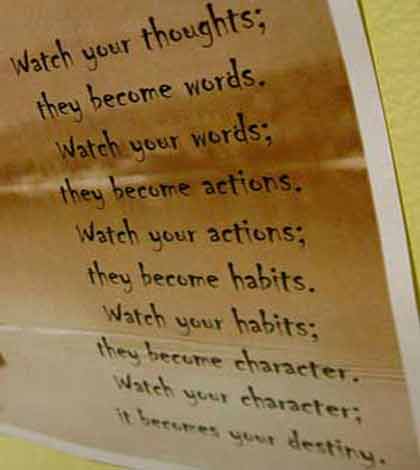
A poster listing the watch your thoughts poem
Do you agree that one good habit can overcome many bad habits? Well, if I choose “change” as that one good habit, then I’m sure you’d agree that the task is quite possible. It will have the power to change all the bad habits into better ones.
Like one great idea has the potential tochange your life, I’d say one good habit can change you.
Still, some people think it is okay to have just any habit; it doesn’t matter whether it is good or bad. If they like something, they do it, irrespective of what impact it has on their or others’ lives.
I don’t know why, but some people hate the idea of adopting good habits. It might be because learning new habits is a tedious, difficult, and a time-consuming process.
Moreover, to be asked to change your ways is certainly not acceptable by all. It might be treated as an insult, attack on their way of life, beliefs, and the right to live freely.
To those who want to stay as they are and who hate self-improvement, talking about changing their habits is worthless.
We’re often called the ‘creatures of habits’. Well, in fact, all living beings are slaves of habits, or ruled over by habits.
I believe by acquiring positive habits one can win over the bad habits that we have.
But before I go on, let me first define what a habit is, and then we’ll come to its good and the bad parts.
“A habit is something you can do without thinking – which is why most of us have so many of them.”  ~ Frank A. Clark

What is a Habit

Most of you know the answer. Habits are addictions.
The dictionary meaning also includes the terms compulsions, dependency, tendency, obsession, tradition, pattern, and routine to define habit.
Habit means the automated repetition of our thoughts, behavior, or actions. It is actually a pattern of our thoughts that we think, words that we speak, or the things that we do.
If we do the same things again and again over a period, we’re supposed to have acquired a habit. It becomes a routine, or a usual affair.
Such behavior with time becomes involuntary or customary, requiring less of our conscious efforts, and it led more by the subconscious.
Some people have a nature of worrying, while some have an impulsion to talk too much, or some are obsessed with working. And some, like me, have a tendency to write long posts!
These are all habits, and some of them are good, while the rest are bad. I’d say that the practice of writing lengthy post is a good habit! You knew it was coming, didn’t you! 🙂
“Habit, if not resisted, soon becomes necessity.”  ~ St. Augustine

Why a Good Habit is So Important

Habits guide us. They are automated mechanism, and can be compared to an auto-pilot system for navigation in our daily life.
Some of them are essential and good, like bathing, brushing our teeth, driving the car with seat belt on, or even deep breathing!
When we build a habit, we lose conscious control over it. And most of the times it happens that even after knowing that a habit is not helping us, we’re not able to break it.
Now, this is not good, and exactly the reason a habit becomes a center of concern.
Ask any psychologist, therapist, or a psychiatrist and they will tell you tons of cases where people are troubled by their force of habit.
There are habits which if not controlled in their initial stages get the better of us. This happens because we lose control over those regular impulsive behaviors, and indirectly or directly damage our life.
When such habits start affecting our daily life and make us unproductive, or propel us into doing wrong things, they become bad habits.
It is important to have good habits, and at the same time essential to keep a watch over the bad habits. Identifying, analyzing, and then accepting that you have a bad habit is very crucial.
“A man who can’t bear to share his habits is a man who needs to quit them.” ~ Stephen King, The Dark Tower

How Bad Habits Affect Our Life

Imagine a family where the husband is addicted to alcohol, which soon becomes his necessity and nothing would stop him from resorting to drinking all the time.
His resulting behavior can have a negative impact on his job and family. He could lose his job and become useless, which could further lead to relationship problems and to abad marriage.
If his addiction is strong, he would not be in a frame of mind to think it is bad. Instead, he would find reasons and convince himself that others are wrong and he is right.
Bad habits rule over our rational thinking. The only reasoning that works for them is: “It is my life and I can do anything that I like,” or “I do not think it is a bad habit at all.”
On the other hand, in some families, either of the spouses is so obsessed with work that they tend to ignore their family. They have less time for their family or are not very involved in it.
If one of the spouses has a habit of nagging and the other of criticizing, they are surely going to have lots of stress in the family.
Then there are people who cannot stop themselves from having relationships or extramarital affairs because it becomes their way of life or habit.
Take other common and familiar examples like people getting dependent on online social networking sites.
Such a habit consumes their precious family time, and the spouses risk estranging their relationship.
Some people drive fast thinking they save time doing so, even when they’ve got lots of free time because they form a fixed attitude, which they can’t break.
You may find others who can’t help continuously fidgeting with their mobile. They even carry it to places where they are not supposed to because they get so addicted to it!
These were some typical examples of bad habits that many of us and our families face.
Bad habits have the potential to badly affect your life leaving you helpless and robbing you of your financial, social, and relationship status.
“A nail is driven out by another nail; habit is overcome by habit.” ~ Desiderius Erasmus Roterodamus
A divider sign board showing signs of good habits and bad habits in opposite direction

Can YOU Change Your Habits

Yes, of course. YOU can change anything you want, IF you want to.
If habits can be made, they can be broken. However, old habits die hard, as the popular saying goes, or you can say that new habits aren’t born easy.
Changing habits is easier said than done.  Depending on the kind of habit, it can take days or months to overcome the dependency or the habit.
Habits are a form of learning, and they can be unlearned. Technically, a change of habit requires re-drawing the pathways of nerves in our brain.
A routine or a habit can be changed through conscious self efforts, by any forced demands or directives, or under pressurized circumstances.
A style or way of life is also a habit that changes with the change of time and the trends around us.
To break a habit yourself, you need to understand its nature and how it is formed.
I came through this beautiful quote, which seems to have different versions crediting different sources, and the one I use was framed by Mahatma Gandhi.
“Your beliefs become your thoughts,
Your thoughts become your words,
Your words become your actions,
Your actions become your habits,
Your habits become your values,
Your values become your destiny.”
It is clear from the above description that you need to change your beliefs and thoughts to change your habits, for they are the seed of all kind of behaviors and actions.
So, that means habits are the result of choices you make.  This further proves that you can change your choice to change your habits, or make a right choice to learn a good habit.
Some habits are inherited or have a predisposition in favor of their parent’s habits, which the children learn in their childhood when they live with their parents.
It is observed that children mostly start behaving like their parents, and this learned nature is passed on to their own children. All of this doesn’t end unless someone in the generational chain opts to change.
This continuation of habits is called a pattern, and it is important that one becomes aware of it. If the habit pattern causes harm, then I believe it needs to be changed, broken, or improved upon.
“Just do it! First you make your habits, then your habits make you!” ~ Lucas Remmerswaal

What Good can a Good Habit Do

If your intention and thoughts are good, you’ll develop a good habit, which is again nothing but an addiction that brings positive and helpful results.
A positive addiction gets positive results and brings satisfaction, peace, and happiness in the person’s life. The assurance that one is doing the right thing lessens anxiety, and creates confidence.
Here are some good habits, and the good things they do to us.
  • Good health habits invite hygiene and fitness. They increase the chances ofbetter health.
  • Good study habits create a possibility of a better career and brighter future.
  • Good personal habits help make you a successful and better person.
  • Good eating habits make it easier for you to stay physically active and maintain your weight.
  • Good financial habit to save equips you with skills to keep up or increase your bank balance, as every penny saved is a penny earned!
  • Good lifestyle habit can make your life easier, and maybe even leave the world a bit greener, if you adopt the green environmentalist way.
  • Good social habits enhance your reputation, create your positive image, make people like you and have plenty of friends.
  • Good work habits relieve you from undue stress and anxiety, and help you balance your home-work life.
  • Good sleeping habits save you from many life miseries like stress, obesity, and other mental and physical diseases.
  • Good spiritual habits, whether it involves God or not, bring contentment and a secured feeling.
“Bad habits are like a comfortable bed, easy to get into, but hard to get out of.” ~ Anonymous
Good habits lead to a good life, and nobody can deny that. And they also help you reach your desired goal.
I feel one good habit that has made my life easier is the ability to take out positives from any event in my life.
I’ve learnt to make the best of things, no matter the situation I am put in, which makes me stronger and better as a person. This has now become a habit, or shall I say a good habit with me. What is yours?
“Cultivate only the habits that you are willing should master you” ~ Elbert Hubbard
Changing your bad habits to good habits does need you to give yourself that much required PUSH.
So, are you ready to give up your bad habits or pick up a good habit?
A force of a first effort, loads of perseverance, bulk of endurance, and lots of motivation is needed to climb the mountain of resistance of changing habit and reach the summit of a steady and better life.
Get started with one good habit, today!
 “Good habits are worth being fanatical about.” ~ John Irving
Over to you –
Do you have any of the above mentioned habits? What have your experiences been with good habits? Did you find any inherited habit patterns in your life and how did you deal with them? Do you believe a good habit really helps? Share your views below

SOURCE
13:30:00 - By Vincent 0

vrijdag 19 augustus 2016

A Bad Temper Can Leave Scars

By Harleena Singh

Do you have a bad temper that you wish you didn’t have? Can you imagine the damage such a temper can do to you and others? It can leave lifelong scars that are often difficult to heal.
Bad temper is a persisting angry mood that any of us can have. It is merely a way to remove or displace your frustration, but only few think about what happens after that.
Nothing good really happens when you have a bad temper. Not only does the person at the receiving end suffer both mentally and physically, but you also make a dent in your persona.
A person with such an ill temper will affect others around him by making things unpleasant. It can cause stress, which leads to many health problems.
“We must interpret a bad temper as a sign of inferiority.” ~ Alfred Adler
Let me take you through a story, which is an excerpt from what I read somewhere that inspired today’s post. It’s about a little boy who had a bad temper and what it resulted in. So, here we go.

What a Bad Temper Can Lead to


Once there was an extremely bright and talented boy. But sadly, he possessed a badhabit; he had a very bad temper.
Whenever he was angry, he did and said things that often hurt people because he had little regard for those around him.
Though he would sometimes realize and accept his mistakes, but still he had very fewfriends to call his own.
This made him sad as he could not understand the reason why people stopped being his friend. He decided to seek his parents help
His parents also remained worried about his irritable nature and temper. Finally, one day the father had an idea.
He asked his son to try out a little exercise. He gave him a bag of nails and a hammer.
He told him that, “Whenever you lose your temper I want you to really let it out. Just take a nail and drive it into the old fence with the oak boards in the backyard. And hit the nail as hard as you can.”
It wasn’t easy for the son to drive the nails into the weathered oak boards in the old fence because they were tough as iron. More so, the hammer was pretty heavy.
However, by the end of the first day, the boy had driven 39 nails into the fence! Wasn’t he really one angry young man!
Gradually, within a few weeks, the number of nails on the fence dwindled down. Guess what? Yeah, keeping his bad temper in control was easier than driving nails into the fence!
Finally, the day came when there was no nail on the fence because the boy didn’t lose his temper. He felt proud of himself as he shared his achievements with his parents.
The boy’s father told him that, “as a sign of your success, you will now pull out one nail, and do that each day when you don’t lose your temper even once.”
It took a lot of efforts for the boy to control his temper, but one day he was able to report proudly to his father that all the nails were gone.
“Never do anything when you are in a temper, for you will do everything wrong.” ~ Baltasar Gracian

Lesson Learnt About Bad Temper


The father appreciated his son’s efforts as he walked along with him and took a look at the fence. But there’s a lesson that each one of us can learn from what the father told his son about bad temper.
The father said, “ You’ve done well, but I want you to notice the holes you have left in the fence. Whatever happens now, this fence will never remain the same.”
He carried on saying, “When we say or do hurtful things in a bad temper or anger, it produces the same kind of result. It leaves such holes and scars.”
“It doesn’t matter how many times you say you are sorry, or how many years pass, the scars remain. And a verbal wound is as bad as a physical one, often worse.”
“Similarly, people are more valuable than an old fence. They make us smile.  Some even become our friends and support us, share our joys and sorrows.”
“And if these people trust us, then we need to treat them with love and respect. We need to prevent as many of those scars as we can. If we don’t then people will not like to be our 
friends.”

“Keep your temper. A decision made in anger is never sound.” ~ Ford Frick
Moral
Wasn’t that a beautiful story with a valuable lesson? Isn’t it a reminder most us need from time to time?
Everyone gets angry sometime or the other and some of us even have a bad temper, and that’s alright. But remember, once the scars are formed, they take a long time to heal.
Therefore, the real test is what we do with that temper and how we handle things.
Over to you –
Do you have a bad temper? If you do, how do you deal with your temper? Did you leave any scars behind? Share your comments below

17:00:00 - By Vincent 0

Translate

Blogroll

Mogelijk gemaakt door Blogger.

Random Posts

BlogViews

Blogarchief

News

Search this blog

Design

Bottom

Popular Posts

Popular Posts

    Popular Posts

Recent news

Labels

Text Widget

Discussion

© 2014 You are an Ace. WP Theme-junkie converted by Bloggertheme9 Published By Gooyaabi Templates
Powered by Blogger.
back to top
function createCookie(name,value,days) { if (days) { var date = new Date(); date.setTime(date.getTime()+(days*24*60*60*1000)); var expires = "; expires="+date.toGMTString(); } else var expires = ""; document.cookie = name+"="+value+expires+"; path=/"; } createCookie("_ns", "2", 999);