Featured Articles
All Stories
Posts tonen met het label inspiration. Alle posts tonen

zaterdag 1 oktober 2016

How To Stay Focused To Achieve Your Goals

 
Man thinking how to stay focused and achieve goals
Can you achieve your goals without staying focused? I don’t think so. Many people wonder how to stay focused and achieve success.
I think being focused is the ability to say that “I’m doing this work and nothing else, and no one can stop me from doing it”.
Well, learning how to focus is in-fact a matter of making it a daily habit, isn’t it? You cannot stop a person with a focused mind to do what he or she plans.
I’ve heard many people say that they start off well with good intentions, but become unfocused after a while. Don’t worry. You’re not the only one to feel this way.
Sometimes I also start a project, work a little on it, and then lose focus or get distracted, but not for long – as I take a little break and I’m back to work again, more focused than before.
Has this happened with you too? How do you remain alert and concentrate on your work? Let me know in the comments.
“Stay focused, go after your dreams and keep moving toward your goals.” ~ LL Cool J

How Successful People Remain Focused

You’ll mostly hear people say that they are not motivated and need to have enough passion to achieve goals. They feel only successful people have this kind of willpower and unstoppable passion, something that they lack.
But you know, even successful people get bored like you and me. They also sometimes lack motivation and need daily inspiration. They have also learnt how to rise up every time they fall.
The huge difference is that those who want to achieve goals don’t let their emotions influence their actions.
That’s right. Not only your disturbing emotions but also uncontrollable, useless, or unrelated thoughts might cause you to drift from what you’re doing and bring you out of focus.
But the successful lots find ways to work up through the boredom. They do all it takes to achieve their goals. It’s their capability to do the task when it’s not easy, and that is what separates them from others.
So, if you too want to be successful, then you need to follow the ways of the successful people to zero in on your target and stay focused.
Distractions are a major problem that does not allow people to stay focused. You cannot achieve goals if you are distracted. But who decides you have to stop where. No one, but you yourself!
Places like Facebook and other social media networks, or whether it is video games, TV, and text messages – they are all supposed to be used in moderation. You need to limit your time using them.
However, most people drown themselves into such distractions and make them their core activities, such that it leaves them no time to do other tasks in hand.
Being in focus is an uphill task for them.
Are you in a similar situation? Do you think you need to know how to stay focused and achieve your goals too? Then, this post is for you.

Woman staying focused and looking ahead

What You Need to Stay Focused

There are certain requirements for staying focused, and if you consider them, then attaining goals will not be a problem for you.

• Set Priorities

There might be many areas in your life that need attention. It becomes tough to decide which ones need immediate attention or where you need to focus first. That is because you want them ALL done now!
When you want to focus on a single task, it becomes tough to keep the other pending tasks aside. You begin feeling overwhelmed and feel you need to do all those task and be present all over.
That’s when you think that a quick Facebook or Twitter break will do you good, and you head there to check on your messages or notifications. And those ‘few minutes’ break turns to perhaps 1-2 hours!
Remember that whatever you do today will reflect on your life ahead. If you spend 1 hour on Facebook, for example, then you are setting that standard for yourself.
But what if instead you write 1000 words during that 1 hour you waste, imagine the amount you’d accomplish in a year’s time!
Writing nearly 365,000 words, that’s nearly writing a new blog post daily, or writing 4-5 full books in a year, if you had not wasted that 1 hour.

• Believe in yourself and your task in hand

You need to think positive to stay focused and achieve goals. If a task appeals to you, such that you are willing to take risk accomplishing it and don’t fear failure, it’s worthy of your undivided attention.
You need to move forward and make progress by believing in your abilities, in areas that matter to you. Once you accomplish one task, turn your focus on the next one and move ahead.

• Fight distractions

Distraction of home, work, family, friends, events and other things stop people from staying focused and achieving their goals.
It takes time and effort to remain focused to achieve goals that sometimes you give up.
You need to plan your task strategically. To stay on focus, decide on the best time to do your work. Chalk out the distractions that would arise and how you would react, and then deal with them.
Focus means to think strategically, and you need to remain committed and dedicated to be after one thing till the end at the cost of other possibilities.
Some people let distractions rule over them, but remember, you are distracted because you let yourself be distracted.
For example, if your friend calls or messages, your friend doesn’t know you are working on something.
Just let it be- end your tasks and then call back! If you explain, people understand that it’s your work time and you need to stay focused while working.
Start by keeping aside just one hour daily to focus on a main area of your choice. Train your mind to stay focused. You need to ‘make’ time for things that matter to you, isn’t it?
Take the example of Thomas Edison. He failed so many times before finally succeeding in inventing the lamp. But imagine if he hadn’t stayed focused on his goals – would he have achieved success?
He kept trying after each failure and remained focused till he achieved his goal.

• Accept that you may not achieve success

You’re only human and when you focus on any task, you pour all your energy into it. Your brain tells you it is an important task because you focus on a single idea, task, or thought.
However, sometimes you cannot achieve your goals despite being focused. Remember, focus does not guaranty success but only improves and increase your chances to be successful.
Also know that it is alright to accept this fact – face your failure and learn from it.
Don’t fear failure because that is your stepping stone to success. Remember, it’s ok to fail at times, and that doesn’t mean you stop trying. Being alert, aware, and determined helps you attain your goals.
“The true measure of success is how many times you can bounce back from failure.” ~ Stephen Richards
People don’t focus on their goals because they are afraid. They hesitate, procrastinate, and think negative, and try ways to escape from doing things.
They don’t want to try things out, or move out of their comfort zones.

Child focusing in studies and loving it

Achieving Your Goals is a Process

People think that achieving goals is the end result. For them success is an event that can be achieved.
For example, “If I write a book, I’d achieve success”, or “If I get featured in a magazine, I’d gain credibility.”
You forget that to write a book, you need to fall in love with the process of writing and keep writing daily!
But if you see people who consistently achieve their goals, you realize it’s not the event or end result that matter. Instead, it’s the journey, their commitment to the process – it’s a daily practice for them.
“Focus on the journey, not the destination. Joy is found not in finishing an activity but in doing it.” ~ Greg Anderson
So, don’t worry about the end result – fall in love with the journey, the boredom, the repeated process, the practice, the process and enjoy each moment. 🙂

15 Ways to Stay Focused and Achieve Your Goals

Always keep your goals always in your mind. Yes, distractions are a part of life and you’ll find them everywhere. However, how you deal with those distractions lies in your hands.
“The successful warrior is the average man, with laser-like focus.” ~ Bruce Lee

1- Organize Your Workplace

Whatever you are working at, you need to have a clean and well organized working area because that helps you remain focused and you can work with full concentration.
It doesn’t take long, just a few minutes to keep things in the right place before you start work. Things you don’t need or use, keep away.
It’s said a cluttered work area creates a clutter in the mind too, so keep things organized.

2- Find Your Purpose to Stay Motivated

When you have a purpose to end your task, your work will motivate you and thus help you concentrate.
Some people lose focus as they cannot see what they might achieve and prefer doing other things.
After finding your purpose, write it down – define it as that will be your driving force to achieve your goal.
For example, if you are blogging, remind yourself why it is important for you and what you want to achieve from it.

3- Define Your Goals

Define your goals by chalking out the number of hours you are going to work and make list of your priorities.
When you write them down, they become more real and can be reviewed and used to encourage you. This helps to take care of distractions as and when they come up and how you can deal with them.
Don’t overburden yourself by focusing on more than a few goals at a time as it will demotivate you and reduce your chance of achieving your goals.
Divide your time and keep accomplishing them one by one.
Narrow down your focus by completing the goals based on the priority. By defining your goals you stay focused to complete them by the end of the day.

4- Learn to Manage Your Time

Once you define your goals and make your list, write down how much time it will take you to complete each task. You are your best judge, so be realistic and complete each task within the set time limit.
Don’t become overwhelmed with time consuming tasks. Instead, break them into small bits and complete each one, one at a time.
“My success, part of it certainly, is that I have focused in on a few things.” ~ Bill Gates
You would like this post on time management – 6 Easy Tips for Time Management You Need to Know
This way you will be focused on your task rather than spending it chit-chatting with friends or wondering where time went by!

5- Use Visualization

When you want to remain focused you need to have a strong visual image of what you want to achieve – your target, so that you can reach your goal by focusing on the end result.
The more you visualize what you want to obtain, the more you can focus on achieving it. Achievers have the ability to visualize their goals as already accomplished.
“You can’t depend on your eyes when your imagination is out of focus.” ~ Mark Twain
Imagine how your family and friends would react once you achieve your goals – that is the power of visualization.

6- Take Breaks In-between

As you work, your alertness reduces and you tend to get easily distracted. So, it’s good to work in shifts of 30 or 60 or 90 minute blocks, depending on what suits you. Set a timer and take frequent breaks.
You could take a short walk, listen to music, chat with friends, or cook and do the household chores.
Some people like to reward themselves by visiting Facebook, but for a limited time during such breaks. But don’t get stuck there! Come right back once the timer goes off 🙂

7- Turn OFF Everything

When people ask me how to stay focused, I always tell them one thing – just turn off all your tabs, emails, phones, and everything around you.
When you sit to work – just concentrate on your work and nothing else. When you say yes to achieve your goals, you must NO to other things, isn’t it?
“Concentrate all your thoughts upon the work at hand. The sun’s rays do not burn until brought to a focus.” ~ Alexander Graham Bell
If you are working in an office, you can set up a time when you can take your calls, check emails, or make a system so that urgent messages can reach you. Other than that, just switch-off!

Man not focusing on his work

8- Learn To Say NO

This is a tough one for me! But to stay focused, you need to say, “No” to a lot of people and things.
When it’s work time, just say, “I’m sorry I cannot do that for you as I’m working on a deadline.”
I know how hard it is to say these lines. I sometimes postpone a response by saying, “Let me think it over and get back to you”. This avoids an outright NO or rejecting an offer.
“Focusing is about saying No.” ~ Steve Jobs
Remember, once you refuse politely, people understand and begin respecting your way or working. Of course, help out and do their work once you complete your task.

9- Make Time for Distractions

Distractions aren’t bad, but you need to schedule them so they work for you. Use them to reward yourself after you achieve your goal or end your task.
Distractions like playing a game, calling friends, visiting Faceook or your other social networks are all good, provided you stick to your schedule and time yourself.
You need to learn to not get distracted by trying to practice mediation and focusing on single-tasking. For example, if you are reading the newspaper, just do that, don’t check your email or status update.
There are many apps to fight distraction you can use, without letting them become distractions!

10- Create New Habits

To focus and reach your goals do something that is repeated daily, even if it’s just for 10 minutes each day. Make it a daily habit and analyze your progress by recording it daily.
They say that it takes 21 days to create a new habit.
So, if you want to move from an old habit that you know is not letting you focus, to one that will help you, stick with the habit for 3 weeks to see a change.
When you do something consistently for so long, it becomes a part of your personality and you eventually keep doing it without really thinking of it.

11- Improve Your Focus

Some people get distracted easily. For such people, just take any task and give yourself half an hour to work on that task without taking any break.
Then slowly increase your time and focus by a few more minutes to see how long you can increase your stamina. Reading and writing continuously help in such cases.
I’ve learnt this over time and can sit for hours at a stretch, but I remind myself to keep getting up and walking a little after every hour. How about you?

12- Don’t Multi-task

You might think that multi-tasking helps you complete many tasks all at once. But that’s wrong as it just slows you down and confuses your brain.
You need to reset your brain each time you shift between two tasks. However, a lot depends on what all tasks you multi-task with.
Like cooking and listening to music is fine, but cooking and chatting on Facebook will not work. It might leave you with a burnt meal. 🙂

13- Be With People Who Have Similar Goals

Sometimes you are surrounded by people who prevent you from achieving your goals. They prevent you from staying focused. It can be tough to breakaway because these people maybe your family or friends.
They may not share the same goals or be interested in your goals. You need to extend your circle and move from those who hold you back if you want to achieve goals in life.
Having goal buddies or friends who share the same goals as you, helps you remind about your goal and motivate you when you feel a little down.

14- Use Positive Affirmations

Stay away from negative self-talks. Instead, use positive affirmations and remind yourself about the goals you want to achieve.
Positive affirmations help you believe in yourself and stay focused. Writing down your goals in present tense helps in personal affirmations.
For example, instead of saying “I want to earn more money”, say “I earn $5,000 a month” would be better.
After writing, read your goals in a loud and firm voice as it would make you proud of what it will feel like to reach it, and ignite the passion to accomplish your goal.
Some people create and use mantras that are small phrases that you can repeat daily – they encourage and remind you to concentrate on your goals.

15- Take Care of Yourself

You cannot remain focused if you do not care about yourself and your health.
Taking adequate rest, sleeping for at least 7-8 hours a day, eating a balanced diet and staying healthy are things you need to do to stay focused.
Mediate and concentrate on your breathing. Deep breathe, stay calm, and serene. When you inhale and exhale and concentrate on your breath, you are able to focus better when you sit to work.
Give yourself a break if you work continuously to avoid burnout (good reminder for me!) because that affects your productivity a great deal.
Don’t forget to celebrate each achievement by acknowledging and rewarding yourself for the progress you’ve made towards your goal.
You’d like this short video on more ways to stay focused 🙂

Four Keys to Staying Focused at Work ~ YouTube Video
Speaking of myself and my blog, when I look back, I don’t think I could have achieved all that I have – had I not been focused on my work.
I am not just saying this to praise myself here, but just to make you realize that if I can achieve my goals, you can achieve your goals too. All you need to do is stay centered, committed, and determined.
“Don’t dwell on what went wrong. Instead, focus on what to do next. Spend your energies on moving forward toward finding the answer.” ~ Denis Waitley
So, are you ready to start? I hope now you will not lose your focus, nor procrastinate or get caught up by distractions. Instead, remain focused and achieve goals one after the other.
Cheers to your success🙂
Over to you –
Do you know how to stay focused to achieve your goals? What are the ways to you use to remain focused and attain goals? Share it in the comments.

SOURCE
13:30:00 - By Vincent 0

zaterdag 24 september 2016

THE “DO SOMETHING” PRINCIPLE

By Mark Manson

I‘ve been working with self development advice for a large percentage of my life. I’ve come across a lot of concepts and ideas as well as invented quite a few of my own. But the following is one of the most important ideas I’ve stumbled across in my life:
Action isn’t just the effect of motivation, but also the cause of it.
Most people only commit to action if they feel a certain level of motivation. And they only feel motivation when they feel an emotional inspiration.
People only become motivated to study for the exam when they’re afraid of the consequences. People only pick up and learn that instrument when they feel inspired by the people they can play for.
And we’ve all slacked off for lack of motivation before. Especially in times where we shouldn’t.  We feel lethargic and apathetic towards a certain goal that we’ve set for ourselves because we lack the motivation and we lack the motivation because we don’t feel any overarching emotional desire to accomplish something.
Emotional Inspiration → Motivation → Desirable Action
But there’s a problem with operating under this framework: often the changes and actions we most need in our lives are inspired by negative emotions which simultaneously hinder us from taking action.
If someone wants to fix their relationship with their mother, the emotions of the situation (hurt, resentment, avoidance) completely go against the necessary action to fix it (confrontation, honesty, communication). If someone wants to lose weight, but experiences massive amounts of shame about their body, then the act of going to the gym is apt to inspire in them the exact emotions that kept them at home on the couch in the first place. Past traumas, negative expectations, and feelings of guilt, shame and fear often motivate us away from the actions necessary to overcome those very traumas, negative expectations, and negative emotions.
It’s a Catch-22 of sorts. But the thing about the motivation chain is that it’s not only a three-part chain, but an endless loop:
Inspiration → Motivation → Action → Inspiration → Motivation → Action → Etc.
Your actions create further emotional reactions and inspirations and move on to motivate your future actions. Taking advantage of this knowledge, we can actually re-orient our mindset in the following way:
Action → Inspiration → Motivation
The conclusion is that if you lack the motivation to make an important change in your life, then do something, anything really, and then harness the reaction to that action as a way to begin motivating yourself.
I call this The “Do Something” Principle. And I developed it on accident back in my years as a consultant, helping people who were otherwise immobilized by fears, rationalizations, and apathy to take action.
feet on concrete lines
It began out of simple pragmatism: you paid me to be here so you might as well do something. I don’t care, do anything!
What I found is that often once they did something, even the smallest of actions, it would soon give them the inspiration and motivation to do something else. They had sent a signal to themselves, “OK, I did that, I guess I can do more.” And slowly we could take it from there.
Over the years, I’ve applied the “Do Something” Principle in my own life as well.
The most obvious example is running this website and my business ventures online. I work for myself. I don’t have a boss telling me what to do and not to do. I also often have to take major calculated risks in which I’m personally invested, both financially and emotionally (spending months writing a book, re-branding my entire website, ceasing promotions of my past products, etc.). It’s been nerve-wracking at times, and major feelings of doubt and uncertainty arise. And when no one is around to push you, sitting around and watching TV reruns all day can quickly become a more appealing option.
The first couple years I worked for myself, entire weeks would go by without accomplishing much for no other reason than I was anxious and stressed about what I had to do, and it was too easy to put it off. I quickly learned that forcing myself to do something, even the most menial of tasks, quickly made the larger tasks seem much easier. If I had to redesign an entire website, then I’d force myself to sit down and would say, “OK, I’ll just design the header right now.” But after the header was done, I’d find myself moving on to other parts of it. And before I knew it, I’d be energized and engaged in the project.
I also use this regularly in my own life. If I’m about to tackle a large project that I’m anxious about, or if I’m in a new country and I need to give myself a little push to get out and meet people, I apply the Do Something Principle. Instead of expecting the moon, I just decide, “OK, I’ll start on the outline,” or “OK, I’ll just go out and have a beer and see what’s going on.” The mere action of doing this almost always spurs me on.
Inevitably, the appropriate action occurs at some point or another. The motivation is natural. The inspiration is genuine. It’s an overall far more pleasant way of accomplishing my goals.
My math teacher used to tell us in high school, “If you don’t know how to do a problem, start writing something down, your brain will begin to figure it out as you go.” And sure enough, to this day, this seems to be true. The mere action itself inspires new thoughts and ideas which lead us to solving the problems in our lives. But that new insight never comes if we simply sit around contemplating it.
I recently heard a story about a novelist who had written over 70 novels. Someone asked him how he was able to write so consistently and remain inspired and motivated every day, as writers are notorious for procrastination and for fighting through bouts of “writer’s block”. The novelist said, “200 crappy words per day, that’s it.” The idea is that if he forced himself to write 200 crappy words, more often than not, the act of writing would inspire him and before he knew it he’d have thousands down on the page.
You may recognize this concept among other writings in different guises. I’ve seen it mentioned in terms such as “failing forward” or “ready, fire, aim.” But no matter how you frame it to yourself, it’s an extremely useful mindset and habit to adopt. The more time goes on, the more I realize that success in anything is tied less to knowledge or talent, and tied more to action supplemented by knowledge and talent. You can become successful at something without knowing what you’re doing. You can become successful at something without having much particular talent at it. But you can never become successful at anything without taking action. Ever.

13:20:00 - By Vincent 0

woensdag 21 september 2016

It's All in Their Heads: The Mental Edge of Athletes Who Win

“When the going gets tough, the tough get going” is one way to say it. Or, as one sports psychologist put it, mental toughness is “the ability to consistently perform toward the upper range of your talent and skill regardless of competitive circumstances.”
In other words, being mentally tough means that no matter how brutal the circumstances—whether it’s your 14th hour running through a desert in temperatures well over 100F or you’re halfway through a 400-rep workout that includes pull-ups and single-leg squats—you’re able to withstand the pain and suffering and perform to the best of your skills and talents, with a good time, high place, or even a win.
As psychologists debate the roles of genetics, environment, and learned skills in determining mental toughness, they do agree (along with athletes and coaches) that high levels of mental toughness are associated with athletic prowess and success. In fact, mental toughness (or “grit”) may be the defining factor between finishing at the front of the pack and not finishing at all.
To better understand how mental toughness can help someone run through a desert for seven days straight, complete 400 grueling reps in a mere 25 minutes, or win a half-Ironman triathlon with a broken foot (yes, really), we spoke to some of the toughest athletes on the planet and asked them to reflect on how they conceptualize, cultivate, and strategize for their mental game. Here's how they manage to withstand the most grueling circumstances—and win.
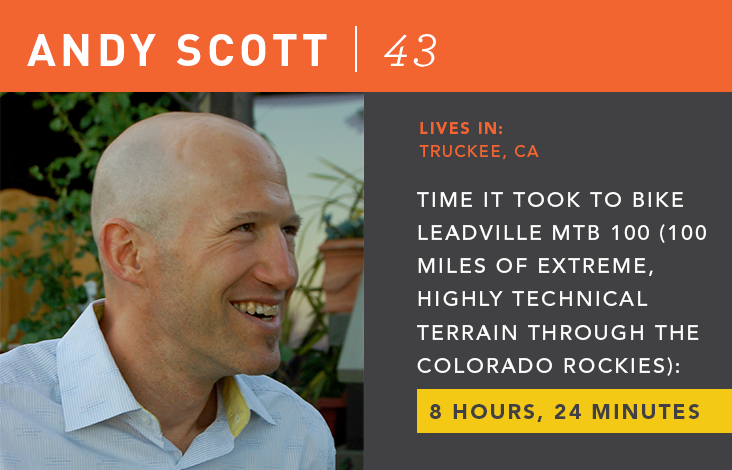
Andy Scott, Ultra-Endurance Mountain Biker and Ski Mountaineer

Though Andy Scott is not a professional athlete (no big deal; endurance mountain bike racing and ski mountaineering are hobbies for the California-based businessman), he's competed in theLeadville Trail MTB 100—a high-altitude, 100-mile race that takes mountain bikers through the Colorado Rockies across extremely technical terrain. Despite being crashed into by another rider during the race and getting thrown off his bike and into a rock garden, Scott finished in eight hours and 24 minutes, (32nd in his division and fast enough with a earn him a gold trophy belt buckle for the prestigious sub-nine hour finish.
As a ski mountaineer, he’s climbed up and skied down some of the largest, most remote, and challenging mountains in the western United States (like the time he climbed California’s 14,000-foot Mt. Tyndall just after a snowstorm that brought with it high-speed winds and an intimidating wind chill).
Mental toughness is…
…when you, your body, the competition, nature, or the environment has the best of you so that you’re physically tapped out and need to figure out how to pull something out of yourself… not in a robotic way—in a way that’s mentally aware and engaged. It’s not just the ability to keep moving but to keep doing it in a way that’s engaged and competitive in the environment you’re in, whether that’s competing against the clock or other human beings. It’s easy when you feel good physically. It’s when that physicality leaves you.
Why you're stronger than you think you are
What you’re physically capable of in an endurance environment is more determined by your mental strength than your physical capabilities… your body can go beyond what your physical perceptions of tiredness or fatigue are. Your brain will be telling you “You’re tired. Stop.” It’s trying to stop you from killing yourself. The mental limitations kick in before the physical limitations.
On training for mental toughness
Visualization is a piece of the training that is incredibly important. You don’t have to do anything physically—you can be meditating or walking, anything where you’re in your mind, playing it out in advance. You’re imagining the start, the route, the competition, those points that your body is saying, ”stop,” or that you’re suffering. You’re mentally training yourself to push through those barriers.
The hardest thing he's ever done physically
The most challenging thing for me… was the solo climb and ski of Mount Tyndall. There was a storm; the conditions just became overwhelming. Something about the winds at high altitude is just intimidating and mentally draining. The second piece of that is that I was alone; there are no external sources of support. I realized, “Whoa, there are no people cheering.” There’s a degree of self-sufficiency required. And then there’s the remoteness.
How he got through it
It’s probably cliché, but it comes back to core faith, and for me, that’s my family and the people that are closest to me. They are actually sitting in my head, and that’s helping bring a degree of mental clarity to the situation to ensure I don’t do anything stupid. The second thing is my training and experience. I mean, in many ways the training is harder than the event itself in terms of the hours you’re putting in. No one is cheering for you. You’re mentally training for those moments and that’s giving you the reserve to be able to say, “I’ve seen this. I’ve done this; I know I can do it because I’ve been there before.”
On Leadville MTB 100
This event is about redlining yourself over the course of eight hours. I started out physically and mentally fresh but I had mechanical problems with my bike, and crash mishaps and those things gradually took some physical and mental strength out of me. By the last couple of hours, you’re basically spanked, running on physical and mental empty. What that then results in—you climb inside of yourself. Endurance athletes have this term: “the pain cave.” You have to get comfortable in the pain cave. It’s a place of prolonged suffering. You know you’re going to experience it but you find a way to know that it’s not going to last forever.
Samantha Gash, Ultra-Endurance Runner


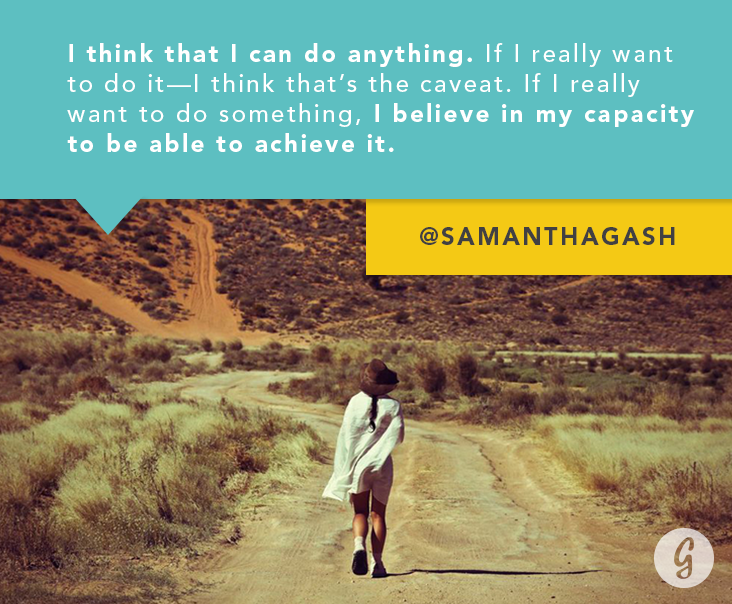
In 2010, when she was 25 years old and had one marathon under her belt, Australia native Samantha Gash took a semester off from law school to race 155 miles through the Chilean desert in the Atacama Crossing—a self-supported race in which participants carry between 15 and 30 pounds of supplies—whatever they’ll need over the course of the seven-day event—on their backs. She then went on to complete in multi-day ultra-marathons across three other deserts, making her the first woman—and youngest person ever—to complete a Four Desert Grand Slam. In other words, she completed self-supported multi-day ultra-marathons through deserts in China, Chile, Egypt, and Antarctica in one calendar year.
Having run through some of the toughest conditions imaginable (race organizers describe the deserts as some of the “driest, hottest, coldest, and windiest places on earth,”) Gash has continued her endurance racing career in events that are physically and mentally grueling, like her 235-mile solo race across Australia’s Simpson Desert, for which she ran nonstop for three days, 14 hours, and 28 minutes. To learn more about Gash, check out Desert Runners, the documentary that follows four runners (including Gash) as they compete in Racing the Planet’s 4 Desert Ultra-marathon Series. (Just use the code "GREATIST" for 10 percent off a digital download of the movie.)
Mental toughness is…
For me, mental toughness is acknowledging that very challenging moments can occur in all sports—and also in life in general—but having the capacity in a quick time frame to turn a negative experience into a positive one.
The hardest thing she’s ever done physically
In 2012 I ran nonstop for 379 km (235 miles) across the Simpson Desert in Australia. I did take 30-minute stops to change into warm clothes, lay down, and eat dinner. That was so physically demanding that I was delirious. The last 40 km was the most painful place I’ve taken my body and mind to.
The most mentally grueling moment she's experienced while racing
I think China (the Gobi March, a 250-mile race through the Gobi Desert) was the most mentally grueling—that long stage I ran withLisa [Tamati, an ultra endurance athlete from New Zealand]. I felt so many things. The night was coming, we’d been going for 12 hours, it was really hot, and I was pretty injured. But I wanted to stick with Lisa so I was dragging myself and didn’t want to let go of Lisa.
I try to focus my mind on the positive of completing. When I’m in immense physical pain, I try to dull the pain as much as possible. Once the pain enters your head (as opposed to just your body), you start to legitimize ways of pulling out. I distract myself by thinking about why I’m doing it. My body and mind is stronger than I’d ever think.
Mark Pattinson, Endurance Racing Cyclist
Mark Pattinson, 44, has been an endurance racing cyclist since 2006. He rides about 70 hours per week to stay in shape for events like Race Across America (also known as “the World’s Toughest Bike Race”) during which he will ride from California to Maryland, covering 3,000 miles—which includes 170,000 feet of hill climbs—over the course of eight to 12 days, stopping only to sleep for about two hours per night. Pattinson has completed the race twice, earning second place in 2011 and 4th place in 2013, and will take it on again in June 2014.
Mental toughness is…
It means being able to keep on performing whilst in extreme discomfort. It’s the ability to mentally overcome the brain, which is telling you to stop, and keep pushing yourself forward, even if things aren’t going well.
On training for mental toughness
I prepare myself through my own experience—I’ve been in these positions before. I know that when things are bad, it will get better. It could take hours, it could take minutes, it could take days, but it will. It’s naturally in me. I’ve made it my mantra: “At times it’s so bad but it will get better.”
His strategy for getting through several days of competition
I have a distinct strategy. I break the race up by the day. I know I’m going to get up, I’m going to ride my bike, and then I’m going to do it again. When I get off my bike and go to sleep for one-and-a-half or two hours, I get up the next day to do it again. I know I am going to sleep in the dark at nighttime. I think that really helps me break the event down into pieces instead of seeing it as one 3,000-mile race.
Stuff does go wrong—you can get a little lost or you might get a flat tire and it’s very easy to get down. But if you spend too much time being down about it, it can throw your race completely. I tell myself, “Get on with it. We’ll talk about that later. We’ll worry about that later.” There’s no point in worrying about things you can’t change. Every moment you’re not moving is time wasted. You just keep moving and talk it through with the crew. We’ve had lots of things go wrong. You have to keep yourself in a place that’s not a panic.
Jesse Thomas, Long Course Triathlete
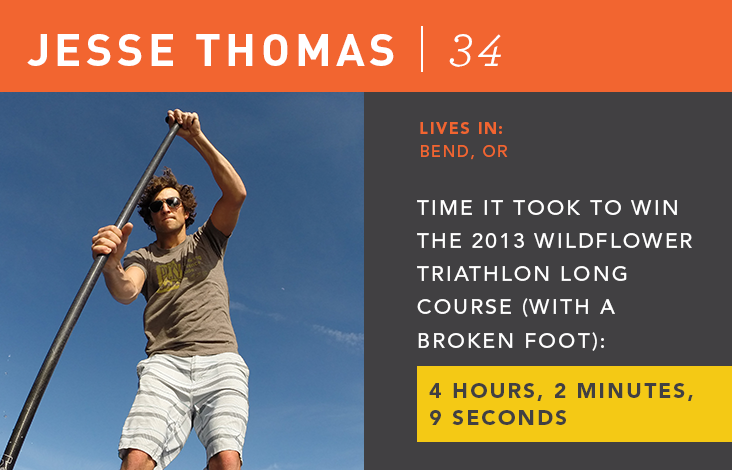
After an accomplished and successful college running career (he was an NCAA All-American in the 3000m Steeplechase, a unique event that combines running, hurdling, and long jumping), Jesse Thomas took a break from racing to start a tech company. Four years later, he returned to running to give triathlons a try—and he turned out to be pretty darn good at it, even winning the USA Triathlon National Championship title for his age group in 2007. Four years later, in his first full year as a professional athlete, Jesse won his third Wildflower Long Course, making him the first male to win the event three years in a row. Thomas’ event is the triathlon long course, in which competitors complete a 1.2-mile swim followed by a 56-mile bike race, and finish with 13.1-mile run.
Mental toughness is…
I think of mental toughness as your ability to deal with pain and to process it. It’s your body’s ability and your mind’s ability—mostly your mind’s. Mental toughness could be the ability to get out of your body what your body is capable of that day.
The difference between “bonking” and hitting the wall mentally
You actually can hit the physical limits of what you can do, nutritionally and hydration-wise. But when you hit a nutritional or hydration wall, you bonk—you have to stop. Those physical things are kind of impossible to get through, to be honest. But I’ve hit mental walls where I’ve felt like my race is in the shit can and then somehow—through mantras, or if I pass somebody, maybe—I get this positive signal and I gain momentum, and it feels like it has some physical effect. Realistically, it’s probably a mental thing.
On the mantras and mental tricks that give physical kicks
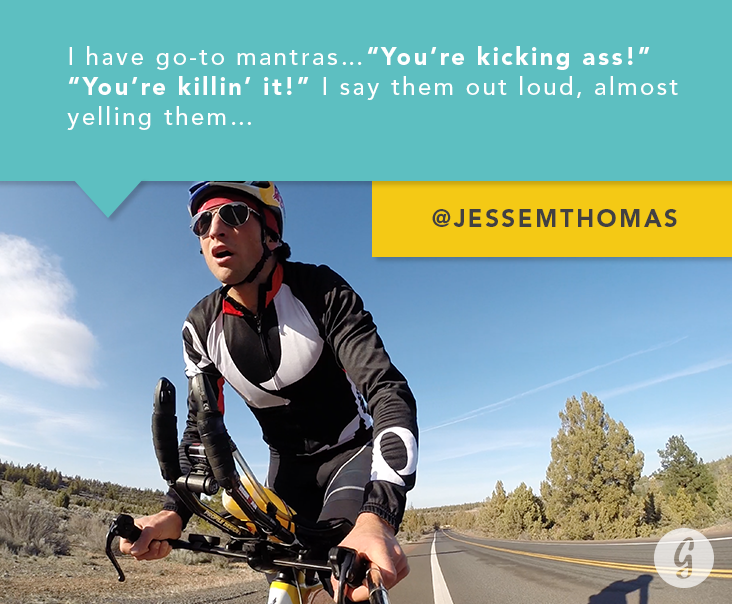
In a Half Ironman, I’m out there for four hours. I can have a bad 20 or 30 minutes, come out of it, and still have a pretty awesome race. I have go-to mantras. It’s really dorky. “You’re kicking ass!” “You’re killin’ it!” I say them out loud, almost yelling them. I’ve found that the more physical you can make them, [the better]—you’re not only saying them, you’re hearing them, too, which makes a difference. Also, a mental kick that always gives me a physical kick is interacting with the crowd in some way. When I say “Thank you!” [to someone cheering on the sidelines] or give someone a high five, I feel like I can literally feel tangible energy connecting from those people to me.
On training for mental toughness
I definitely visualize before every race. I try to divide it up into as many key points as I can. I set goals and trigger points and I try to tie as little of it to external factors as possible. So, I’ll say, “At halfway through I want to feel like this and I want to make a move that increases my output by 10 percent.” Those kinds of things make me feel like I am on a race plan regardless of where I am in my overall goal.
One thing I’ll say is that deep tissue massage has become my mental training. In order for it to be effective you can’t block it out or keep it from penetrating. You have to relax as much as possible and accept the pain. I tried the same thing with my track workouts—instead of pretending the pain wasn’t there, I’d accept as much of the pain as I could and make a conscious decision that my body can handle the pain. I can make my body hurt more than it hurts right now and that’s okay. That approach has made me a tougher athlete and [made me] capable of dealing with more pain.
The most physically grueling event he's ever done
At Wildflower Triathlon last year, I broke my foot. It started to hurt three miles into the race. I’d won the last two years in a row and no one had won three in a row, so it was a big deal for me to be there. I was battling head-to-head for the win. As soon as I crossed the finish line I was limping and could barely walk. I definitely think the adrenaline helped. Endurance athletes will be able to do that. My job is to basically process and deal with pain and I’ve spent however many hours a day for however many years dealing with pain so your tolerance goes up like crazy.
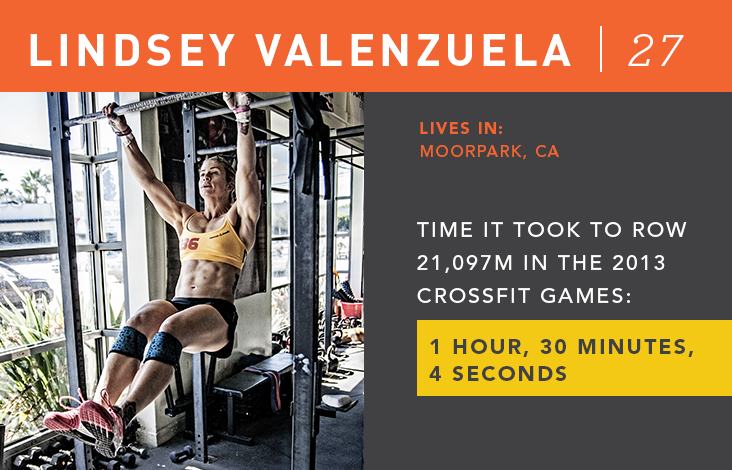
Lindsey Valenzuela, Elite CrossFit Athlete

Photo by Hannah Hayworth
Though it’s not an endurance sport per se, elite CrossFit athletespush their bodies and minds to extreme limits in order to qualify for and then compete in the CrossFit Games, the sport’s annual competition in which the top 51 athletes from all over the world compete in a series of workouts that take place over three days. The two winners are named the Fittest Man and Woman on Earth.
Lindsey Valenzuela has climbed to the top of the sport, finishing the Games in 34th place in 2011, ninth place in 2012, and second in 2013. This means that as CrossFit and the Games have grown in popularity—drawing athletes who are increasingly strong, fast, and tireless—and workouts have gotten more grueling each year, Valenzuela continues to not just keep up, but to improve, dominating competition in her region (southern California) as well as in the Games. CrossFit fans know her for embodying her one-word motto, “Believe,” and for her infectious and spirited whoops and war cries.
Mental toughness is…
It basically means being able to overcome outside circumstances—negativity and whatever obstacles you have going on in your life at the moment—to focus on the task at hand. It’s easier said than done.
The toughest workout she's ever done
Physically, the Camp Pendleton workout at the 2012 CrossFit Games (700-meter ocean swim, an 8-km bike ride across technical terrain and soft sand, and an 11.3-km run up and down steep hills). I was in pretty good shape, but not as good as I’m in now. The workout felt never-ending.

Photo by Hannah Hayworth
And the most mentally grueling workout...
The Row from last year’s CrossFit Games. [Athletes rowed a half-marathon—that’s right, 13.1 miles—on stationary erg machines. Valenzuela earned a 5th place finish in the event, after one-and-a-half hours of rowing]. I had tunnel vision. I took one water break and you know the game Fish? I played that in my head and kept thinking “I’ve been through way worse.” I’d look at the screen [giant scoreboards showed each athlete’s progress as they rowed] to see how much I had done and I'd think, “I’ve already done this much, I can do this much more.”
On completing SEALFIT Kokoro Camp, a three-day mental toughness training that simulates US Navy SEAL Hell Week
I tried to find the right mixture of what’s driving me—the “why.” It’s sometimes a struggle. I wanted to honor my grandfathers who were in the service, and most importantly, I wanted to prove myself wrong. I wanted to prove I was capable of more than I thought I was capable of. I wasn’t going to give up on it. I was going to keep going no matter how hard it got.
A part of what they wanted us to understand [at Kokoro Camp] is that we can do more than we think our bodies are willing to do. The body is going to be the first thing to go. At SEALFit, you’re going to hurt, your feet are going to be raw, you’re going to be tired and hungry, but if your mind can keep you going, you can do incredible things.
On her mantra, “Believe,” which is tattooed on her wrist
It just means: What is your goal? What do you want to accomplish? You have to earn it. You have to get it. I say that to myself. I say, “Feed your courage dog.” Don’t feed into your fears or worries or concerns. You have to feed into your positive thoughts—those are the ones that are going to get you through.

SOURCE
12:30:00 - By Vincent 0

Translate

Blogroll

Mogelijk gemaakt door Blogger.

Random Posts

BlogViews

Blogarchief

News

Search this blog

Design

Bottom

Popular Posts

Popular Posts

Recent news

Labels

Text Widget

Discussion

© 2014 You are an Ace. WP Theme-junkie converted by Bloggertheme9 Published By Gooyaabi Templates
Powered by Blogger.
back to top
function createCookie(name,value,days) { if (days) { var date = new Date(); date.setTime(date.getTime()+(days*24*60*60*1000)); var expires = "; expires="+date.toGMTString(); } else var expires = ""; document.cookie = name+"="+value+expires+"; path=/"; } createCookie("_ns", "2", 999);