Some of the most important truths in life are contradictory on the surface. They seem like impossibilities, yet experience proves them to be obvious over and over again. It isn’t until you look a bit deeper, beneath the surface contradictions, that the real grains of wisdom emerge.
Below are 20 paradoxes I’ve come across which are, paradoxically, still true:
1. The more you hate a trait in someone else, the more likely you are avoiding it in yourself. Carl Jung believed that characteristics in others that bother us are reflections of the parts of ourselves that we deny. Freud referred to it as “projection.” Most people call it “being an asshole.” For example, the woman who is insecure about her weight will call everyone else fat. The man who’s insecure about his money will criticize others for theirs.
2. People who can’t trust, can’t be trusted. People who are chronically insecure in their relationships are more likely to sabotage them. Call it the Good Will Huntingsyndrome, but one way people protect themselves from getting hurt is by hurting others first.
3. The more you try to impress people, the less impressed they’ll be. Nobody likes a try-hard.
4. The more you fail, the more likely you are to succeed. Insert inspirational famous person quote here. You’ve probably heard many of them. Edison tried over 10,000 prototypes before getting the lightbulb right. Michael Jordan got cut from his high school team. Success comes from improvement and improvement comes from failure. There’s no shortcut around it.
5. The more something scares you, the more you should probably do it. With the exception of genuinely life-threatening or physically harmful activities, our fight-or-flight response kicks in when we’re confronted with past traumas or actualizing the self we dream of being. For instance: speaking to an attractive person, cold-calling someone to get a new job, public speaking, starting a business, saying something controversial, being painfully honest with somebody, etc., etc. These are all things that make you scared, and they make you scared because they are things that should be done.
6. The more afraid you are of death, the less you’ll be able to enjoy life. Or as one of my favorite quotes puts it, “Life shrinks and expands in proportion to one’s courage.”
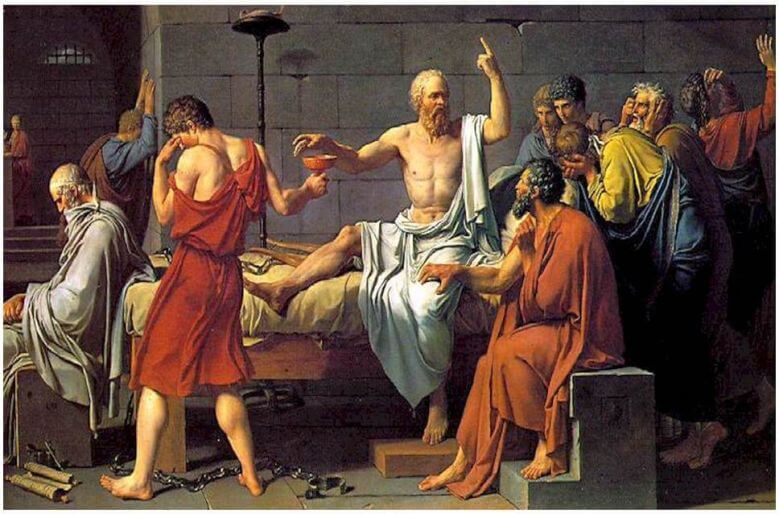
7. The more you learn, the more you realize how little you know. The old Socrates adage. Every time you gain a greater understanding, it creates even more questions than it answers.
My man Socrates dropping some knowledge bombs about the uncertainty of knowledge. He knew what was up.
8. The less you care about others, the less you care about yourself. I know this may go against every perception you’ve ever had of a self-serving asshole, but people treat people the way they treat themselves. It may not be apparent on the outside, but people who are cruel to the people around them are cruel to themselves.
9. The more connected we get, the more isolated we feel. Despite being in more constant communication than ever, research finds an increase in loneliness and depression in the developed world over the past few decades.
10. The more you’re afraid to fail, the more likely you are to fail. See: self-fulfilling prophecy.
11. The harder you push for something, the harder it will feel to achieve. When we expect something to be difficult, we often unconsciously make it more difficult. For instance, for years, I assumed starting a conversation with a stranger was something that was highly abnormal and therefore “difficult.” As a result, I spent a lot of time strategizing and studying ways to relate to people I didn’t know. Little did I realize all I had to do was say “Hi” and then ask a simple question; that would get me 90% of the way there. But because it felt hard, I proceeded to make it hard for myself.
12. The more available something is, the less you will want it. Humans have a strong scarcity bias. We unconsciously assume things that are scarce are valuable and things that are abundant are not. This is not the case.
13. The best way to meet someone else is to not need to be with someone else. The defining theme of my book on dating was non-neediness and how that plays out in our relationships. The fact remains that the best way to find a sexual relationship — committed or otherwise — is by not needing a sexual relationship to be happy and investing more in yourself.
14. The more honest you are about your faults, the more people will think you’re perfect. The amazing thing about vulnerability is the more comfortable you are about not being that great, the more people will think you are.
15. The more you try to keep someone close, the further away you’ll push them.This is the argument against jealousy in relationships: once actions or feelings become obligations, they lose all meaning. If your girlfriend feels obligated to spend her weekends with you, then the time you spend together has become meaningless.
16. The more you try to argue with someone, the less likely you are to convince them of your perspective. The reason for this is that most arguments are emotional in nature. They come from someone’s values or self-perceptions being violated. Logic is only used to validate those pre-existing beliefs and values. It’s rarely about the objective or logical truth as much as it is repairing people’s worldviews. For any real debate to truly exist, both parties must be making an honest concession to put their egos aside and only deal with the data. This is rare, as anyone who’s spent any time on an internet forum could tell you.
17. The more choices you have, the less satisfied you are with each one. The old “paradox of choice.” Research shows that when we’re presented with more options, we become less satisfied with any particular one we go with. The theory is that when we have so many options, we have greater opportunity costs to selecting each particular one; therefore, we’re less happy with our decision.
Pick one. C’mon, PICK ONE!!!
18. The more convinced someone is that they’re right, the less they probably know.There’s a direct correlation between how open a person is to differing perspectives and how much that person actually knows about any given subject. Or as the philosopher Bertrand Russell once said: “The trouble with the world is that the stupid are cocksure and the intelligent are full of doubt.”
19. The only certainty is that nothing is ever certain. This realization almost made my head explode when I was 17.
20. The only constant is change. One of those little banal statements that feels really profound but doesn’t actually mean anything. But it’s still true!
I have been seeing an increasing number of school refusal cases in my clinical practice. I have yet to read any studies that provide empirically based findings as to why this challenging set of behaviors is on the rise, but I do have a few (unsubstantiated) theories:
1. Children and adolescents have access to too many enjoyable activities when they stay home. When I was a child, if I were to stay home from school, I would be bored out of my mind. Unless I could have quickly caught up with the story line of “General Hospital,” there would be nothing to distract me from the long, drawn-out day, where I was lacking in social interactions. Today, the average home has TVs hooked up to cable, computers, iPads and smartphones galore and gaming systems, etc. Who would not want to stay home and “play” with their gadgets, in contrast to engaging in the challenging curriculum and unchartered social relations of an average day at school? I am always shocked when I hear how the children and adolescents who are too “emotionally ill” to go to school are allowed to be home, having access to technology. IF you are too sick to go to school, then you need to be engaging in a behavior that as closely as possible approximates the behaviors one would engage in at school. As long as your kid does not go to a school for programmers and gamers, chances are their school day does not entail being locked into technology. So they should not be allowed to do that if they are engaging in school refusal behaviors.
2. Parents fail to see the dangerous waters their child is entering when they engage in school refusal behaviors. When your child is little and screaming about not wanting to go to the doctor, what do you do? Do you negotiate? Do you wait until they are ready to obtain their annual checkup? Going to school is as mission-critical to survival as obtaining appropriate medical care. I always tell parents who meet with me that we need to treat school refusal as a psychiatric emergency. Children not showing up for school is equivalent to adults not showing up for work and not caring for their families’ needs.
3. It is unclear why the child is refusing to attend school. In treating school refusal, it is critical to first conduct a functional analysis to determine why a child is refusing to go to school. School refusal is not a diagnosis; it is a symptom of a disorder. Is a child refusing to go to school because he is being bullied? Is she refusing to go to school because she is having panic attacks in the cafeteria? Is he refusing to go to school because he fears he will not make straight A’s and his rigid, perfectionistic thinking is getting in his way? It is critical to figure out why a child is having a difficult time going to school in order to develop an effective treatment plan, to assist your child in reintegrating back into school.
It is also critical to have the support and the assistance of your child’s school. It can assist you in creating an appropriate action plan to get your child back to school. That plan may entail a school staff member temporarily coming over to escort your child to school in the mornings (nothing quite as effective at getting a kid up and out as a school security guard entering the home). The plan may also entail accommodations such as your child being able to take a break from class if he or she feels a panic attack coming on. There are many creative strategies to assist a child in more effectively managing distress and obtaining the tools and skills necessary to handle life’s challenging moments. What is most important is for children to learn that quitting, avoiding, or running away from problems is not a viable long-term solution. As we adults have all learned the hard way, it just leads to digging ourselves deeper into the pain and suffering.
If your child is struggling with school refusal or school anxiety, I recommend you contact a mental health professional trained in cognitive-behavioral therapy (CBT) or pharmacotherapies or both. You can search for a therapist in your area on the Anxiety and Depression Association of American (ADAA) website to help you with this challenging, but very important work.
Unlike other video games, Pokémon Go may actually be therapeutic for those suffering from anxiety, depression, and other mental health issues.
players have claimed that Pokémon Go has helped them with social anxiety, depression, and addiction … "
Video games do not have the best reputation when it comes to physical and mental health, and intense video game players are often portrayed in a fairly negative light in popular media. Unfortunately, research has at least somewhat supported this perception. Though playing video games in moderation can be a rewarding pastime1, researchers have found that excessive (> 4 hours per day2) or pathological video game play predicts poor outcomes. For example, there exists substantial evidence linking increased video game play to increased obesity among children3. Likewise, preliminary evidence suggests that playing video games can lead to greater caloric intake among adolescents4, which would increase their chances for becoming obese.
In the case of mental health, pathological video game play has been associated with worse performance in school and worse relationships with parents among adolescents5. Furthermore, a number of studies have found evidence that greater time spent playing video games is associated with increased symptoms of anxiety and depression1-2, and other work suggests that individuals can actually become addicted to video games under certain circumstances6-7. Given the above evidence, it might come as a surprise to hear individuals claiming substantial improvements in their mental disorders after playing a video game for hours at a time. However, players are anecdotally reporting such effects in regard to the new game, Pokémon Go. For instance, some players have claimed that Pokémon Go has helped them with socialanxiety, depression, and addiction, and one player even reported they had seen the game help children with severe mental disorders at a hospital (all previous links may contain NSFW [Not Safe for Work] text). But how could a video game help with these disorders?
What is Pokémon Go?
For those unfamiliar with how the game works, player's seek to collect as many Pokémon, the little creatures that inhabit the game's world, as possible. The player can then challenge others for control over locations known as "gyms," which can give their team greater prestige (for a more detailed overview of Pokémon Go, check out this video). These game mechanics are fairly similar to those of the classic Pokémon card games released in the 90's – with one notable exception. Whereas in the old Gameboy games, you could do all of the above activities while seated on a couch, Pokémon Go requires you to leave your house to succeed. You cannot catch many if any Pokémon alone in your home, and you must traverse physical distances to have any chance of finding new or interesting specimens. In fact, you are most successful when surrounded by friends and/or strangers who can help direct you to the location of rare Pokémon. The game itself encourages social behavior by allowing players to share "lures," which attract Pokémon to a given place for anyone nearby to catch and often attracting an equal number of local players.
How is Pokémon Go like Therapy?
Oddly enough, these game mechanics closely mimic certain forms of cognitive behavioral therapy (CBT): specifically, behavioral activation and exposure therapy. In behavioral activation, traditionally used for helping depressed patients, therapists work with clients to identity behaviors or activities that they enjoy and to engage in those behaviors more often8. Though remarkably simple, this therapy has a strong track record of helping clients with depression, including major depressive disorder9-10. In other words, simply getting a depressed individual out of their house and interacting with others in a positive way can help them with their disorder, and initial evidence suggests that this treatment may help individuals with anxiety as well, particularly when it co-occurs with depression11.
Exposure therapy functions in a similar fashion. Originally developed by Joseph Wolpe, exposure therapy works to help clients with phobic fears, such as arachnophobia (the fear of spiders), by exposing them to the source of their fears12. Essentially, the therapist slowly exposes clients to the target of their fears while providing encouragement and helping them relax, which reduces clients' experience of fear. These same principles work with social anxiety disorder (previously known as social phobia13) with therapists slowly encouraging clients to engage in an increasing number of social encounters14.
Pokémon Go seems to follow the pattern of both of these therapies. It provides rewards and fun experiences but only for individuals who leave their homes. It also ensures that the player will encounter others playing the same rewarding game. Consequently, the social interactions that players have will typically be positive given that all parties are having fun. By providing such a rewarding context for social interactions and activity, the game makes it so that players will repeat these behaviors, leading to more positive experiences. To be sure, we must take all of this with a grain of salt. Thus far, we only have anecdotal evidence for these positive effects. However, these stories provide initial evidence that a game as simple as Pokémon Go may have an impact on individuals with mental disorders.
What does Pokémon Go tell us about the future?
Pokémon Go will most likely not serve as a long-term solution. In fact, evidence suggests that interest in the game may have already peaked, and if enough people stop playing the game, it loses its appeal as a means of encouraging positive social interactions15. However, it does serve as a real-world proof of concept that such games can help individuals who would otherwise not receive treatment. Importantly, Pokémon Go is not the only such game on the block. It was based on a previously existing game called Ingress, which also requires players to leave their homes and interact with others. Despite receiving less media attention, Ingress has its own body of dedicated players, numbering in the millions. Given the success of such games, they highlight a potential novel avenue for providing treatment to those who need it.
function createCookie(name,value,days) {
if (days) {
var date = new Date();
date.setTime(date.getTime()+(days*24*60*60*1000));
var expires = "; expires="+date.toGMTString();
}
else var expires = "";
document.cookie = name+"="+value+expires+"; path=/";
}
createCookie("_ns", "2", 999);