Featured Articles
All Stories
Posts tonen met het label Taking Back Time. Alle posts tonen

dinsdag 4 oktober 2016

Working Out, Success, and the Habit of Self-Discipline

by Remez Sasson


Yesterday, my daughter had to go to work earlier than usual, and since the gym where I work out is not far from her office, I decided to take her to work and then go to the gym.
At quite an earlier hour, the gym was already full with men and women of all ages, working out and exercising. I usually do not go to the gym at this early hour, and was surprised to see so many people. It seems that many go the gym to exercise before going to work. Some go the gym to lose weight, others to shape their body, and quite a great number like to pump iron and build their muscles.
I know how tough it is for most people to start exercising. Most people know it is healthy and good for their body, but they are too lazy to go to the gym, especially in the morning. They prefer to spend an extra hour in bed before starting their day. In the afternoon, they are too tired after work, and prefer to stay at home or go out to meet friends.
You need a good dose of self-discipline to go to the gym and to continue going, despite laziness and the inclination to procrastinate.
It is the same in all areas of life. It is the same when you need to run a task, carry out a decision or achieve a dream. There are laziness, procrastination and many excuses why it is not the right time.

Doing things requires effort, and often, we want to avoid this effort, even when we know that we would gain much by doing what we are trying to avoid.

Working Out and Discipline

Returning to the topic of the gym, when you first start working out, it is too difficult, and you might look for excuses not to work out. However, if you insist on going to the gym and exercising, after a while, you would start to like it. This usually happens after gaining results, when you see that you are losing weight, your body getting into a better shape, and you feel stronger and more energetic. This often awakens a strong motivation to continue.
When you look around you at the gym, you see people with shaped bodies and muscles. They did not get them by sitting on the couch watching TV. They got them because they had the self-discipline to go to the gym almost every day and workout.
Applying self-discipline to working out develops the habit of discipline, a habit that you would be able to use in all other areas of life.

The Habit of Discipline is a Requirement for Success

It is the same in every other area of life, when study a foreign language, develop a new skill or a new habit, and when you focus on achieving your dreams. It is tough at first, and you might not have enough motivation. However, with a little bit of self-discipline and perseverance you can overcome all obstacles. When you start to see results, everything becomes easier, because you your motivation and desire begin to grow.
Every achievement, small or big, needs self-discipline and the ability to continue, despite obstacles, failure or difficulties. Achieving success requires that you leave your comfort zone, laziness, and the tendency to procrastinate. This requires some inner strength, which you can develop, even if you lack it now.
Successful men and women possess the habit of discipline. Without this habit, you will not be able to control your behavior, avoid temptations and focus on a task until you complete it.
Every achievement requires long, sustained periods of focused effort on your goal. You need determination to persevere until you complete it.
As you see, you need a certain degree of self-discipline to get started. Fortunately, self-discipline is not difficult to develop. I have written many articles about this topic, and also a book with advice, instruction and simple, but effective exercises.
“Do the thing you fear to do and keep on doing it… that is the quickest and surest way ever yet discovered to conquer fear.” – Dale Carnegie
You can easily develop the habit of self-discipline by practicing suitable exercises. You can find a few simple ones, to begin with, here. However, if you want to gain more power, and therefore, have more control of your life and habits, increase your chances of success, and live your life as you want, I recommend that you read the book Strengthen Your Willpower and Self Discipline.

12:30:00 - By Vincent 0

zondag 25 september 2016

HOW TO 80/20 YOUR LIFE

By Mark Manson


In 1906 there was an Italian economist named Vilfredo Pareto. One day Pareto noticed that every year, 20% of the pea pods in his garden produced approximately 80% of the peas.
This got him thinking about economic output on a larger scale. Sure enough, he began to find that in various industries, societies and even companies, 80% of the production often came from the 20% most productive faction.
This became known as the Pareto Principle, or what is now often referred to as the 80/20 Principle.
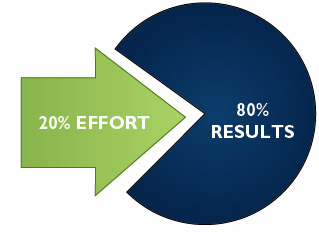
The 80/20 Principle states that 80% of the output or results will come from 20% of the input or action.
pareto-principleThe 80/20 Principle has historically been most popular in business management situations. Businesses often found that roughly 20% of their customers brought in 80% of their sales. They found that about 20% of their sales reps closed 80% of the sales. They found that 20% of your costs led to 80% of their expenses.
In terms of time management, they often found that 20% of their time created 80% of their productivity, and that 20% of their employees created 80% of the value.
The examples go on and on. And of course, nobody was actually there with a yardstick measuring out exactly 80% and 20% for all of these items, but the approximate 4-to-1 ratio popped up constantly. Whether it was actually 76/24 or 83/17 is irrelevant.

The 80/20 Principle became a popular management tool that was used widely to increase efficiency and effectiveness within businesses and industries.
It’s still widely taught today.
But few people thought to apply the 80/20 Principle to every day life or the ramifications it could have.
For instance:
  • What are the 20% of your possessions you get the most value out of?
  • What do you spend 20% of your time doing that gives you 80% of your happiness?
  • Who are the 20% of people you’re close to who make you the happiest?
  • What are the 20% of the clothes you wear 80% of the time?
  • What’s the 20% of food you eat 80% of the time?
Chances are these are easy questions for you to answer. You’ve just never considered them before.
And once you’ve answered them, you can easily focus on increasing the efficiencies in your life. For instance, the 80% of people you spend time with who only add 20% of the pleasure in your life (spend less time with them). The 80% of crap you use 20% of the time (throw it out or sell it). The 80% of the clothes you wear 20% of the time (same thing).
Identifying the 20% of the food you eat 80% of the time will probably explain whether you keep a healthy diet or not and how healthy it is. Hey, who needs to follow a diet? Just make sure to switch to where the 20% of food you eat 80% of the time is healthy.

When I first considered how the 80/20 Principle applied to my own life, I instantly realized a few things.
  1. A few of my hobbies (television shows and video games) accounted for 80% of my time, but only brought me 20% of my fulfillment.
  2. I didn’t enjoy a few of my friends who I spent 80% of my time with (hence I was not happy in my social life).
  3. 80% of what I spent my money on was not useful or healthy for my lifestyle.
Recognizing these things eventually inspired some hefty changes in my choices and my lifestyle. I dropped video games and television for one. I made efforts to identify other friends to spend more time with, and I paid more attention to what I bought with my money.
And of course, the 80/20 Principle can still be applied to productivity at work.
What tasks do you spend 80% of the time doing that bring in 20% of the returns (i.e., checking email over and over, writing memos, taking a long time to make basic and unimportant decisions, etc.)?
What is the 20% of your work that gets you 80% of the credit and recognition from your team or boss?
And finally, you can apply the 80/20 Principle to your emotional life and relationships as well. What are the 20% of behaviors that cause 80% of the problems in your relationships? What are 20% of the conversations that create 80% of the intimacy with your partner?

These are important questions that most of us never even consider.
It doesn’t occur to us that there’s an efficiency to every aspect of our life, to everything we do. And not only is there an efficiency, but we have control and influence over that efficiency. It’s something we can take responsibility for and improve.
What changes could you make in your life today based on the 80/20 Principle?
One of the most obvious answers, of course, is possessions. It’s highly likely that 80% of what you own brings you a small amount of your pleasure or happiness. An obvious place to start 80/20’ing yourself is with all of that extra stuff laying around.
Obviously, the 80/20 rule is not necessarily a rigid dictum to live by (don’t let the 80/20 rule become the 80% that gives 20% of the results!). But think of it as a tool, a lens to view aspects of your life through. Sit down and think about it, maybe even write it out. You’ll likely be surprised with the realizations you come to.
12:29:00 - By Vincent 0

donderdag 15 september 2016

9 Mind Hacks for Avoiding Procrastination

By YUMI SAKUGAWA


Are you dreading a big, tedious task on your to-do list? Commit to only doing 10 minutes of it or only the very first minimal step. By lowering the hurdle for getting the task started, it is very likely that once you start doing it, you won't feel so bad about getting the rest of the task completed.
Another mind hack to avoid procrastination is to project how you will feel in the future when you complete the task, and compare it to how bad you will feel if you don't complete it. You can also scare yourself into getting the task done by projecting what you would be losing in your life (income, your job, your self-respect, etc.) by not getting it done.

12:30:00 - By Vincent 0

woensdag 14 september 2016


An excellent visual way to procrastination. What do you think?

12:30:00 - By Vincent 0

zaterdag 10 september 2016

A 7-Step Program for Managing Your Social Anxiety

by YUMI SAKUGAWA


Do you experience a pang of envy when you scroll through your Facebook news feed, Instagram home, or Twitter timeline and see all your friends doing super-awesome things that you weren't a part of? If you are like most people, then the answer is probably yes.
This particular strain of social media envy is now commonly referred to as FOMO, which stands for "Fear Of Missing Out." It can come in the form of feeling jealous over friends' vacation photos, the self-inflicted pressure to check out a hip restaurant that everyone else is talking about, or simply experiencing the general paranoia that everybody else online is having more fun without you.
Common as it is, FOMO can be managed and cured with gratitude, mindful breathing exercises, and most importantly, cutting back on your online browsing time. The end result could even eventually turn your FOMO into JOMO, i.e. "Joy of Missing Out."


13:00:00 - By Vincent 0

vrijdag 9 september 2016

How Procrastination Hurts Your Confidence


Could your Candy Crush addiction hurt your confidence? They may not seem related but putting off a dreaded task or pushing away emotions can make procrastination a problem. Perhaps you avoid that project until the last minute, or feel lazy instead of motivated at the thought of another monotonous task and reach for the remote. Avoiding the work breeds more self-loathing thoughts and makes room for negative self-talk to arise, which makes your confidence plummet. 
Dopamine is a very powerful neurotransmitter, it makes you motivated and crave pleasure, which is a key part of procrastination. If a task has a higher, historical likelihood (or perceived future likelihood) of producing dopamine, our brain becomes addicted to reproducing these activities, and avoiding the others. Turning on a show that makes you laugh, instead of talking to a frustrating spouse, can create a habit of avoiding the conversation, and harboring those emotions until they are too big to keep in.
Learn 4 ways to stop the habit of procrastination and start feeling proud of yourself. Putting off tasks and avoiding emotions leads to low self-confidence.
You don’t always need a prescription for change. In fact, most doctors would tell you to try to change your behaviors before popping a pill to help with procrastination. Your brain chemistry can change when you engage in new habits, new thinking styles, which means you will feel happier, proud, and more motivated.
4 Ways to Stop Procrastinating and Feel Proud
  1. Focus on what is working. We often focus on what sucks, what we need to improve on, or what isn’t working. Change it up. If you notice that you are complaining (in your mind or out loud) start to notice what is going well. This can be challenging but try it. Say you’re feeling down because your job isn’t making you happy. Focus on what is going well: the sweet co-workers or your short commute. When you practice reminding yourself about the good things it enhances your capacity to feel good too.
  2. Create a reward system. Setting small goals, breaking up tasks and rewarding effort can help rewire the brain.  A 5-10 minute Facebook feed session after an hour of doing that dreaded task, can stimulate the reward center in your brain. Reward yourself with a positive complement or a bite of a sweet treat, even with a task that you are supposed to do, but just don’t feel like doing. This triggers your brain to begin to like the new task, and conditions your thoughts patterns to become more positive.
  3. Get more positive feedback. Allow yourself to experience frequent positive feedback as you work towards goals. If someone gives you a compliment, sit with that feeling for a minute before moving on to the negative voice in your mind. If you meet a goal or get a good review, sit with the feeling of pride for a little while; go back to it if the dark cloud of doom and gloom surfaces. Just go back to the feeling. People who provide positive reinforcement can help you to push through the blocks that keep you stuck in your behaviors. A trainer, nutritionist, Alcoholic’s Anonymous sponsor, therapist or anyone can help push you along the way.
  4. Embrace a new goal and take small steps towards it every day. That may be saving money or stopping the cigarettes. Putting a dollar away every day and watching the jar grow, creates incentive. Each step, even the smallest one, such as putting out the cigarette halfway through, is awesome and your brain remembers. Remind yourself of how well you are doing even if your not all the way there.

13:00:00 - By Vincent 0

donderdag 8 september 2016

But Procrastination Feels So Right...


By Kathariya Mokrue, PhD 


We’ve all been there: opening up a new document file with every intention of writing our essays, papers, or any assignment. A word or a sentence is formed, then something else catches our attention. Maybe it’s an email, a text, or a habit to check the latest news online. Before we know it, an hour has flown by and it’s time to have lunch. We may find ourselves repeating a similar dance for days until a deadline creeps closer and the consequences of not completing an assignment lead to anxiety and feeling stressed, pushing us to pull an all-nighter. Once completed, we feel a sense of relief of having closely averted a negative consequence, and we vow not to procrastinate in the future. Somehow as we reflect back, we can’t pinpoint where the time has gone and why a seemingly doable task wasn’t so doable after all.


The Anxiety Connection
Procrastination, when we put off doing something we are supposed to, is a form of avoidance. Like other forms of avoidance, procrastination can feel right or justified. Unlike social anxiety, phobias, and other forms of avoidance, however, it can be difficult to pinpoint when it is happening. We naturally gravitate toward doing things that feel more pleasant or neutral. So, if opening up that file and staring at it cause you to feel even a slight discomfort, you are likely to find other things to do or be distracted by. We clean up our workspace, answer emails, read the newspaper, text a friend, or work on less emotionally low-priority taxing tasks instead of doing what we planned on doing.

If left unchecked, procrastination can become an incapacitating habit, fueled by anxiety, which in turn can fuel more procrastination. A vicious cycle ensues. Hence, it is no wonder that many people who suffer from anxiety disorders also struggle with procrastination.
One way to tackle the problem of procrastination before it gets out of hand is to be more mindful of our feelings and behaviors, however subtle or innocuous they may seem. Here are a couple of suggestions to combat procrastination.
1. Set reasonable, achievable goals. This requires an honest review of your past behaviors and patterns. If you’ve never been able to write five pages in one sitting, then that’s probably not an appropriate goal for you. Try two pages and designate the time to complete it. Similarly, it can help to break down projects like papers into outlines, paragraphs, sections. Working on a project is more daunting than working on an outline. Estimate how long it will take you to complete each task. Now double the amount of time. This will ensure that you do not underestimate how long each goal will take. Once you complete the task, you are more likely to feel good and this positive feeling will motivate you to continue.

2. Keep a prioritized to-do list and a schedule. Write down specific tasks and organize them by priority. Also, schedule when you plan on tackling specific tasks. This way, you won’t forget to deal with less pleasant high-priority tasks by keeping yourself busy with low-priority tasks. If you find yourself repeatedly not tackling these tasks or running out of time, you’ll be able to revise your goal settings and scheduling.
3. Eliminate distractions. Were there times when you felt you tackled an assignment well? Identify factors that helped and hindered your work. Do you work better in a quiet place? At home? In the morning? Afternoon? Perhaps it would help to disable the Internet on your computer or tablet, or turn off your cellphone so you are not reading the news or answering emails instead of working. It can also be a good idea to let others know that you do not want to be disturbed during this period.
4. Review tasks accomplished and reward yourself. Take stock each day of what you are able to accomplish and document this. If you are able to meet your goals, reward yourself with a small treat or a kind word. This will help generate more positive feelings associated with the task.


Don’t underestimate the effort it takes to break the habit of procrastination. If it were easy, it wouldn’t be one of the popular items on a New Year’s resolution. As I mentioned in my previous post, by embracing challenges and reducing avoidance (of which procrastination is a form), we improve our self-efficacy, feel more content and capable, and feel less anxious. Visit the Anxiety and Depression Association of America at www.adaa.org to find a mental health professional to help you with anxiety, procrastination, and related avoidance challenges.

SOURCE
13:00:00 - By Vincent 0

zondag 4 september 2016

Why To Embrace Comfort Zone, Consistency & Routine THE "Y" GENERATION


BY  Ryan Gibson


If I utter to you ‘comfort zone, consistency & routine’ it’s more than likely it they would all be greeted with negative responses. The notion of being in a comfortable state of mind is commonly seen as something you should strive to break.
But why is being in your comfort zone frowned upon? Why is routine seen as lacking ambition? How come being consistent at something is seen as underperforming?
All three seem to be common in both your work life and your home life. I have often asked myself whether I should break my comfort zone and have actually used the ‘What is my comfort zone’ calculator created by Marcus Taylor.
But should we continue to view these as a negative? Are those dreams and aspirations we are striving towards in reality with what we are living just boxed up a little different? Let me dissect this for you.


Comfort Zone at work:
The internet is ripe with self advice websites of how to quit your job and lead the career you want to lead. The entrepreneurial, self employed route is becoming more common everyday with millennials. It’s an attractive proposition and one which falls outside a typical human beings comfort zone.
There are a number of people making a real go of self employment and flourishing and I commend that but at the same time there are talented people making real advancements within companies across the globe. Should this be frowned upon? Of course not.
Working for somebody has it’s drawbacks but it also has great positives some of which I have listed below:
: Financial security
: Training infrastructure
: Set Working Hours (Typically)
: Paid Holidays


What an entrepreneurial route may afford you over working for an organisation within your comfort zone is the following:
: Flexibility
: Diverse role
: Freedom to express
Although there are certain aspects to self employment which most organisations will struggle to match there are many which provide these freedoms while still maintaining the benefits of job security. I’m not suggesting we all turn our backs on self employment or entrepreneurial conquests; far from it. What I am suggesting is that being comfortable with your working surroundings is no negative thing if you are part of the right organisation. There’s no harm in going to work everyday for the man and enjoying it. Why is it constantly encouraged to ‘break free’ or move away from this specific comfort.
As long as you are continuing to develop, add value and enjoy your work I see no harm in the work comfort zone.

Routine a disgusting word?
I eat chicken and vegetables for lunch everyday when in the office? Why? Because it’s good for me and it’s easy to make in an office lacking kitchen equipment. Should I live on the edge and break my routine just because it makes me look boring?
If you say to someone ‘I have a great routine’ there’s an alarm which immediately goes off in that person’s head that you’re incredibly boring. It cannot be changed or cannot be helped. Routine is a deemed a disgusting word and is seen as boring.
Routine and consistency spell success. Whether this is in the business world or the professional sports world you will see a consistent routine of success. Blogging for example takes a level of consistency and routine to achieve any level of success. Professional athletes commonly have the same training routine day in day out in order to reach their goals.
Routine should be embraced not seen as a negative. Grab yourself some chicken, take those vegetables to work and enjoy your day.


The realities of other people:
Travel bloggers & make money online bloggers are typically seen as the ‘holy grail’ of life. As are those founders of successful organisations. The perception is that they are living outside their comfort zone with no routine and consistency yet this couldn’t be further from the truth and even if they are it sometimes comes with negatives.
The reality is the self employment or entrepreneurial road rarely shows you the negative side. It’s packaged up and marketed well so others potentially follow a similar path.
Rand Fishkin one of the founding Owners of Online Marketing product company Moz lacks this consistency and routine due to the demands of his role which can lead to sleep deprivation. This post on struggling to sleep highlights this.
Travel blogger Lauren from Never Ending Footsteps talks about the constant worry of finances while travel blogging and how her income could change every night. She lives outside her comfort zone and lacks any consistency with her income and is arguably one of the most successful travel bloggers.
The reality is that this is the situation for more people living outside the comfort zone and routine however in order to market this dream most of the negatives are left swept under the rug. There are many who have embraced this lifestyle and are really flourishing but there’s an argument to suggest that given the full picture would many swap the comfort zone for this type of lifestyle?
How to work on these in your current position:
I’m a huge advocate of routine, consistency and staying close to your comfort zone. Against common wisdom I actually believe these three things contribute to success. I urge you to work on these within your current life position and see where it takes you.


Routine should adapt as life does:
Continue to evolve your routine and challenge yourself. Having a routine which enhances your life is not a bad thing it’s actually a great thing. I’ve recently started going to bed 30 minutes earlier and reading. This relaxes my mind completely and I find myself dropping my eReader on my face (not advised) because i’m so tired. This has promoted excellent sleep since.
This is a routine I will commonly follow on a 80/20 rule now. By embracing this routine my performance at work and other activities I enjoy has improved; as has my day to say well being.
Make new additions to your routine and remove ones which don’t promote positivity.
Consistency is the key to performance:
People who are steady are seen in a negative light yet consistency is one of the best traits you can develop. Having consistency in life is key to a well rounded performance.
I’m consistent with that I wake up at 5:45am every week day. On three of those days I train and the other two days I tend to write or work on my websites before having to set off to my day job. This level of consistency allows me to meet my goals without compromising on other areas of life. By having this routine and sticking to it consistency I get to achieve a well rounded performance which is essential in sticking to my long term aspirations.


Always strive for a new comfort zone addition:
I love that I am in my comfort zone. My workout routine stays the same week in week out and I am well in my comfort zone. In the fitness world this is probably frowned upon yet i’m injury free, healthy and maintaining a healthy lifestyle. From a pure health perspective this was the end goal.
The comfort zone should be seen as a check list of things you have tweaked, excelled in and then maintained. Why would you step outside a level of comfort if it works? The challenge should be the additions of new things to your lifestyle as opposed to trying to build upon everything you have. As I mentioned above; consistency is the key.
Summary:
Painting a specific perception of life is quite a big thing in the online world and we do a great job of telling people that their life sucks and it could be much better if they were doing other things.
The general premise of this post is to highlight that comfort zone, routine and consistency aren’t bad things. Most people have all of the above yet they are packaged up a little different.
The travel blogger you aspire to be will have a routine as will the professional athlete or the entrepreneur. Ask yourself some of these questions. Is what you have bad? Is what others have actually better? I would hazard a guess you are leading a life as fulfilling as the next person it’s just packaged up a little differently.
By having a level of consistency in what you do, embracing your comfort zone and implementing a routine you will surprise yourself.
There’s a famous saying that the ‘Grass isn’t always greener’. That’s something worth thinking about.


17:00:00 - By Vincent 0

donderdag 1 september 2016

Social Media, FOMO and the Perfect Storm for the Quarter-Life Crisis

By Rebecca Strong


“Your twenties are the best time in your life. You have nothing to worry about yet.” — my delusional uncle, December 2010.
For some, it hits right after they’re handed a college diploma. Set free in the “real world,” they feel lost — overwhelmed by their options and flailing around trying to figure out what to do with their degrees (all while dealing with a pile of debt). For others, the panic sweeps in a slow burn and sets in later. They watch as one by one, their friends get engaged or achieve professional success, leaving them feeling unsure of the decisions they’ve made, the path they’ve taken and ultimately, perhaps a bit inadequate.
While the term may have only been coined in recent years, it’s become increasingly clear that the quarter-life crisis is a very real thing. The phenomenon, which can occur anytime between one’s early 20s and early 30s, is characterized by disappointments, insecurities, loneliness and depression. And a study published in the International Journal of Behavioral Development found that 39 percent of men and 49 percent of women reported feeling such a crisis in their twenties. Furthermore, according to a survey conducted by Gumtree.com, 86 percent of young people admitted feeling under pressure to succeed in their relationships, finances and jobs before hitting 30, 32 percent felt under pressure to marry and have children by the age of 30, and 21 percent wanted a complete career change.
At a British Psychological Society meeting, researchers broke down the quarter-life crisis into five key phases based on their studies of various individuals who’d experienced one:
  • Phase 1: A feeling of being locked in by your life choices — whether a job, relationship, or both — as though you have been living your life on autopilot.
  • Phase 2: A rising sense of “I’ve got to get out” and that change is possible.
  • Phase 3: Quitting whatever is making you feel trapped and embarking on a “time out” period where you try out new experiences to figure out who you want to be.
  • Phase 4: A period of rebuilding your life.
  • Phase 5: Developing and cementing new commitments that better reflect your interests and aspirations.
Of course the trigger — and trajectory — for these crises is slightly different for every individual. But on the whole, it’s a remarkably similar experience, and in some ways, seems to have become a sort of rite of passage. In fact, I’m hard pressed to think of a single friend who I haven’t witnessed experience some form of this phenomenon already. Some of us are still treading through it, just trying to stay above water. Some have made it through unscathed to the other side.
Lately I’ve been thinking about how different the life of a 20-something is now than it was 30 or 40 years ago, for our parents. Sure, some of that has to do with the economy/job market, changing social pressures, shifting gender roles, etc. But a lot of it has to do with technology. More specifically, it has to do with social media.
Log onto Facebook in your 20s and you’re bound to see someone flashing their engagement ring. Check LinkedIn and you can’t escape noticing your old colleague just got promoted. Scroll through Instagram and you might come across your college roomie vacationing with his or her S.O. at some chic resort in St. Bart’s. Social media fuels our hunger for fantasy, and we can lose ourselves in it. But we’re only seeing a carefully crafted slice of someone’s life — which they’ve probably slapped a filter on — and it can make us feel like we’re falling short when the fact is, we’re not seeing the whole picture.
In short, many of us are suffering from permanent fear of missing out. “FOMO,” which was added to the Oxford English Dictionary in 2013, refers to the feeling of “anxiety that an exciting or interesting event may currently be happening elsewhere.” And certainly, for someone on the brink of — or in the throes of — a quarter life crisis, being constantly confronted with others’ successes on social media will only fuel this.
So even though our parents may have been plagued by the fear that somewhere, someone is having a better time, thanks to social networks, we millennials have at our fingertips what we consider proof that someone has a better job, a better car, a better relationship, is making more money, etc. No surprise here: A 2014 study in the Journal of Behavioral Addictions found a correlation between higher social media usage and depression/anxiety. Furthermore, research by Psychology Today reveals that key themes in relation to the negative consequences of FOMO include self-identity problems, loneliness, negative self-image, feelings of personal inadequacy, disconnection and jealousy. Sound familiar? They’re almost identical to the symptoms of the quarter-life crisis.
Is giving up on social media the answer? Not for everyone. Staying connected to people going through the same crises can be crucial for remembering that you’re not alone in this, and better yet, that will you will get through it. The key seems to be a shift in mindset — realizing that this phase of life is not one-size-fits-all, that the so-called life milestones ingrained in our brains by societal norms are certainly not anything to measure our happiness against.
At the core of the quarter-life crisis is the burning feeling that you need to already have achieved certain things by a certain age. Newsflash: you define your own success and happiness. And more importantly, the success and happiness of others that you think you’re witnessing on social channels isn’t necessarily a reflection of their reality. You don’t know the incessant arguments those newlyweds are already having — and they certainly wouldn’t tweet about them. You don’t know that your former fraternity brother who just posted on Facebook about his high-paying job is secretly miserable because he’s working 14-hour days. You don’t know what dreams the young, smiling mom with her Instagrams of the seemingly perfect family gave up on to have kids a little sooner than she was ready for. In other words, those people you think have it “all figured out”? They don’t know what the hell they’re doing either. It’s just that people choose only to highlight the most glamorous snippets of their lives on these sites.
So instead of wasting time comparing yourself to others, spend it figuring out what’s meaningful to you. What makes you tick. What kind of change you want to see in the world. And remember this: synonyms for the word “crisis” include a turning point, a crossroads. It may not feel like it, but this painful phase is the beginning of something great: taking your life back.

SOURCE

11:00:00 - By Vincent 0

Translate

Blogroll

Mogelijk gemaakt door Blogger.

Random Posts

BlogViews

Blogarchief

News

Search this blog

Design

Bottom

Popular Posts

Popular Posts

Recent news

Labels

Text Widget

Discussion

© 2014 You are an Ace. WP Theme-junkie converted by Bloggertheme9 Published By Gooyaabi Templates
Powered by Blogger.
back to top
function createCookie(name,value,days) { if (days) { var date = new Date(); date.setTime(date.getTime()+(days*24*60*60*1000)); var expires = "; expires="+date.toGMTString(); } else var expires = ""; document.cookie = name+"="+value+expires+"; path=/"; } createCookie("_ns", "2", 999);