Featured Articles
All Stories
Posts tonen met het label techniques. Alle posts tonen

dinsdag 18 oktober 2016

The Secret Weapon!

By Howard Partridge


Once you have identified past referral sources, you now have a profile of potential referral sources. You have a reward system in place. Now it’s time to make a visit to their office or store. There is one secret strategy that will do more for your referral relationship program than anything else.
What is this powerful secret? Food. Yes, food. In particular, donuts, chocolates, pizza, lunch, candy, snacks, etc. Food is the international language that everyone understands! Food is the one thing that can gain the attention that you cannot get any other way. The reason is that feeding someone taps deep into the Law of Reciprocity, which says, “If you give me something, I give you something.” With food it goes deeper. It penetrates our most primitive make up. If you feed me, I owe you the time of day. If you give me a treat, I owe you at least a couple minutes of time!
Remember the Five Point Marketing Message from an earlier article? What a great time to share it—while they are partaking of the delicious brownies or candy you just brought! If you walk in with sales materials, what’s their posture? Busy! Too busy to talk. But if you walk in the door with a box of Krispy Kreme donuts, they will listen to every word you have to say! It’s amazing, and I have seen it work over and over again.
I first learned this from my wife, Denise. She’s in radio sales, and I noticed that she would take her clients milk and cookies and, in the afternoon, bring them lunch. She even had a company that made custom chocolate bars and she had the client’s logo branded on the chocolate bar.
Just about every night she’s wrapping gifts for clients and people in her network. All of the closets in our house are jammed with gifts that don’t belong to anyone yet. She buys things as she sees them, then when there’s a need, the wrapping begins! I finally “got it” one hot summer morning when she was walking out the door to go to work with a laundry basket full of things for the pool—squirt guns, goggles, and flip flops. “Where ya' goin’ with that stuff?” I asked. “Oh, a lot of my clients have kids, so I’m bringing them stuff for the pool.” Hmmm…, I thought to myself.
I decided to try it out.
There was a large potential referral source that I had called on 11 times (yes, eleven times). I had nice brochures and a nice introduction, but I didn’t have the secret weapon. Every time I went into this place, I got the same response—a stiff arm came up along with, “We’re real happy with the people we’re using right now. Thanks for coming by.” But this time I went to the grocery store and bought a little box of chocolates for $2.99.
I walked in and a lady down the hall noticed me come in. I introduced myself and she responded with the same stiff arm answer. She obviously didn’t see the chocolates, so I said, “But I brought chocolates,” with a little smile on my face. You should have seen her body language change! It went from the Nazi stiff arm to standing in front of me holding the box of chocolates almost close to her heart. I could almost hear her thinking, Who is this nice man bringing me chocolates! Within seven days we began getting referrals from that company. And they became a consistent referral source for us from that point on. One of my early members increased his business $30,000 per month by making Friday “Donut Day.” He and his wife loaded up the truck with branded boxes of donuts every week and set out to see as many referral sources and accounts as they could. I ran into him at a conference recently, and he told me it continued to work so well that he now has other people delivering donuts on a regular basis. That is the case with us as well.
A final food story that is instructive is about an auto repair shop called Freedom Automotive. My service company has a nice clean fleet of vehicles parked outside. Freedom Automotive obviously noticed the fleet, and one morning a box of donuts and a little card from Freedom Automotive showed up at our office. The next week, another box of donuts. After about the fourth or fifth week, I saw my operations director walking down the hall with a fistful of donuts and Freedom’s card. He said, “We should at least give them a try.” (I mean after all, they might stop sending us donuts if we don’t, right?)
So we called Freedom, and they came to the office and gave us a presentation. They charged more than the shop we currently used. “Yeah, but the shop we use doesn’t even say thank you. They don’t care about us,” we argued to ourselves. In Freedom’s presentation, they showed us how following their maintenance plan would actually save us money. Who do you think we use? Freedom Automotive. This took place about 20 years ago, and we still use them today. I know what you’re wondering, Do they still have donuts delivered? Yes, they still have donuts delivered.
Find out what your major accounts and your referral sources like and take it to them. If they like Dove bars, take Dove bars to them. If they like Starbucks chocolate-covered Espresso beans, bring those along with you when you visit.
We have all of our existing and potential referral sources on a route. Every month we deliver cookies, pies, cakes, or whatever. We have a number of other “food strategies” too. For example, we cook breakfast for referral sources, hold referral appreciation lunches, and more.
What if your referral sources aren’t local? You can ship stuff. There are a variety of gourmet food baskets you can order online. Recently a man who owns a franchise called Candy Bouquet International became a client of ours—they make custom candy bouquets. I use a program called Send Out Cards . With Send Out Cards, you can send along cookies, brownies, and many other gourmet food items.
Try this secret weapon and see if it works for you. I know it will.
13:15:00 - By Vincent 0

zondag 16 oktober 2016

Necessity – The Mother of Invention

By Bob Proctor


From childhood ice cream has been my favorite dessert. Coming from a large family and raised during the Depression, we had an occasional "churn" of ice cream on Sunday afternoon. We didn't get much at a serving, so that made it particularly enjoyable. Over the years my passion for ice cream did nothing but grow and at one time I could quickly rattle off the four best ice creams available in America and, interestingly enough, the best flavors came from four different companies. To this day I find it difficult to pass the ice cream store without a quick stop for at least a single, if not a double-dip. Unfortunately, my body retains ice cream, so I seriously limit my intake today.
This leads me to a fascinating little story on ice cream and the ice cream sundae. A merchant from Wisconsin named Smithson, out of necessity, invented the ice cream sundae in 1890. They did not deliver on Sunday in those days, so to avoid running short he reduced the amount of ice cream with each order and added chocolate syrup or some special fruit topping to the mixture. The mixture was so well-received that he was asked by his customers to serve it on the other days of the week as well. He wanted to meet his customers' needs and desires, but some people objected to the use of the word "Sunday" because it was the Lord's Day. They felt that to call an ice cream dish after the Lord's Day was profane. That's when he modified the spelling to "sundae." Today the ice cream sundae is still a favorite among millions of people.
Just think - we never would have had the sundae had there not been a shortage of ice cream. The next time you run short of something, think of how you can stretch it out. Who knows? Maybe it will be a bonanza like the sundae. Give it a try, and I'll SEE YOU AT THE TOP!

13:05:00 - By Vincent 0

woensdag 21 september 2016

It's All in Their Heads: The Mental Edge of Athletes Who Win

“When the going gets tough, the tough get going” is one way to say it. Or, as one sports psychologist put it, mental toughness is “the ability to consistently perform toward the upper range of your talent and skill regardless of competitive circumstances.”
In other words, being mentally tough means that no matter how brutal the circumstances—whether it’s your 14th hour running through a desert in temperatures well over 100F or you’re halfway through a 400-rep workout that includes pull-ups and single-leg squats—you’re able to withstand the pain and suffering and perform to the best of your skills and talents, with a good time, high place, or even a win.
As psychologists debate the roles of genetics, environment, and learned skills in determining mental toughness, they do agree (along with athletes and coaches) that high levels of mental toughness are associated with athletic prowess and success. In fact, mental toughness (or “grit”) may be the defining factor between finishing at the front of the pack and not finishing at all.
To better understand how mental toughness can help someone run through a desert for seven days straight, complete 400 grueling reps in a mere 25 minutes, or win a half-Ironman triathlon with a broken foot (yes, really), we spoke to some of the toughest athletes on the planet and asked them to reflect on how they conceptualize, cultivate, and strategize for their mental game. Here's how they manage to withstand the most grueling circumstances—and win.
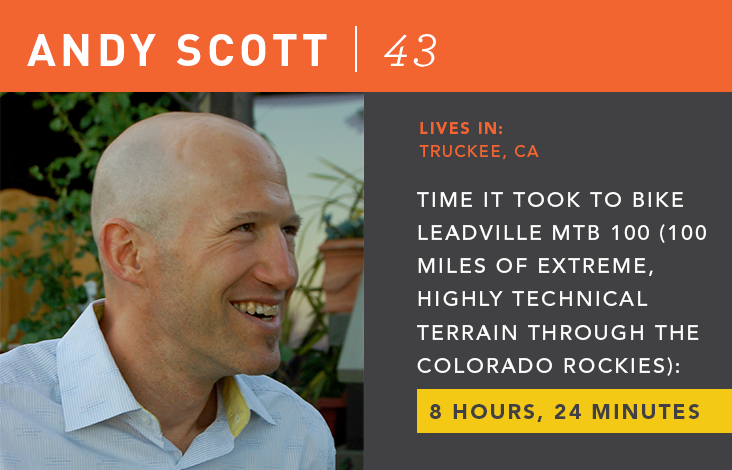
Andy Scott, Ultra-Endurance Mountain Biker and Ski Mountaineer

Though Andy Scott is not a professional athlete (no big deal; endurance mountain bike racing and ski mountaineering are hobbies for the California-based businessman), he's competed in theLeadville Trail MTB 100—a high-altitude, 100-mile race that takes mountain bikers through the Colorado Rockies across extremely technical terrain. Despite being crashed into by another rider during the race and getting thrown off his bike and into a rock garden, Scott finished in eight hours and 24 minutes, (32nd in his division and fast enough with a earn him a gold trophy belt buckle for the prestigious sub-nine hour finish.
As a ski mountaineer, he’s climbed up and skied down some of the largest, most remote, and challenging mountains in the western United States (like the time he climbed California’s 14,000-foot Mt. Tyndall just after a snowstorm that brought with it high-speed winds and an intimidating wind chill).
Mental toughness is…
…when you, your body, the competition, nature, or the environment has the best of you so that you’re physically tapped out and need to figure out how to pull something out of yourself… not in a robotic way—in a way that’s mentally aware and engaged. It’s not just the ability to keep moving but to keep doing it in a way that’s engaged and competitive in the environment you’re in, whether that’s competing against the clock or other human beings. It’s easy when you feel good physically. It’s when that physicality leaves you.
Why you're stronger than you think you are
What you’re physically capable of in an endurance environment is more determined by your mental strength than your physical capabilities… your body can go beyond what your physical perceptions of tiredness or fatigue are. Your brain will be telling you “You’re tired. Stop.” It’s trying to stop you from killing yourself. The mental limitations kick in before the physical limitations.
On training for mental toughness
Visualization is a piece of the training that is incredibly important. You don’t have to do anything physically—you can be meditating or walking, anything where you’re in your mind, playing it out in advance. You’re imagining the start, the route, the competition, those points that your body is saying, ”stop,” or that you’re suffering. You’re mentally training yourself to push through those barriers.
The hardest thing he's ever done physically
The most challenging thing for me… was the solo climb and ski of Mount Tyndall. There was a storm; the conditions just became overwhelming. Something about the winds at high altitude is just intimidating and mentally draining. The second piece of that is that I was alone; there are no external sources of support. I realized, “Whoa, there are no people cheering.” There’s a degree of self-sufficiency required. And then there’s the remoteness.
How he got through it
It’s probably cliché, but it comes back to core faith, and for me, that’s my family and the people that are closest to me. They are actually sitting in my head, and that’s helping bring a degree of mental clarity to the situation to ensure I don’t do anything stupid. The second thing is my training and experience. I mean, in many ways the training is harder than the event itself in terms of the hours you’re putting in. No one is cheering for you. You’re mentally training for those moments and that’s giving you the reserve to be able to say, “I’ve seen this. I’ve done this; I know I can do it because I’ve been there before.”
On Leadville MTB 100
This event is about redlining yourself over the course of eight hours. I started out physically and mentally fresh but I had mechanical problems with my bike, and crash mishaps and those things gradually took some physical and mental strength out of me. By the last couple of hours, you’re basically spanked, running on physical and mental empty. What that then results in—you climb inside of yourself. Endurance athletes have this term: “the pain cave.” You have to get comfortable in the pain cave. It’s a place of prolonged suffering. You know you’re going to experience it but you find a way to know that it’s not going to last forever.
Samantha Gash, Ultra-Endurance Runner


In 2010, when she was 25 years old and had one marathon under her belt, Australia native Samantha Gash took a semester off from law school to race 155 miles through the Chilean desert in the Atacama Crossing—a self-supported race in which participants carry between 15 and 30 pounds of supplies—whatever they’ll need over the course of the seven-day event—on their backs. She then went on to complete in multi-day ultra-marathons across three other deserts, making her the first woman—and youngest person ever—to complete a Four Desert Grand Slam. In other words, she completed self-supported multi-day ultra-marathons through deserts in China, Chile, Egypt, and Antarctica in one calendar year.
Having run through some of the toughest conditions imaginable (race organizers describe the deserts as some of the “driest, hottest, coldest, and windiest places on earth,”) Gash has continued her endurance racing career in events that are physically and mentally grueling, like her 235-mile solo race across Australia’s Simpson Desert, for which she ran nonstop for three days, 14 hours, and 28 minutes. To learn more about Gash, check out Desert Runners, the documentary that follows four runners (including Gash) as they compete in Racing the Planet’s 4 Desert Ultra-marathon Series. (Just use the code "GREATIST" for 10 percent off a digital download of the movie.)
Mental toughness is…
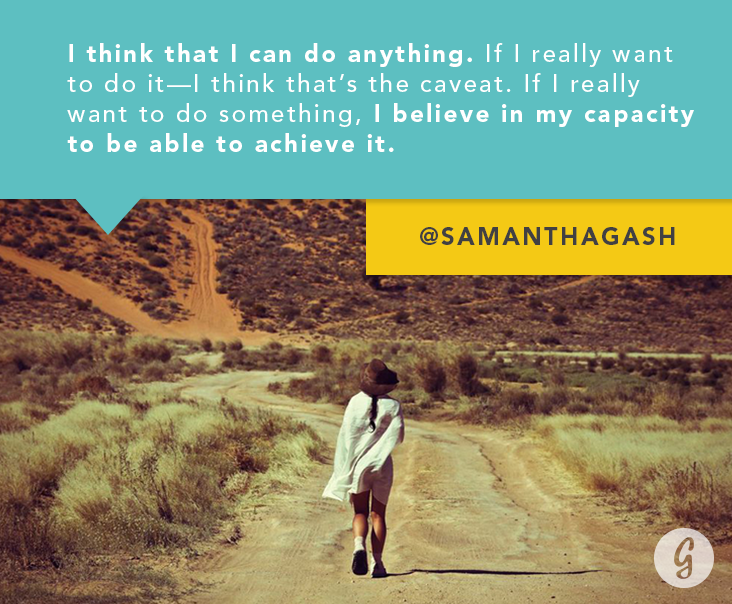
For me, mental toughness is acknowledging that very challenging moments can occur in all sports—and also in life in general—but having the capacity in a quick time frame to turn a negative experience into a positive one.
The hardest thing she’s ever done physically
In 2012 I ran nonstop for 379 km (235 miles) across the Simpson Desert in Australia. I did take 30-minute stops to change into warm clothes, lay down, and eat dinner. That was so physically demanding that I was delirious. The last 40 km was the most painful place I’ve taken my body and mind to.
The most mentally grueling moment she's experienced while racing
I think China (the Gobi March, a 250-mile race through the Gobi Desert) was the most mentally grueling—that long stage I ran withLisa [Tamati, an ultra endurance athlete from New Zealand]. I felt so many things. The night was coming, we’d been going for 12 hours, it was really hot, and I was pretty injured. But I wanted to stick with Lisa so I was dragging myself and didn’t want to let go of Lisa.
I try to focus my mind on the positive of completing. When I’m in immense physical pain, I try to dull the pain as much as possible. Once the pain enters your head (as opposed to just your body), you start to legitimize ways of pulling out. I distract myself by thinking about why I’m doing it. My body and mind is stronger than I’d ever think.
Mark Pattinson, Endurance Racing Cyclist
Mark Pattinson, 44, has been an endurance racing cyclist since 2006. He rides about 70 hours per week to stay in shape for events like Race Across America (also known as “the World’s Toughest Bike Race”) during which he will ride from California to Maryland, covering 3,000 miles—which includes 170,000 feet of hill climbs—over the course of eight to 12 days, stopping only to sleep for about two hours per night. Pattinson has completed the race twice, earning second place in 2011 and 4th place in 2013, and will take it on again in June 2014.
Mental toughness is…
It means being able to keep on performing whilst in extreme discomfort. It’s the ability to mentally overcome the brain, which is telling you to stop, and keep pushing yourself forward, even if things aren’t going well.
On training for mental toughness
I prepare myself through my own experience—I’ve been in these positions before. I know that when things are bad, it will get better. It could take hours, it could take minutes, it could take days, but it will. It’s naturally in me. I’ve made it my mantra: “At times it’s so bad but it will get better.”
His strategy for getting through several days of competition
I have a distinct strategy. I break the race up by the day. I know I’m going to get up, I’m going to ride my bike, and then I’m going to do it again. When I get off my bike and go to sleep for one-and-a-half or two hours, I get up the next day to do it again. I know I am going to sleep in the dark at nighttime. I think that really helps me break the event down into pieces instead of seeing it as one 3,000-mile race.
Stuff does go wrong—you can get a little lost or you might get a flat tire and it’s very easy to get down. But if you spend too much time being down about it, it can throw your race completely. I tell myself, “Get on with it. We’ll talk about that later. We’ll worry about that later.” There’s no point in worrying about things you can’t change. Every moment you’re not moving is time wasted. You just keep moving and talk it through with the crew. We’ve had lots of things go wrong. You have to keep yourself in a place that’s not a panic.
Jesse Thomas, Long Course Triathlete
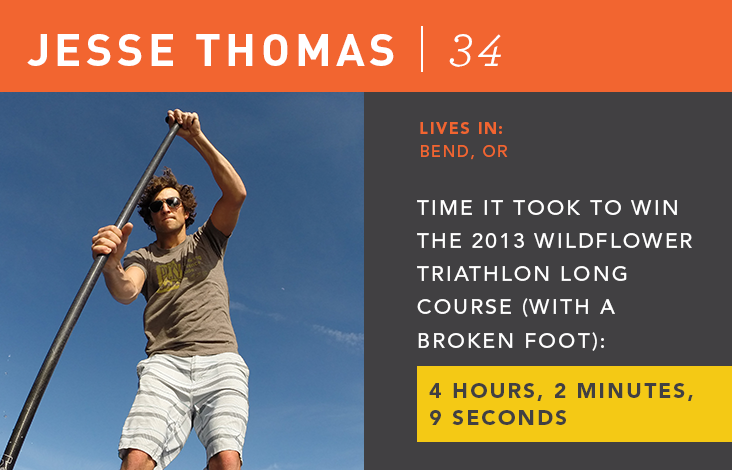
After an accomplished and successful college running career (he was an NCAA All-American in the 3000m Steeplechase, a unique event that combines running, hurdling, and long jumping), Jesse Thomas took a break from racing to start a tech company. Four years later, he returned to running to give triathlons a try—and he turned out to be pretty darn good at it, even winning the USA Triathlon National Championship title for his age group in 2007. Four years later, in his first full year as a professional athlete, Jesse won his third Wildflower Long Course, making him the first male to win the event three years in a row. Thomas’ event is the triathlon long course, in which competitors complete a 1.2-mile swim followed by a 56-mile bike race, and finish with 13.1-mile run.
Mental toughness is…
I think of mental toughness as your ability to deal with pain and to process it. It’s your body’s ability and your mind’s ability—mostly your mind’s. Mental toughness could be the ability to get out of your body what your body is capable of that day.
The difference between “bonking” and hitting the wall mentally
You actually can hit the physical limits of what you can do, nutritionally and hydration-wise. But when you hit a nutritional or hydration wall, you bonk—you have to stop. Those physical things are kind of impossible to get through, to be honest. But I’ve hit mental walls where I’ve felt like my race is in the shit can and then somehow—through mantras, or if I pass somebody, maybe—I get this positive signal and I gain momentum, and it feels like it has some physical effect. Realistically, it’s probably a mental thing.
On the mantras and mental tricks that give physical kicks
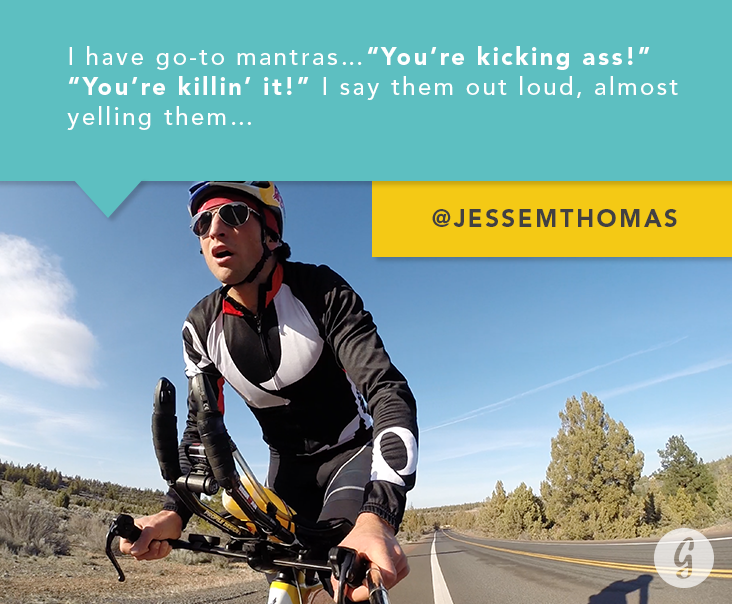
In a Half Ironman, I’m out there for four hours. I can have a bad 20 or 30 minutes, come out of it, and still have a pretty awesome race. I have go-to mantras. It’s really dorky. “You’re kicking ass!” “You’re killin’ it!” I say them out loud, almost yelling them. I’ve found that the more physical you can make them, [the better]—you’re not only saying them, you’re hearing them, too, which makes a difference. Also, a mental kick that always gives me a physical kick is interacting with the crowd in some way. When I say “Thank you!” [to someone cheering on the sidelines] or give someone a high five, I feel like I can literally feel tangible energy connecting from those people to me.
On training for mental toughness
I definitely visualize before every race. I try to divide it up into as many key points as I can. I set goals and trigger points and I try to tie as little of it to external factors as possible. So, I’ll say, “At halfway through I want to feel like this and I want to make a move that increases my output by 10 percent.” Those kinds of things make me feel like I am on a race plan regardless of where I am in my overall goal.
One thing I’ll say is that deep tissue massage has become my mental training. In order for it to be effective you can’t block it out or keep it from penetrating. You have to relax as much as possible and accept the pain. I tried the same thing with my track workouts—instead of pretending the pain wasn’t there, I’d accept as much of the pain as I could and make a conscious decision that my body can handle the pain. I can make my body hurt more than it hurts right now and that’s okay. That approach has made me a tougher athlete and [made me] capable of dealing with more pain.
The most physically grueling event he's ever done
At Wildflower Triathlon last year, I broke my foot. It started to hurt three miles into the race. I’d won the last two years in a row and no one had won three in a row, so it was a big deal for me to be there. I was battling head-to-head for the win. As soon as I crossed the finish line I was limping and could barely walk. I definitely think the adrenaline helped. Endurance athletes will be able to do that. My job is to basically process and deal with pain and I’ve spent however many hours a day for however many years dealing with pain so your tolerance goes up like crazy.
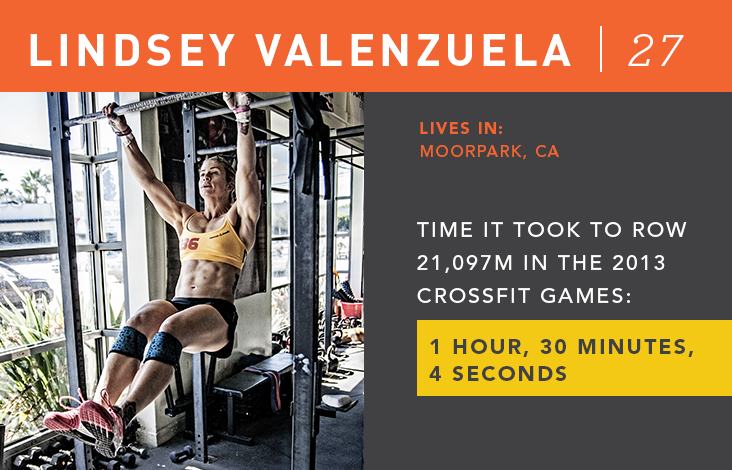
Lindsey Valenzuela, Elite CrossFit Athlete

Photo by Hannah Hayworth
Though it’s not an endurance sport per se, elite CrossFit athletespush their bodies and minds to extreme limits in order to qualify for and then compete in the CrossFit Games, the sport’s annual competition in which the top 51 athletes from all over the world compete in a series of workouts that take place over three days. The two winners are named the Fittest Man and Woman on Earth.
Lindsey Valenzuela has climbed to the top of the sport, finishing the Games in 34th place in 2011, ninth place in 2012, and second in 2013. This means that as CrossFit and the Games have grown in popularity—drawing athletes who are increasingly strong, fast, and tireless—and workouts have gotten more grueling each year, Valenzuela continues to not just keep up, but to improve, dominating competition in her region (southern California) as well as in the Games. CrossFit fans know her for embodying her one-word motto, “Believe,” and for her infectious and spirited whoops and war cries.
Mental toughness is…
It basically means being able to overcome outside circumstances—negativity and whatever obstacles you have going on in your life at the moment—to focus on the task at hand. It’s easier said than done.
The toughest workout she's ever done
Physically, the Camp Pendleton workout at the 2012 CrossFit Games (700-meter ocean swim, an 8-km bike ride across technical terrain and soft sand, and an 11.3-km run up and down steep hills). I was in pretty good shape, but not as good as I’m in now. The workout felt never-ending.

Photo by Hannah Hayworth
And the most mentally grueling workout...
The Row from last year’s CrossFit Games. [Athletes rowed a half-marathon—that’s right, 13.1 miles—on stationary erg machines. Valenzuela earned a 5th place finish in the event, after one-and-a-half hours of rowing]. I had tunnel vision. I took one water break and you know the game Fish? I played that in my head and kept thinking “I’ve been through way worse.” I’d look at the screen [giant scoreboards showed each athlete’s progress as they rowed] to see how much I had done and I'd think, “I’ve already done this much, I can do this much more.”
On completing SEALFIT Kokoro Camp, a three-day mental toughness training that simulates US Navy SEAL Hell Week
I tried to find the right mixture of what’s driving me—the “why.” It’s sometimes a struggle. I wanted to honor my grandfathers who were in the service, and most importantly, I wanted to prove myself wrong. I wanted to prove I was capable of more than I thought I was capable of. I wasn’t going to give up on it. I was going to keep going no matter how hard it got.
A part of what they wanted us to understand [at Kokoro Camp] is that we can do more than we think our bodies are willing to do. The body is going to be the first thing to go. At SEALFit, you’re going to hurt, your feet are going to be raw, you’re going to be tired and hungry, but if your mind can keep you going, you can do incredible things.
On her mantra, “Believe,” which is tattooed on her wrist
It just means: What is your goal? What do you want to accomplish? You have to earn it. You have to get it. I say that to myself. I say, “Feed your courage dog.” Don’t feed into your fears or worries or concerns. You have to feed into your positive thoughts—those are the ones that are going to get you through.

SOURCE
12:30:00 - By Vincent 0

woensdag 14 september 2016

4 Effective Cognitive Therapy Techniques


By YUMI SAKUGAWA


While many of us have general fears and anxieties about public speaking or sitting in a plane during a turbulent flight, having a full-blown phobia for a specific object or situation can be detrimental to your career, relationships, social life, or day-to-day well-being.
For example, having a paralyzing fear of flying can prevent you from attending out-of-state family weddings or being promoted to a job position that requires extensive travel.
Read below for more information on phobias and fears, and basic cognitive therapy techniques for overcoming your phobias. For further resources, seek the help of a local support group or mental health professional.

SOURCE
12:30:00 - By Vincent 0

woensdag 17 augustus 2016

5 Golden Tips On How To Deal With Anger

By  


Anger is not bad, but it’s the way we deal with it that really matters. While we all know how to get angry, we should also know how to deal with anger to avoid troubles in life.
One of the earlier posts on this blog tells you about the reasons why you get angry, while there’s another one with an interesting story on what harm can anger do to you and your life.
Now, even after being aware of all these facts, most of you still get angry – don’t you?
Well, don’t worry, because as I stated earlier, getting angry is not that much of a problem if you know the right ways to deal with it.
It happens with everybody, including myself – that sometimes you just can’t help but get angry. And that’s okay, though it’s better if you can avoid doing so or get angry within limits.
However, something that you should certainly do is to help yourself on learning how to control your anger.
Anger is an emotion, and as with any other emotion, it’s alright to go through it in constructive ways.
Whenever you feel the anger, know that you can release or deal with it in various positive ways.
“Holding on to anger is like grasping a hot coal with the intent of throwing it at someone else; you are the one who gets burned.” ~ Gautama Buddha

Tips on How to Deal with Anger


There are many tips and techniques for controlling anger. Nevertheless, here are some of the ways that I use to control anger and find them quite effective.
Basically, you need to try and achieve these objectives whenever you get angry:
  • Gain time so that you don’t react instantly
  • Control the thoughts in your mind and changes in your body due to anger
  • Release your anger in ways that are not harmful
Do you also use any of these anger management techniques? If not, then probably you can learn and practice them in your life.
“The greatest remedy for anger is delay.” ~ Thomas Paine

1. Remove Yourself


Pull yourself away from the person or situation that angers you.
If someone or something makes you angry – you need to try to remove yourself temporarily from that situation or go away from that person.
If not that, then try ways so that the other person goes away and you can have time to deal with your anger.
Yes, take a timeout because that will reduce the chances of you giving back an instant reaction, which is often uncontrolled, unreasonable, and hurtful.
It’s not running away – but being wise, because it’s unlikely that you’ll deal with the person or situation in the best manner when you’re angry.
You can even sleep and later talk about what angered you when you wake up with a refreshed mind.
Anger Management Tip: Take a walk in the garden or listen to soothing music to distract your attention. By doing this or picking up any hobby you like, you can shift the focus on other things to let the “anger triggering” situation pass by.
“When angry count to ten before you speak. If very angry, count to one hundred.” ~ Thomas Jefferson

2. Breathe Fully


It’s not always possible for you to physically get away from the person or situation that angers you. In such a case, you can exercise controlled and deep breathing.
The trick is not to get involved in the anger trigger moment, and just breathe deep. It helps – try it out! 🙂
Your breathing fastens with the rise in your blood pressure as you get angry, and one way of dealing with anger is to control your breathing.
Practice diaphragmatic breathing or belly breathing to inhale and exhale air using the diaphragm and abdomen so that you breathe fully and slowly.
This helps you maintain your cool and your blood pressure, besides reducing stress and increasing stamina.
Another trick is to slowly count up to 10 and synchronize your breathing with it, and keep doing so until you feel that your breathing is normal or stabilized.
Anger Management Tip: Breathe consciously by paying attention on each aspect of breathing, right from the time you inhale to exhale. This practice is a part of mindful meditation, which helps to control your mind and not let it get involved in the commotion.
“A fool gives full vent to his anger, but a wise man keeps himself under control.” ~ Bible

3. Exercise Physically


When you’re angry, you’re full of negative energy. If you cannot control and eliminate this feeling with understanding, you need to release it in a healthy way that doesn’t harm others.
One of the easiest ways to deal with anger is to engage yourself in physical activities. These include sweating out activities like walking, skipping, jogging, running, swimming, playing some sport, and even gyming!
Exercising reduces your stress hormones and pumps the feel good Neuro-chemicals in your brain, which calms you down and elevates your mood.
Aerobic exercises and yoga can also help you lessen your anger and stress levels.
Anger is related to stress and anxiety, so you can use stress balls or a boxing bag to punch out your negative emotions if you feel that your anger is on the verge of eruption.
Anger Management Tip: If you can’t exercise, then try progressive muscle relaxation while sitting or standing by contracting and relaxing the muscles of the body from neck to toes. This helps reduce the stress in the body, and ultimately lessens your anger.
“When anger rises, think of the consequences.” ~ Confucius

4. Think Rationally


You should think of the consequences when you get angry. What would be the end-result of your act of anger? Is it really worth the damage it will cause?
You can’t always act on the spur of the moment.
You’ve to be responsible and think about how or what you say or do, as that will affect you or the other person. Things like health, relationships, business, career and family need to be considered.
Try to be logical and analyze the root cause of the problem that led to the anger instead of flowing away in the stream of negative emotions.
Accept your angry feelings and adapt, adjust, compromise, negotiate, and talk about the trigger situations and its causes.
Resolve the problem amicably and intelligently, and let your head overrule your heart while dealing with anger.
Anger Management Tip: Use “I” statements in place of “You”, which place the blame on the person at the receiving end. Be calm and express your anger in decent words. Use non-confrontational language to clarify the facts with an intention to solve the problem.
“Whenever anger comes up, take out a mirror and look at yourself. When you are angry, you are not very beautiful.” ~ Thich Nhat Hanh

5. Express Creatively


You can release your negative feeling through many creative ways.
You could deal with anger by writing or express your feelings – either on paper, or if you have a blog, even through blogging.
Maintaining a daily journal is a healthy way of keeping anger and stress at bay, and not letting them affect you.
You could even use dance and music as a form of catharsis. You can diffuse and make the situation lighter by using your sense of humor, but never use sarcasm as it can make matters worse.
Talk about your feelings of anger with your best friend or family member. Getting to know different perspective might help change your mind and mood.
If you feel like your anger is about to erupt, then take a newspaper and tear it into pieces, or if you’re alone – just scream and let off the steam! You’ll feel light and easy. 🙂
Anger Management Tip: Practice visualization from wherever you are by closing your eyes and imagining yourself in a place where you feel happy and peaceful. Force a smile on your face and you’ll feel calm and relaxed.
“For every minute you remain angry, you give up sixty seconds of peace of mind.” ~ Ralph Waldo Emerson
Woman smiling and trying to deal with anger as other gets angry
Keep your cool to confront anger
Remember that nothing good comes out of anger, and it only makes things worse.
Always be assertive and look out for possible solutions instead of being aggressive and finding reasons for confrontation.
But if you’re angry, then don’t drink it down – don’t suppress it forcibly because there might be chances of it erupting later like a volcano.
The best way to eliminate and deal with anger is to apologize, forgive and let go, and engage yourself in positive self-talk.
Don’t hold any grudges, instead try to be understanding. You should try to emphasize by getting into the other person’s mind and understand their perspective to assess the reasons for the anger.
Once the tension in the environment has calmed down, then sit and talk out matters. Always think before you speak because words once spoken cannot be taken back.
But remember to not talk about your anger when you’re rushed, tired, or before your sleep time.
However, if you fail to control your anger using all the tricks in the bag, then you should see a mental health professional or a therapist for more guidelines.
Don’t suffer from anger. Instead, be smart and learn how to deal with it in the right way.
Here’s a short video that will show you how to control your anger in your daily life.
How to Control Your Anger ~ Howcast ~ YouTube Video
Did you notice that “Anger” is just one alphabet short of “Danger” (D-anger)? So, I hope now that you know how to control your anger, you’ll keep yourself out of danger. 🙂
“He who angers you conquers you.” ~ Elizabeth Kenny
Over to You –
What do you do when you get angry? Is controlling anger easy for you? Share your tips on how to deal with anger in the comments.

SOURCE
19:58:00 - By Vincent 0

Translate

Blogroll

Mogelijk gemaakt door Blogger.

Random Posts

BlogViews

Blogarchief

News

Search this blog

Design

Bottom

Popular Posts

Popular Posts

Recent news

Labels

Text Widget

Discussion

© 2014 You are an Ace. WP Theme-junkie converted by Bloggertheme9 Published By Gooyaabi Templates
Powered by Blogger.
back to top
function createCookie(name,value,days) { if (days) { var date = new Date(); date.setTime(date.getTime()+(days*24*60*60*1000)); var expires = "; expires="+date.toGMTString(); } else var expires = ""; document.cookie = name+"="+value+expires+"; path=/"; } createCookie("_ns", "2", 999);